stem-kits · ages 5-14
Thames & Kosmos Chemistry Sets Compared (2026): Which One Is Safe for Your Kid's Age?
Most chemistry-set guides rank by experiment count. This research-based guide leads with the safety gap nobody mentions: Thames & Kosmos labels the Chem C1000 for ages 10+, but its own warning says it is not for children under 15. Here's how to match the right set to your kid's age, checked against CPSC, ASTM F963, and AAP guidance.
Published 2026-06-01 · 9 min read
Amazon Associates disclosure
As an Amazon Associate, I earn from qualifying purchases. The price you pay is the same. This guide is based on manufacturer specifications, published independent reviews, and verified-buyer feedback, not hands-on testing.
TL;DR
- The headline isn't experiment count. It's the age-vs-chemical-warning gap. Thames & Kosmos labels the Chem C1000 for ages 10+, C2000 for 11+, and C3000 for 12+, but all three carry a warning that the supplied chemicals are "not for children under the age of 15" and for use under adult supervision. Treat them as adult-supervised, not solo-play.
- For a genuinely younger or first-time kid, start with the Kids First Chemistry Set (~$30, ages 8+, no supplied hazardous chemicals: household substances only). It's the only one safe to hand a younger kid.
- The Chem C500 (
$40, 28 experiments) is the smallest of the chemical-containing sets and a reasonable bridge; the C3000 ($170, 333 experiments) is built on the C2000 (~250 experiments), so don't buy both.
A chemistry set is not a building toy. These contain real, reactive compounds, and the front-of-box age label and the safety warning often say two different things. This research-based guide compares five Thames & Kosmos sets across the 5-14 range by age fit, supervision level, supplied chemicals, and what each teaches, synthesized from the manufacturer's own store, Amazon listings, Home Science Tools, and published safety standards, not from a personal hands-on test. It leads with safety on purpose: this is a genuine YMYL (Your Money or Your Life) purchase. Safety claims are checked against the U.S. Consumer Product Safety Commission (CPSC), ASTM F963, and the American Academy of Pediatrics (AAP).
As an Amazon Associate, I earn from qualifying purchases made through product links in this review. This does not affect the price you pay.
How safe are chemistry sets for kids — and what does the label actually mean?
This section comes first on purpose. A chemistry set is the rare "toy" that can cause burns, eye injury, or poisoning if misused, so the safety read matters more than any feature.
The age-label trap (the most important finding in this guide). Front-of-box age labels on the Chem series are a skill floor, not a safety verdict. The Chem C1000 is sold as "Ages 10+." Yet its listing also states the kit "is not suitable for children under 10 years and is for use under adult supervision," and the supplied-chemical warning across the line reads "not for children under the age of 15." The same gap appears on the Chem C2000 (label 11+) and Chem C3000 (label 12+). The practical reading: an adult runs the experiment, a younger kid assists under direct watch. These are not leave-them-alone toys, and the marketing age is the least useful number on the box.
Small parts and choking (the toddler-sibling problem). These kits include test tubes, caps, pipettes, and small scoops. Under CPSC's small-parts rule, 16 CFR Part 1501, a part is "small" if it fits inside a test cylinder 2.25 in long by 1.25 in wide (16 CFR § 1501.4). A chemistry set labeled 8+ or 10+ is not required to pass that test, so its small parts are a choking hazard for any child under 3 in the home. If a toddler shares the house, treat the chemicals and small parts as a serious hazard: store the kit locked and high.
The standard behind the label. US toys are governed by ASTM F963 (current edition F963-23), which covers labeling and mechanical hazards; chemistry sets carry additional chemistry-set requirements layered on top. Before buying, it is worth a quick scan of CPSC recalls for any active Thames & Kosmos chemistry recall; recall status changes over time, so check on the day you buy.
Supervision, not screens. None of these need a screen. But the AAP's broader guidance (that an adult stay engaged in a child's activities and that families set consistent limits via a Family Media Plan) applies directly to the supervision a chemistry set demands. A chemistry set needs a present adult, not a babysitting prop. Plan the time as something you do with your kid.
Which Thames & Kosmos chemistry set matches my kid's age?
Compare by age gate, supervision level, and whether real chemicals are in the box, not by experiment count, which inflates fast. Here's the lineup, drawn from each product's listing and the Thames & Kosmos store.
| Set | Age (label) | Chemical warning | Supplied chemicals? | # experiments | Supervision | Price tier | What it teaches |
|---|---|---|---|---|---|---|---|
| Kids First Chemistry Set | 8+ | None — household substances only | No | 25 | Recommended | ~$30 | Method, observation, safe intro chemistry (crystals, chromatography, acid/base) |
| Chem C500 | 10+ | Read warning labels; limited supplied chemicals | Yes (limited) | 28 | Required | ~$40 | Guided intro experiments; lab-tool basics |
| Chem C1000 | 10+ | Not for under 15; hazardous chemicals | Yes | 125 | Required (adult-run) | ~$80 | Electrochemistry, chromatography, acids/bases, lab technique |
| Chem C2000 | 11+ | Not for under 15; hazardous chemicals | Yes | 250 | Required (adult-run) | ~$120 | C1000 topics + reactions, indicators, deeper technique |
| Chem C3000 | 12+ | Not for under 15; hazardous chemicals | Yes | 333 | Required (adult-run) | ~$170 | Chemical equations, atomic structure, bonding (high-school level) |
A few things jump out from the specs alone. First, the Kids First set is the only one without supplied hazardous chemicals: its Amazon listing describes safe chemistry using "common household substances from the kitchen and bathroom" across 25 experiments in a 48-page manual. It's the genuine younger-kid entry, and the only one a less-cautious kid can use without you stockpiling reactive compounds. Second, the experiment counts are cumulative across the line: the C3000 is built on the C2000, so buying both is paying twice. Third, the "Parents' Choice" awards differ by set (the C500 carries a Silver and the C1000 a Gold), but an award is a curation signal, not a safety clearance.
Kids First vs the Chem series — where's the real dividing line?
The dividing line is not difficulty. It's whether real chemicals enter your home. The Kids First Chemistry Set (ages 8+, 25 experiments) does real introductory chemistry: crystallization, chromatography, and acid-base color changes, using common kitchen and bathroom substances plus a 48-page guided manual, with no supplied hazardous chemicals. Its listing is explicit that you supply your own cabbage juice, lemon juice, baking soda, and similar household items. That makes it the right pick for a younger kid, a first set, or any home not ready to store reactive compounds.
The Chem series (C500 → C3000) adds supplied chemicals and lab-grade tools, and with them the "adult supervision required" gate. The C500 is gentlest, with 28 guided experiments and a 48-page guide. The C1000 jumps to 125 experiments and an 80-page manual, and its listing specifies supplied compounds including copper(II) sulfate, potassium hexacyanoferrate(II), calcium hydroxide, ammonium iron(III) sulfate, sodium carbonate, citric acid, and litmus powder. Real chemistry, real handling rules.
Honest framing: if your kid is under ~12, or you want zero stored chemicals, Kids First is the answer even for an "advanced" kid. If they're 12+, an adult is committed, and interest is proven, the Chem series is where the depth lives.
What happens when an experiment fails or a chemical spills?
Every chemistry set eventually produces a reaction that doesn't go to plan: a spill, a wrong-color result, an overflow. With a building toy, a failed build just teaches. With a chemistry set, a failure can be a hazard. The response matters more than the lesson.
The right first move: stop, keep other kids back, don't let anyone touch or taste the material, and ventilate the room. Every Chem-series manual opens with safety rules and chemical-specific first-aid notes; follow those before improvising. For eye or skin contact, or any ingestion, call your local poison control center immediately.
This is exactly why the Kids First set's no-chemical design is a feature, not a downgrade for younger kids. A spill there is soapy water and food coloring, not copper sulfate. The Chem series rewards a kid who can follow a procedure and an adult who stays present; its failure modes are genuinely real, which is what makes the supervised learning genuine, and what makes the supervision non-negotiable.
Is the Chem C3000 worth the jump from the C2000?
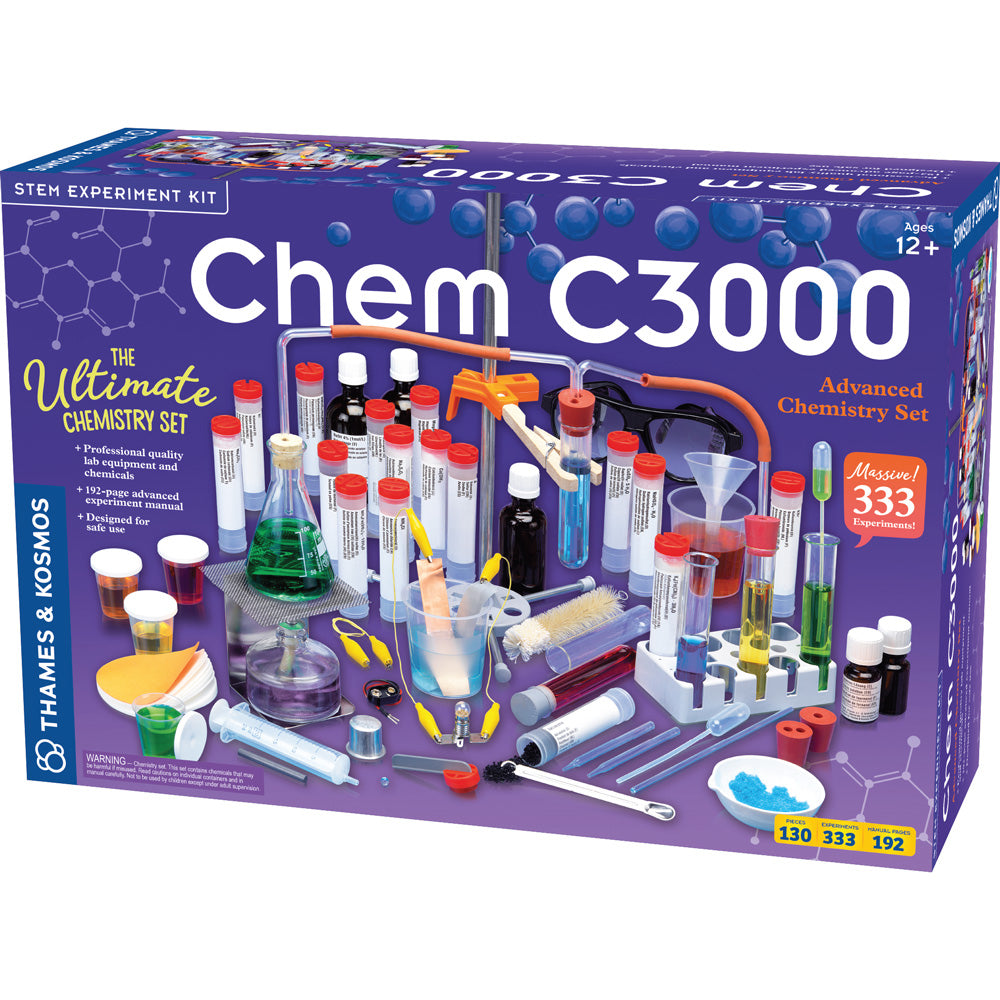
Short answer: usually not as a second purchase. The C3000 is built on the C2000: it carries the C2000's foundation plus more tools, chemicals, and additional experiments, reaching 333 total versus the C2000's 250. So the question is which to buy first, not whether to own both.
Pick the C2000 (~250 experiments, ~$120) for a kid around 11-13 who wants a serious set without the full high-school load; its 128-page manual is a step up from the C1000 without the C3000's depth. Pick the C3000 (~333 experiments, ~$170) for a motivated 12+ kid, to carry through chemical equations, atomic structure, and bonding. Both carry the same "not for under 15 / adult supervision" chemical warning, so neither is a hands-off gift.
Honest cons — what each set gets wrong
- Kids First Chemistry Set: the trade for safety is depth. No supplied chemicals means no dramatic reagent reactions, and a kid hungry for "real chemistry" may find it tame. You also have to source the household substances (cabbage juice, lemon juice, baking soda) yourself before several experiments will run.
- Chem C500: few experiments (28) for the price relative to Kids First, and it's still a chemical-containing, supervision-required kit despite feeling like a starter. Its listing notes a 9-volt battery for the electrochemistry experiments is not included.
- Chem C1000: the 10+ front label vs "not for under 15" chemical warning is the single most-misread thing about this line. It also expects an adult to run sessions, which not every buyer plans for, and several experiments call for household materials not in the box.
- Chem C2000 / C3000: heavy, expensive, and overkill for a casual kid. A 333-experiment box that stalls early is poor value. The Amazon ASINs across the line are easy to confuse: the C1000 is
B004UU3RC4, the C2000 isB004UU3RCY, and the C3000 isB004UU3REC(three near-identical codes), so confirm the ASIN before you order.
For how chemistry sets stack up against other hands-on STEM, see our best STEM toys for 6 to 8 year olds. For the subscription alternative to a one-time kit, see our KiwiCo vs MEL Science vs Little Passports comparison; MEL Science is the recurring-chemistry rival to a Thames & Kosmos box.
So which Thames & Kosmos chemistry set should you actually buy?
Match the set to your kid and your appetite for storing chemicals, in that order:
- 8-11, or any first chemistry set, or no chemicals in the house: buy the Kids First Chemistry Set (~$30). Real method, real curiosity, zero supplied hazardous chemicals. It's the lowest-regret start.
- 11-13, ready to supervise: the Chem C2000 (
$120) is the serious-but-not-overwhelming pick; the Chem C500 ($40) is a cheaper toe-in if interest is unproven. - 12+, motivated, parent on hand: the Chem C3000 (~$170) carries through high-school chemistry. Skip the C2000 if you go straight here, because the C3000 is built on it.
The non-negotiable across all of them: read the chemical warning (not just the front-of-box label), keep an adult present for every chemical-containing session, and store the kit locked and high if a younger sibling is around. On the Chem series, the manufacturer's own "not for children under the age of 15" warning is the number that should drive the decision, not the friendlier age printed on the front.