STEM and science · Ages 5-12
Best STEM Toys for Back to School 2026: 6 Learning Toys That Reinforce the School Year
The best STEM toys for back to school 2026, ranked by learning value, age fit, and price: electronics, coding, building, science, and physics picks.
Published Jul 21, 2026 · 10 min read
As an Amazon Associate, I earn from qualifying purchases. Your price stays the same.
TL;DR
- Buy Snap Circuits Jr. SC-100 (~$30) for the best all-around back-to-school STEM value: real, working electronics for ages 8-12, no soldering, 100+ projects, and a 4.8-star average across 28,000+ reviews.
- Buy Botley 2.0 (
$85) if you want screen-free coding for a 5-8-year-old, and Magna-Tiles Classic 100 ($84-120) for open-ended building that works from age 3 up.- Buy the National Geographic Dual LED Microscope (
$40-60) for a budding scientist, and GraviTrax Starter Set ($50-60) or ThinkFun Gravity Maze (~$34) for physics and logic.
As an Amazon Associate I earn from qualifying purchases. This guide is based on manufacturer specs, published expert reviews, verified-buyer feedback (with review counts cited inline), CPSC safety standards, and Common Sense Media curriculum guidance, not personal hands-on testing. Where safety claims appear, they cite CPSC regulations. When ranking STEM toys, we weight real learning value, honest age fit, durability, and price heavily.
What makes a STEM toy actually worth buying for the school year?
The back-to-school aisle is full of toys with "STEM" printed on the box that teach nothing a child couldn't get from a coloring book. A back-to-school STEM toy earns its place when it does three things: it reinforces a subject the child is meeting in class this year, it fits their real developmental stage (not the optimistic age on the box), and it survives daily use across a nine-month school year. Coding robots align with K-12 computer-science standards, building sets reinforce geometry and physics, and electronics kits teach the applied science covered in grades 3-8, per Common Sense Media's STEM curriculum guidance.
Timing matters more than most parents expect. Per the Deloitte 2026 Back-to-School Survey, 48% of back-to-school spending is done by the end of July, and searches for STEM learning toys peak in August and September (Faire trend data). Buying in late July to early August gets the best selection and lets the toy become part of the new-year routine. The six picks below cover the core STEM pillars (electronics, coding, building, science, and physics), so you can choose by the child rather than the marketing.
Best overall value: Snap Circuits Jr. SC-100
Snap Circuits Jr. SC-100 (~$25-35) gives the most learning per dollar of anything here. Its 28 snap-together components build over 100 working electronics projects (LEDs, switches, alarms, a music-playing chip) with no soldering and no tools, on a plastic grid that clicks together like a puzzle. The deciding number is the review record: a 4.8-star average across 28,000+ Amazon reviews and roughly 14 years of continuous sales from Elenco. Owners consistently describe "real working circuits, not fake," and the instant pride of a child lighting an LED they wired themselves.
The one honest friction point is that parts need careful alignment to snap cleanly, so expect a ~30-minute learning curve at the start. It is officially rated 8+, and the small parts are a genuine choking hazard for younger siblings, so keep it away from children under the labeled age per CPSC small-parts labeling rules. For a child meeting applied physics in the grade 3-8 band, nothing else here matches its value. See our circuit kits under $50 guide and Snap Circuits vs littleBits comparison for how it stacks up against pricier sets.
Best for screen-free coding: Botley 2.0
Botley 2.0 Coding Robot (~$85) teaches programming logic with zero screen time. The child builds sequences of up to 150 steps on a physical remote, with no tablet or app, then watches Botley run them, including six-direction movement and line-following. For a 5-8-year-old meeting early computer-science standards, that loop of "plan a sequence, run it, debug it" is exactly the computational thinking schools introduce, and owners praise how fast kids grasp sequencing (4.4 stars on average).
Now the honest con most guides skip: remote transmission is flaky in roughly 10% of units per critical reviews, and line-following can degrade with heavy use. Battery quality matters, and some owners report trouble with off-brand AAAs. It teaches logic, not machine learning. Skip it if your child needs on-screen feedback or has fine-motor delays that make the small remote buttons frustrating. For screen-free coding, though, it remains a standout; compare it in our best screen-free coding toys guide and the Botley vs Code & Go comparison.
Best open-ended builder: Magna-Tiles Classic 100
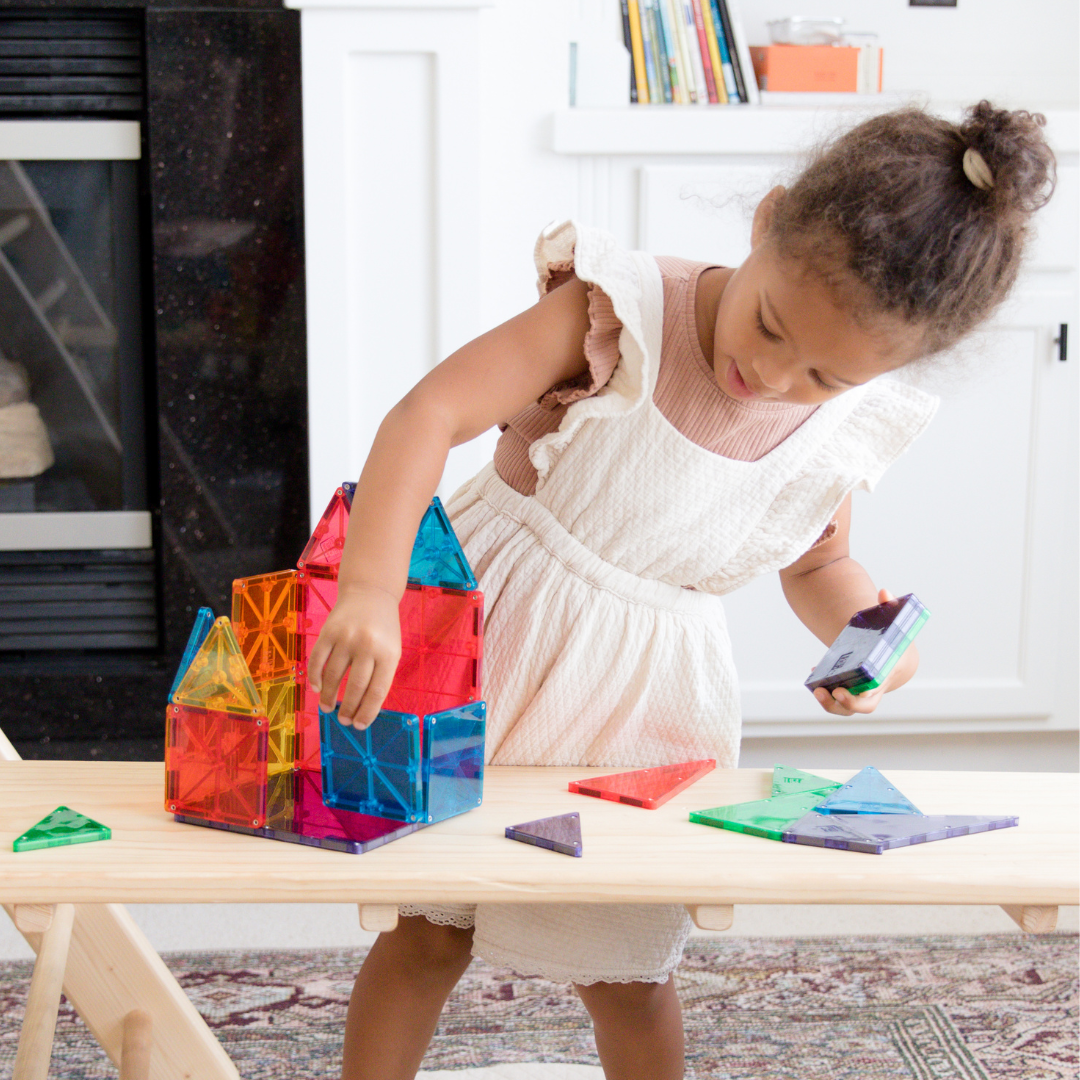
Magna-Tiles Classic 100 (~$84 on sale, $120 MSRP) is the widest-age STEM toy on this list: it works from age 3 and still engages a 12-year-old. The 100 translucent, riveted-magnet tiles snap into 3D structures in seconds, reinforcing spatial reasoning, geometry, magnetism, and the physics of balance without a single instruction card. It carries 3,500+ five-star reviews, a zero-recall history, and owner reports of durability after two-plus years of heavy play.
Two honest caveats. First, price: at $120 MSRP it is a premium buy, though it dips to around $84 on sale (documented June 2026 Prime Day pricing). Cheaper look-alikes exist and can be a smart budget entry, covered in our best magnetic tiles for kids guide. Second, safety: the magnets are strong, so keep the set away from children under 18 months, who face a real pinch and ingestion risk per CPSC magnet guidance. From age 3 up under supervision, the large tiles are CPSC-exempt from the small-parts rule and safe. For the youngest builders, our best building toys for 4-year-olds covers ages 3-5 in depth.
Best for budding scientists: National Geographic Dual LED Microscope
National Geographic Dual LED Microscope (~$40-60) turns a child's curiosity about "what's actually in there" into a real life-science habit. It pairs upper and lower LED illumination with 20x and 50x optical-glass magnification (not plastic lenses) and ships with 35 prepared slides, 10 blanks, and a full accessory kit down to a brine-shrimp hatchery. At a 4.6-star average across 407 reviews, owners highlight the genuine glass optics and how kids "spend hours exploring," which is the point: it builds observation, the scientific method, and patience.
It suits ages 8-12; the focus knob needs a gentle touch that younger kids find fiddly. Two honest limits: magnification tops out at 50x (fine for cells, insects, and prepared slides, but short of the 400x a middle-school biology unit may want), and there is no USB or digital capture. Skip it for a child under 6 whose focus is not there yet, or if you need on-screen or high-magnification imaging. For older kids, our best microscopes for kids guide covers step-up options.
Best physics and logic: GraviTrax and ThinkFun Gravity Maze
Two sets teach cause-and-effect physics from opposite directions. GraviTrax Starter Set (~$50-60) is a 122-piece, build-your-own marble run driven by gravity and magnetic elements. It is the #1 marble-run system in the U.S. with 15.5M+ units sold worldwide, and its real strength is being a modular, expandable ecosystem: a child designs a track, tests it, and iterates, which is engineering-design thinking made physical. It needs a dedicated 4-6 sq ft of tabletop and a 20-40 minute build per setup, so skip it for small-space families or kids who want instant gratification. It is STEAM-certified and best from age 8 (marbles are a choking hazard under 3). Our best marble run sets guide compares it to other track systems.
ThinkFun Gravity Maze (~$34) is the quieter, cheaper companion: a single-player logic game with 60 progressive challenges from beginner to expert, where the child places towers so a marble reaches its target. It builds spatial reasoning, planning, and iterative problem-solving with no batteries and no setup footprint, ideal for a homework-desk break. The trade-off is that it is single-player only, so skip it if your child wants collaborative play, and it is abstract for kids under 6. Between the two, GraviTrax is the bigger, expandable engineering toy; Gravity Maze is the budget, take-anywhere logic builder.
How the six compare
| STEM Toy | Price (USD) | STEM pillar | Best age | Screen-free | Standout number |
|---|---|---|---|---|---|
| Snap Circuits Jr. SC-100 | ~$25-35 | Electronics / circuits | 8-12 | Yes | 4.8★, 28,000+ reviews |
| Botley 2.0 | ~$85 | Coding / logic | 5-8 | Yes | 150-step sequences |
| Magna-Tiles Classic 100 | ~$84-120 | Building / geometry | 3-12+ | Yes | 3,500+ 5★, zero recalls |
| Nat Geo Dual LED Microscope | ~$40-60 | Science / biology | 8-12 | Yes | 20x/50x optical glass |
| ThinkFun Gravity Maze | ~$34 | Logic / physics | 8-12 | Yes | 60 progressive challenges |
| GraviTrax Starter Set | ~$50-60 | Physics / engineering | 8-14 | Yes | 15.5M units sold |
Who should skip which
Skip Botley 2.0 if your household has a history of remote-toy signal complaints or unreliable AAA batteries. The ~10% transmission-failure rate is the one real weakness, and a child who needs on-screen feedback will do better with a tablet coding app.
Skip Magna-Tiles if your total budget is under about $80. The base set is a $120 premium buy, and capable value-brand tiles cost a third as much (our magnetic tiles guide covers them). Also skip it for children under 18 months due to strong-magnet pinch and ingestion risk.
Skip GraviTrax if you live in a small apartment or want a portable toy. It needs 4-6 sq ft of dedicated space and does not travel. Reach for Gravity Maze instead, which packs into a small box.
Skip the microscope if your child is under 6, or you need high magnification (100x+) or digital capture. This is a direct-view, 50x-max instrument built for elementary observation, not a middle-school lab scope.
Our pick for back to school
For most families adding STEM to the school year, Snap Circuits Jr. SC-100 is the one to buy first. At roughly $30 it delivers the most genuine learning per dollar of anything here: real circuits a child wires and lights themselves, 100+ projects that reinforce grade 3-8 physics, and a 4.8-star, 28,000-review record that proves it holds up. It teaches a concept schools actually cover, screen-free, without needing a big space or budget.
Then buy by the child. If they're 5-8 and drawn to coding, add Botley 2.0. If they're a preschooler-to-tween who loves to build, Magna-Tiles grows with them. For a science-curious 8-12, the National Geographic microscope; for physics and logic, GraviTrax or the budget Gravity Maze.
Bottom line: Snap Circuits Jr. SC-100 (4.8/5) is the best all-around back-to-school STEM toy: the highest value-to-learning ratio, real applied physics, screen-free, and proven across 28,000+ reviews. Match the rest to your child: Botley for screen-free coding, Magna-Tiles for open-ended building, the National Geographic microscope for young scientists, and GraviTrax or Gravity Maze for physics and logic.
FAQ
What are the best STEM toys for back to school?
For most kids, Snap Circuits Jr. (real electronics, ~$30) is the best all-around back-to-school STEM pick because it teaches applied physics with the highest value-to-learning ratio. Pair it by interest: Botley 2.0 for screen-free coding, Magna-Tiles for open-ended building and geometry, a National Geographic microscope for budding scientists, and GraviTrax or ThinkFun Gravity Maze for physics and logic.
What age are STEM toys best for?
It depends on the toy. Magna-Tiles works from age 3; Botley 2.0 fits 5-8; Snap Circuits Jr., the National Geographic microscope, ThinkFun Gravity Maze, and GraviTrax are best from age 8, though a curious 6-7-year-old can use them with adult help. Match the toy to the child's real stage rather than the grade they are entering.
Are STEM toys with small parts safe for younger kids?
Per CPSC small-parts rules, toys with small parts carry a choking-hazard warning for children under 3, and some (like Snap Circuits) are labeled 8+. Snap Circuits components, marble-run marbles (GraviTrax, Gravity Maze), and microscope accessories are choking hazards for toddlers and must be kept away from children under the labeled age. Magna-Tiles' large tiles are CPSC-exempt from the small-parts rule and safe from age 3 under supervision.
Do STEM toys actually help with school?
They reinforce, not replace, classroom learning. Coding robots align with K-12 computer-science standards, building sets reinforce geometry and physics, and electronics kits teach the applied circuits covered in grades 3-8 science (per Common Sense Media curriculum guidance). The benefit comes from hands-on repetition of concepts a child is already meeting in class.
When should I buy back-to-school STEM toys?
Earlier than you think: 48% of back-to-school spending happens by the end of July, and searches for STEM learning toys peak in August and September (Deloitte 2026 and Faire trend data). Buying in late July to early August gets the best selection and lets the toy be part of the new-school-year routine rather than a mid-semester afterthought.
For more by age and interest, see our best STEM toys for 6-to-8-year-olds and best STEM subscription boxes if you'd rather send a new project every month than buy a single kit.
Sources:
- Deloitte 2026 Back-to-School Survey
- Deloitte Back-to-School Spending (PRNewswire)
- Common Sense Media: STEM Games and Lessons
- CPSC Small Parts for Toys and Children's Products
- CPSC Small Parts and Choking Hazard Labeling FAQs
- Faire: Back-to-School Trends 2026
- Elenco: Snap Circuits Jr. Official
- Magna-Tiles Classic 100 Official
- Ravensburger: GraviTrax Official
Shopping for a gift? Start here
- Best LEGO Botanicals Sets for Adult Builders and Gift-Givers (2026)
- LEGO Botanicals Bonsai Tree vs LEGO Botanicals Orchid: Which Is Better for Adult Builders and Gift Buyers?
- Holiday Gift Guide 2026: The Best Toys by Age and Budget, From Preschool to Grown-Ups
- Gifts for Grown-Ups Who Still Love Toys: LEGO, Board Games and Puzzles (2026)
How we research: This guide is based on manufacturer specifications, published independent reviews, and verified-buyer feedback, not hands-on testing.
Holiday gift guide drops every Friday in Q4
One email a week with the newest review and the toys our community is actually buying. No spam, unsubscribe anytime.