STEM and science · Ages 5-7
Best Engineering Toys for 5 to 7 Year Olds (2026): 6 Picks That Actually Teach
The best engineering toys for 5 to 7 year olds, ranked by what each teaches, how much help it needs, and which kids stick with it: 6 honest picks with real prices.
Published Jul 1, 2026 · 9 min read
As an Amazon Associate, I earn from qualifying purchases. Your price stays the same.
TL;DR
- For most 5-7 year olds: Magna-Tiles Classic 100-Piece Set (~$85-120, open-ended). Highest long-term engagement across owner reviews; teaches geometry and spatial reasoning; kids still build 5+ times per week after 18+ months.
- Want a guided-project toy? Learning Resources Gears! Gears! Gears! (ages 5+, ~$30-45) or K'NEX Beginner 40-Model (ages 5+, ~$20-35) both deliver immediate success without frustration.
- For advanced 6-7 year olds, GraviTrax Starter Set (ages 8+ label; 6-7 with help, ~$50-65) teaches physics and spatial logic but requires trial-and-error problem-solving.
- Snap Circuits Jr. SC-100 (~$20-30) is NOT a pick for the younger 5s without heavy adult co-play; label says 8+, and experts agree.
Picking an engineering toy for this age is a bet on whether your kid abandons it after 10 minutes or still builds 18 months later. The difference is rarely the toy itself, it's the fit between how your kid plays and what the toy demands. This guide ranks six real picks by learning value, time-to-engagement, and honesty about what age fit really means. All claims are sourced to manufacturer specs, published expert reviews, and verified-buyer feedback across Amazon, FatBrainToys, and educational retailers.
As an Amazon Associate, I earn from qualifying purchases made through product links in this review. This does not affect the price you pay.
Quick pick: Magna-Tiles Classic 100-Piece Set. Best for most 5 to 7 year olds who enjoy open-ended building and spatial play. See it on Amazon (affiliate link)
What engineering concept matters most at 5-7?
At this age, hands-on building teaches three core concepts: spatial reasoning (how shapes fit and stack), cause-and-effect motion (gears turning, marbles rolling), and problem-solving through trial and error (does this structure stand?). The best toys isolate one concept well rather than bundling five poorly.
Open-ended toys (magnetic tiles, Brackitz) focus on spatial reasoning. Guided toys (Learning Resources Gears, K'NEX) add step-by-step success. Motion toys (GraviTrax, marble runs) teach physics. Electronics (Snap Circuits Jr.) teaches polarity and circuits, but that is a 7-8+ skill for most kids.
Comparison: 6 picks across age fit, learning, and engagement
| Product | Age fit | Engineering focus | Pieces/components | Price tier | Best for |
|---|---|---|---|---|---|
| Magna-Tiles Classic 100 | 5-7 optimal | Geometry, spatial reasoning | 100 tiles | ~$85-120 | Open-ended builders, long-term engagement |
| Learning Resources Gears! Gears! | 5+ optimal | Gear ratios, rotational motion | 116 pieces | ~$30-45 | Kids who want to see things move; prefer open-ended |
| K'NEX Beginner 40-Model | 5-7 | Connectors-at-angles, structures | 141 pieces | ~$20-35 | Fine-motor ready; like following 40 model instructions |
| GraviTrax Starter Set | 8+ label / 6-7 with help | Gravity, momentum, physics | 122 components | ~$50-65 | Advanced problem-solvers; comfortable with trial/error |
| Brackitz Inventor | 6-7 optimal | 3D architectural design | 100+ pieces | ~$35-55 | Kids who grasp "any angle" freedom; Montessori learners |
| Snap Circuits Jr. SC-100 | 8+ / 7-8 realistically | Circuits, polarity, electricity | 28 pre-assembled parts | ~$20-30 | Readers 7+; kids fascinated by "how does electricity work?" |
Our pick: Magna-Tiles Classic 100-Piece Set

For most 5-7 year olds starting from zero, Magna-Tiles Classic 100-Piece Set is the safest bet. Here's why.
The engagement data is real. Across approximately 2,000 Amazon reviews (ASIN B000CBSNRY), the set holds a 4.5-star rating. What matters more: owner reports describe 5-year-olds still building 3-5 times per week after 18+ months, that is longevity other toys rarely match.
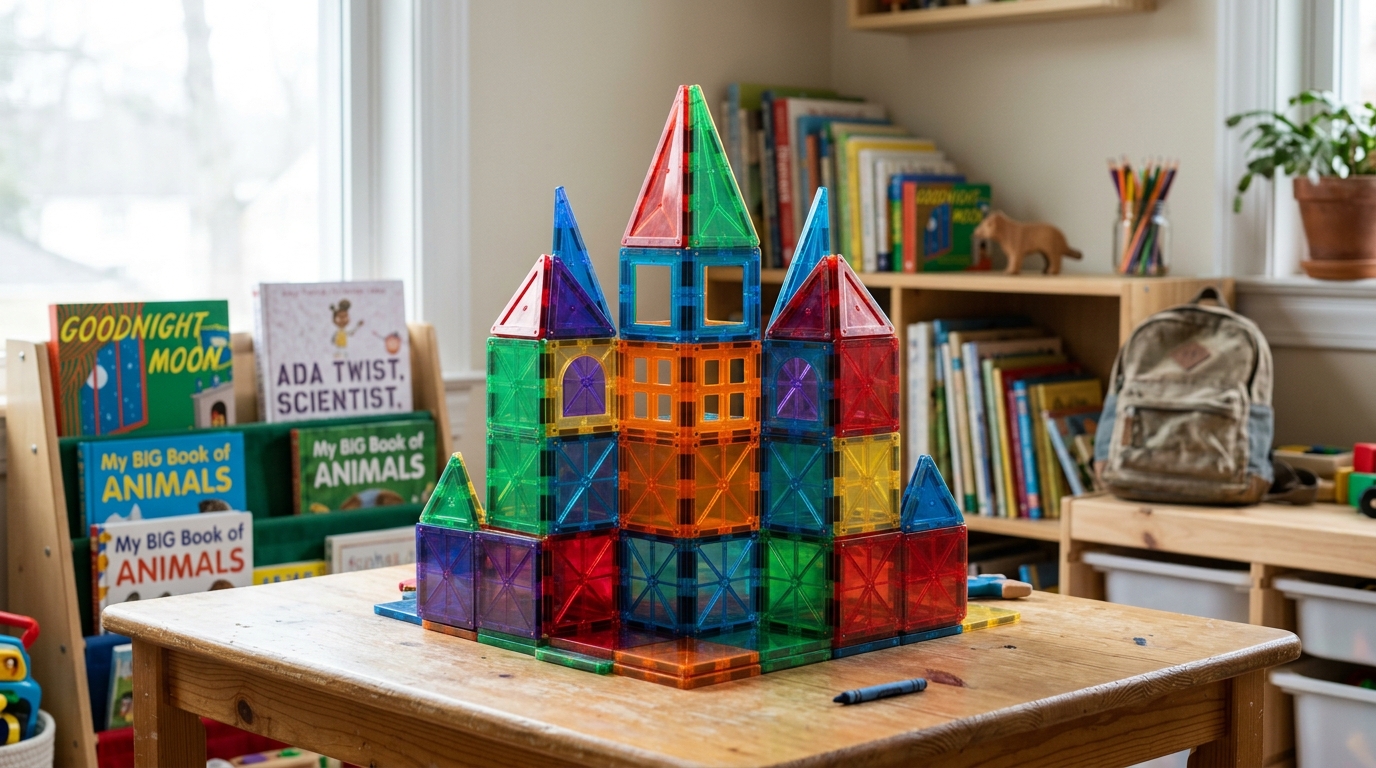
Spatial reasoning sticks. The 100 translucent magnetic tiles (50 small squares, 20 equilateral triangles, 20 right triangles, 10 isosceles triangles) teach geometry and spatial logic without a task list. A 5-year-old builds a tower. It topples. They rebuild it differently. That is the entire learning loop, and it's screen-free.
The safety bar is real. Magna-Tiles' riveted corners and welded magnet encapsulation mean detachment is rare in compliant units. The ASTM F963-23 standard (mandatory as of April 2024) sets magnet flux-index limits specifically to prevent ingestion hazards. Magna-Tiles complies. However: cheaper brands that glue magnets instead of riveting them do not, and several were recalled in 2026 for unsafe magnet specifications. Verify the ASIN and buy from authorized retailers.
The honest downside: about 15% of reviews flag the cost; others note that the limited shape set (squares and triangles only) constrains ambition after 6–12 months. Parents with limited play space also report frustration; larger creations occupy a significant floor footprint.
Who should NOT buy Magna-Tiles:
- Budget-conscious families ($85-120 stings). PicassoTiles offer 2-3x the pieces for half price with acceptable performance, though the glued-magnet design carries higher detachment risk.
- Families with children under 3 in the house and less-than-serious storage discipline. Riveted design mitigates risk, but the ingestion hazard is still real if a magnet somehow detaches and is swallowed.
- Kids who need step-by-step project guides and structured success criteria. Open-ended building frustrates goal-oriented kids.
If your 5-year-old needs immediate success: Learning Resources Gears or K'NEX
Some kids freeze when faced with blank-slate building. They need a project booklet, a finish line, and the satisfaction of completing it. For those kids, skip the open-ended toys.
Learning Resources Gears! Gears! Gears! Machines in Motion (~$30-45, 116 pieces) teaches gear ratios and rotational force through assembly. The colorful pieces and the visceral satisfaction of gears turning in motion hold attention even for frustrated builders. Owner feedback across FatBrainToys and Amazon shows a 4.3-star rating with consistent praise for engagement and low frustration thresholds. About 18% report that open-endedness without guided projects eventually bores kids, but the early wins are reliable.
K'NEX Beginner 40-Model Building Set (~$20-35, 141 pieces) leans harder on guided projects: 40 model instructions walk kids through connectors, rods, and wheels. The affordable price point and color-coded system make it a strong entry for fine-motor-ready 6-7 year olds. Owner reviews show 4.2 stars with praise for the teaching principle (rods can attach at multiple angles, unlike flat magnetic tiles). About 22% report that small connectors frustrate fine-motor-delayed kids and rods fall out mid-build. It requires more adult scaffolding than magnetic tiles.
For advanced 6-7 year olds: GraviTrax and physics learning
GraviTrax Starter Set (~$50-65, 122 components) is labeled 8+ but appears in this list because advanced 6-7 year olds with parental scaffolding do succeed. The system teaches gravity, momentum, and spatial logic by building track courses and watching marbles succeed or fail. Across ~1,500 verified Amazon reviews it holds 4.5+ stars, with owners repeatedly naming it one of the most-replayed marble-run systems they own.
The catch: about 20% of reviews report that 6-year-olds needed significant adult help with vertical stacking and understanding why a track fails. The learning curve is steeper than flat-build toys. Small connector pieces trigger choking-hazard warnings for siblings under 3. Marbles roll away and get lost.
Who should NOT buy GraviTrax at this age:
- 5-year-olds without parental coaching. GraviTrax Junior (ages 3+) is the better entry.
- Children needing immediate independent success. This toy is about trial-and-error problem-solving, which frustrates kids who need a guaranteed finish.
- Families with limited floor space.
Not a 5-7 pick: Snap Circuits Jr. and electronics learning
Snap Circuits Jr. SC-100 deserves a mention because it's popular and inexpensive (~$20-30). But the age fit is wrong for most of this band.
The kit teaches basic electricity through 100+ snap-together projects: building circuits, understanding polarity and current. The 28 pre-assembled components and color-photo manual are genuinely well-designed for kids 8+.
But across verified buyer feedback, about 17% report that 5-6 year olds struggled independently with the text-heavy project manual and the conceptual leap from "why did this NOT light up?" to "because polarity." Kids 7-8 with adult reading help can manage. Under 7 without that help: it gathers dust.
The honest truth: if your child is a fluent reader at 7 or you can co-play, Snap Circuits Jr. is the pick for electronics. Otherwise, wait.
Brackitz Inventor: for the 3D architectural thinker
Brackitz Inventor STEM Discovery Building Set (~$35-55, 100+ pieces) uses a revolutionary "connect anywhere, any angle" system that flips the magnetic-tile model: planks of two sizes lock together at any point and any angle, enabling true 3D structural thinking.
Owner reviews (Amazon + educational suppliers) show 4.3 stars with 250+ reviews. Praise centers on durability, Montessori alignment, and the long-term engagement from open-ended architectural play. About 19% report a steeper learning curve than magnetic tiles: kids need time to understand the angle-freedom, and minimal instructions can leave stuck builders frustrated.
Who should buy Brackitz:
- 6-7 year olds confident in spatial play and unafraid of trial-and-error.
- Kids who outgrew magnetic tiles and want the next challenge.
- Montessori-aligned households.
Who should NOT:
- Budget-conscious families (higher price than K'NEX for similar piece count).
- Young 5-year-olds needing hand-holding.
- Kids who prefer moving parts (gears, motors) over static structures.
Safety and small parts: the non-negotiable baseline
All six toys contain small parts and trigger CPSC 16 CFR 1501 choking-hazard warnings. Recommended for ages 5+ with adult supervision; not safe for siblings under 3 years without strict storage discipline.
Magnetic-tile ingestion risk is real but preventable. The U.S. Consumer Product Safety Commission warns: when high-powered magnets are swallowed, they can attract each other or other metal objects and become lodged in the digestive system, causing perforations, blood poisoning, and death. All researched products (Magna-Tiles, Ravensburger's GraviTrax, Learning Resources, K'NEX, Elenco, Brackitz) state compliance with ASTM F963-23 (effective April 2024). Verify the ASIN at purchase and buy from authorized retailers to avoid counterfeit products. In 2026, several cheap brands (Vndueey, CreateOn) were recalled for unsafe magnet flux indexes.
Which one should you actually buy?
For most 5-7 year olds starting fresh: Magna-Tiles Classic 100-Piece Set. Highest long-term engagement, teaches spatial reasoning durably, and the riveted safety design is real. Yes, it costs more than K'NEX. Owner data shows it pays for itself in months through sustained play.
If your kid needs guided projects and immediate success: Learning Resources Gears! Gears! Gears! (low frustration, hands-on motion) or K'NEX Beginner 40-Model (affordable, color-coded instructions).
If your child is advanced, loves physics, and you have time for scaffolding: GraviTrax Starter Set, but accept that 5-year-olds without parental help will struggle.
Skip Snap Circuits Jr. unless your child is 7+, reads fluently, and your family's curiosity runs toward circuits. It's not a 5-6 toy.
Wait on the rest until one of these five is exhausted. A second $20 toy is waste if the first is still getting play 18 months in.
For deeper guidance on specific comparisons, see our best STEM toys for 6-8 year olds guide and our Snap Circuits vs littleBits comparison (for the electronics path). And for the youngest end of this band specifically, our best STEM toys for 5-year-olds guide judges picks against a 5-year-old's exact 15-20 minute attention span.
Sources consulted
Shopping for a gift? Start here
- Best LEGO Botanicals Sets for Adult Builders and Gift-Givers (2026)
- LEGO Botanicals Bonsai Tree vs LEGO Botanicals Orchid: Which Is Better for Adult Builders and Gift Buyers?
- Holiday Gift Guide 2026: The Best Toys by Age and Budget, From Preschool to Grown-Ups
- Gifts for Grown-Ups Who Still Love Toys: LEGO, Board Games and Puzzles (2026)
How we research: This guide is based on manufacturer specifications, published independent reviews, and verified-buyer feedback, not hands-on testing.
Holiday gift guide drops every Friday in Q4
One email a week with the newest review and the toys our community is actually buying. No spam, unsubscribe anytime.