STEM and science · Ages 6-14
Best Telescopes for Kids in 2026: 5 Picks That Actually Show Saturn's Rings
Five real kids' telescopes compared on what your child can actually see. Why the '500x power' claim is a trap, and which scope shows Saturn's rings for about $70.
Published Jun 25, 2026 · 8 min read
As an Amazon Associate, I earn from qualifying purchases. Your price stays the same.
TL;DR
- Best first telescope for most kids: Celestron FirstScope 76mm (~$60–80). Reflector, tabletop mount, sees Saturn's rings and Moon craters. Ages 8–12. No tools needed.
- Step-up pick for older kids: Sky-Watcher Heritage 130P (~$120–150). Larger mirror, stable Dobsonian base, visible planetary detail and star clusters. Ages 10–14.
- Budget with accessories: Gskyer 70mm (~$50–70). Refractor with phone mount and tripod. Ages 6–10, but watch for chromatic aberration.
How we evaluated: This comparison draws on manufacturer specifications, published expert reviews (Space.com, Astronomy.com, BBC Sky at Night Magazine), optical research (Live Science, Telescopic Watch), verified-buyer feedback patterns, and U.S. CPSC safety standards (16 CFR 1501), not hands-on testing of every telescope.
The #1 mistake: chasing magnification numbers
Every toy-store shelf has a telescope advertising "500× magnification" in large print. Parents see that number and think: my kid can zoom way closer than any other telescope. So they buy it. Then their child looks through, and everything is blurry and dim.
Here's why: doubling magnification makes an image four times dimmer. Live Science explains the physics clearly: "When magnification is doubled, the image gets four times dimmer. Earth's atmosphere is usually the limiting factor in maximum magnification; the more you magnify celestial objects, the more you magnify the atmosphere, and if the atmosphere is turbulent, that turbulence will blur the image." Department-store scopes advertised as "up to 500× magnification" have figures that are almost never usable in practice.
The real number that matters: aperture (the objective lens or mirror size, in millimeters). A 76mm reflector telescope at 57× magnification will show you Saturn's rings more clearly than a 50mm refractor at 500×. The larger mirror gathers more light; the lower magnification keeps the image bright and stable.
The math is simpler than the box makes it look. Magnification is just the telescope's focal length divided by the eyepiece's focal length, so swapping to a shorter eyepiece buys more power, but only up to a hard limit set by aperture. The long-standing optical rule of thumb is a maximum useful magnification of about 2× the aperture in millimeters. For a 76mm scope that ceiling sits near 150×; for a 50mm one it is closer to 100×. Push past it and you are not magnifying the planet anymore, just the blur. That gap, a 50mm lens claiming "500×" against a real ceiling of ~100×, is the whole trick.
Pick aperture and mount stability first. Magnification claims are marketing noise.
What can a kid actually see with different apertures?
The question every parent asks: "Will my 9-year-old see Saturn's rings or Jupiter's moons?"
The honest answer depends on aperture and optical quality. Here's what you can expect:
50–60mm scopes (refractors): Moon craters in decent detail, bright planets (Venus, Jupiter as a disk with cloud belts, Saturn's rings extremely difficult or impossible).
70–76mm scopes (refractors or small reflectors): Moon craters in excellent detail, Saturn's rings clearly visible, Jupiter's cloud belts and four major moons identifiable, brighter star clusters.
100–130mm scopes (reflectors): All of the above, plus Saturn's Cassini Division (the dark line in the rings), Jupiter's Great Red Spot under good conditions, planetary nebulae, and fainter star clusters.
Astronomy.com's expert guide confirms the FirstScope's "high quality Dobsonian style stand with enough light gathering ability to view celestial objects like the rings of Saturn" defines the entry-level sweet spot. Space.com recommends tabletop Dobsonians and refractors for children, stressing that "toy telescopes tend to have plastic lenses and are poorly aligned, and the blurry, poorly magnified views might actually end up putting them off."
Expect to see the Moon and planets clearly if the aperture is 76mm or larger and the optics are glass, not plastic.
Reflector vs. refractor: why Dobsonians win for kids
There are two main telescope types. Understanding the difference saves you from a frustrating purchase.
Refractor telescopes use a lens (like a magnifying glass) to focus light. They're intuitive (point it, look) and they don't need alignment maintenance. The downside: Telescopic Watch documents chromatic aberration in budget refractors, where "a simple lens cannot focus all colors to the single sharp point, it results in images that have colored edges or halos, degrading overall sharpness and clarity. This is especially common in cheaper refracting telescopes that use just two ordinary glass lens elements." At $50–70, budget refractors show purple or blue fringes around the Moon and planets, especially at higher magnifications. That color haze is a performance limit, not a defect you can fix.
Reflector telescopes use a curved mirror to focus light (like a satellite dish). No chromatic aberration. Larger mirrors cost less than equivalent-aperture lenses, so you get more light for the dollar. The downside: mirrors need occasional collimation (alignment), and a cheap tripod sags.
Dobsonian mounts (tabletop wooden or aluminum bases) are the sweet spot for kids. BBC Sky at Night Magazine notes that "a tabletop Dobsonian type of telescope is usually recommended for children, seconded by a refractor type of telescope," and praises the Sky-Watcher Heritage for its "smooth, fluid movement between targets and fair-quality eyepieces included. The wooden base provides stability without bulk."
For kids: a 76mm reflector on a stable tabletop Dobsonian beats a 50mm refractor on a wobbly tripod every time.
Celestron FirstScope 76mm: the value pick for most families
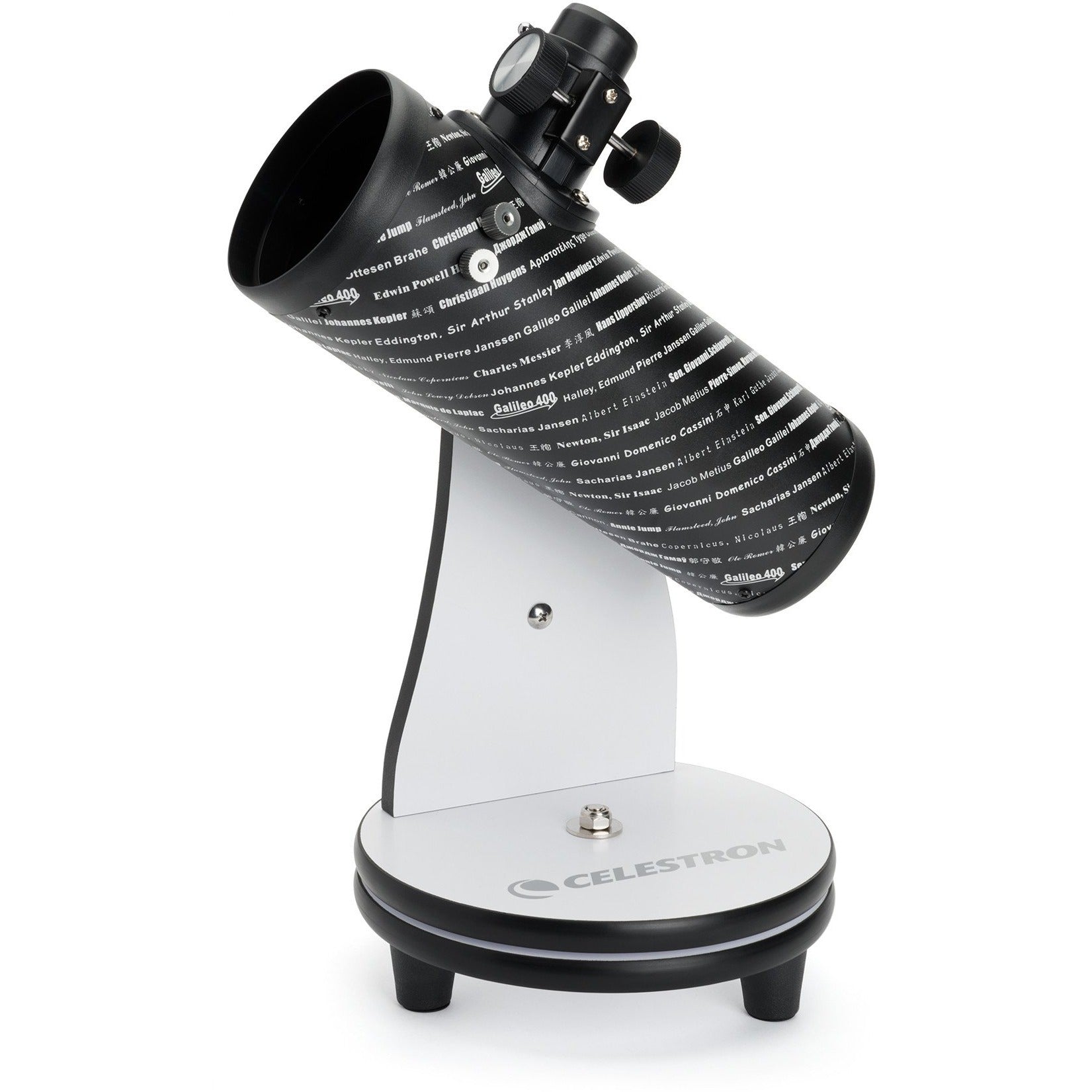
The Celestron FirstScope 76mm is the most-recommended entry-level telescope for ages 8–12. At $60–80, this reflector Dobsonian checks every box for a beginner: 76mm aperture (large enough to see Saturn's rings), a stable wooden tabletop base (no wobbly tripod), and Astronomy.com lists it as "the most affordable quality beginner telescope, arriving assembly-ready and capable of viewing Saturn's rings and the Moon's craters."
The mirror quality is good, and the two included eyepieces cover a low-power finder view and a higher-power planetary view, entry-grade glass, but enough to land Saturn on the first night. No tools required for assembly. Verified-buyer feedback consistently reports kids see the Moon in detail and Saturn's rings within the first night, that "wow" moment that hooks them on astronomy.
Downside: no built-in finderscope (you aim by hand), and the mirror can drift out of collimation over time if the scope is bumped or stored poorly. It's a minor maintenance task, but it's one more thing.
Who it's for: Families wanting a serious-but-affordable first telescope. Ages 8–12. Most owners keep this scope for years.
Sky-Watcher Heritage 130P: the step-up
For a child who has outgrown the FirstScope, or a family wanting deeper viewing, the Sky-Watcher Heritage 130P is the logical next step. At $120–150, it nearly doubles the aperture (130mm vs. 76mm), which more than triples light-gathering power. You see Saturn's Cassini Division, Jupiter's Great Red Spot, and planetary nebulae that the FirstScope cannot resolve.
The tabletop base is compact (collapsible for travel) and stable. Dobsonian motion is smooth. Glass optics are quality. Included eyepieces are better than FirstScope's. BBC Sky at Night rates it a recommended entry point for older children.
Downside: heavier, requires more care during setup, and a larger mirror needs collimation attention. The Dobsonian base can tip if bumped sideways, so it needs deliberate placement.
Who it's for: Ages 10–14, children serious about seeing planetary detail, or families upgrading from a smaller scope. Compact enough for a backyard but heavier than FirstScope.
Gskyer 70mm: budget with accessories
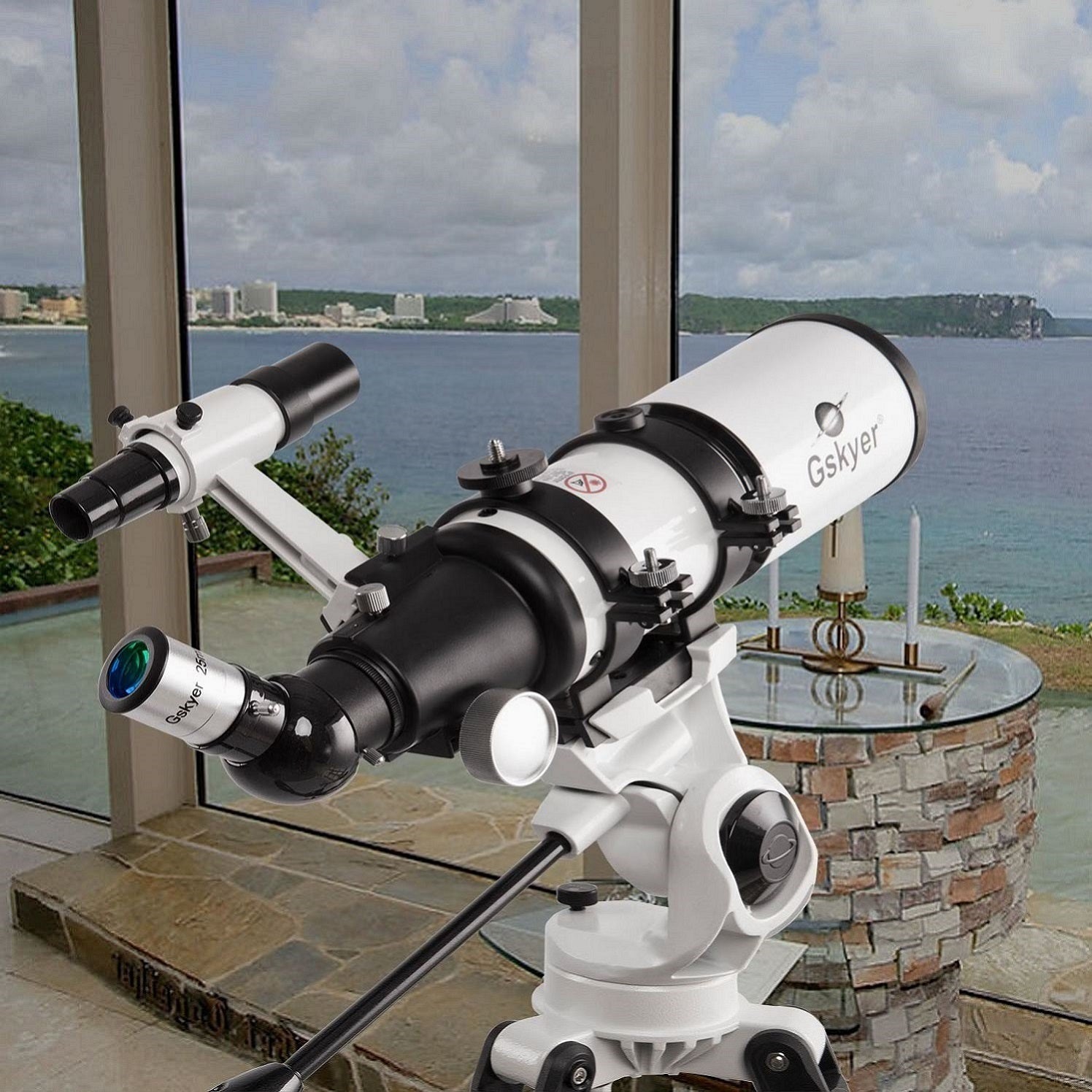
The Gskyer 70mm refractor is the most portable option and comes with extras: phone mount, wireless remote, and carry bag. At $50–70, it appeals to families wanting a complete kit right out of the box.
The 70mm aperture is respectable (similar light-gathering to FirstScope's 76mm), and it's a refractor, so no collimation needed. Tripod-mounted, so it travels easily. Buyer feedback emphasizes portability and the accessory bundle.
Downside: chromatic aberration. Telescopic Watch documents that cheap refracting telescopes "suffer from chromatic aberration (colored fringes around objects) due to low-quality glass lenses." At the Gskyer's price point, you will see purple fringes around the Moon and bright planets, especially at magnifications above 50–75×. The tripod is also thinner and wobbles more than a Dobsonian base. Kids get frustrated when the image drifts with every touch.
Who it's for: Ages 6–10, families prioritizing portability and included accessories, or budget-conscious buyers willing to trade off some optical purity. Not the best for precise planetary viewing.
Celestron PowerSeeker 50AZ: absolute budget
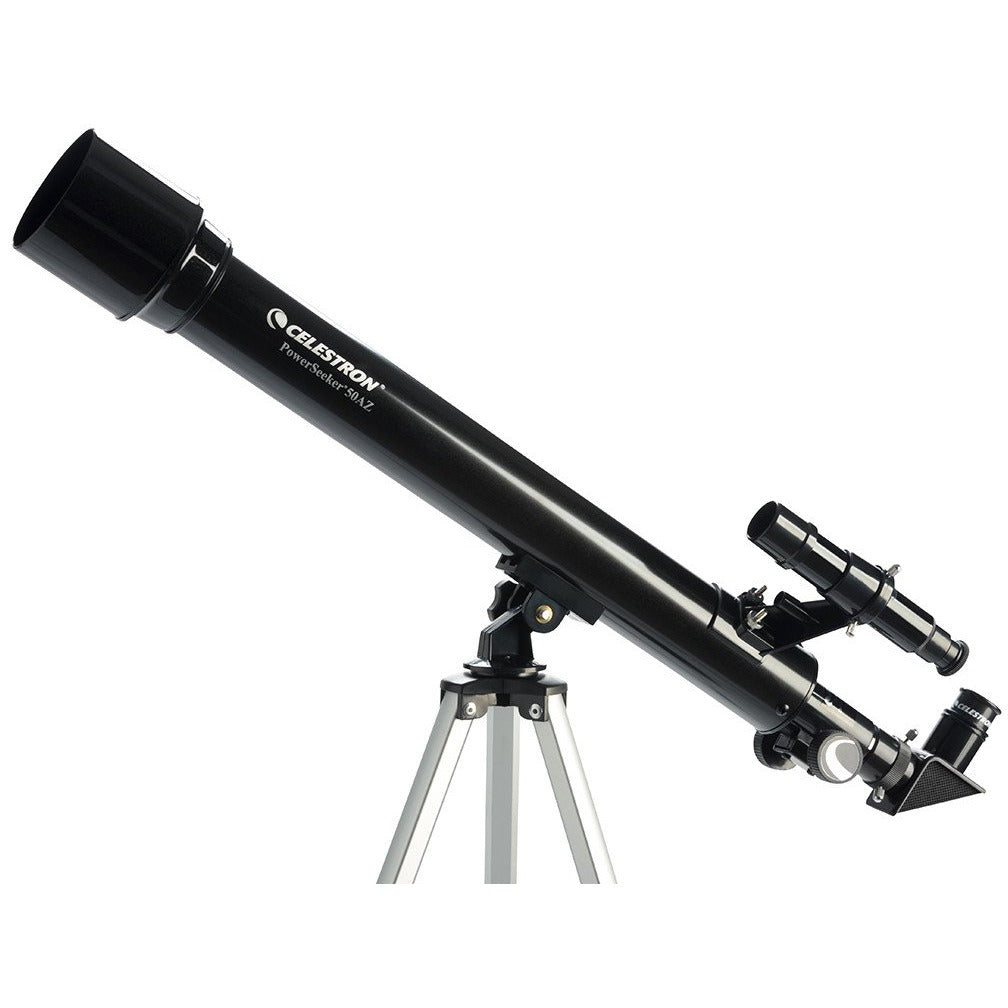
The Celestron PowerSeeker 50AZ is the lowest entry price: $45–60. It's a 50mm refractor, compact, easy to set up, and fits a small budget.
At 50mm, aperture is limited; Saturn's rings are difficult. The tripod is cheap aluminum. Telescopic Watch's research on chromatic aberration applies here too: you'll see colored fringes, especially at higher magnifications.
This is the telescope that ends up in a closet. Jump to the FirstScope 76mm if you can afford the extra $20–40; you'll have a much better experience.
Who it's for: Very young kids (ages 6–8) with close supervision, or a trial purchase to test interest before spending more. Not a serious astronomy scope.
National Geographic 50mm: budget plus nature viewing
The National Geographic 50mm is marketed as a dual-purpose telescope: astronomy and terrestrial (nature) viewing. At $50–70, it's compact and lightweight.
Like the PowerSeeker, the 50mm aperture limits deep-sky viewing, and refractor chromatic aberration is present. Verified-buyer feedback flags mount stability: the tripod shifts during use. It's a hybrid pick for kids interested in both stargazing and daytime bird or wildlife observation.
Who it's for: Kids (ages 7–11) who want dual astronomy and nature viewing, or families willing to trade deep-sky power for portability and a nature focus. For a kid more drawn to the very small than the very far, a microscope for kids scratches the same curiosity itch.
Telescope comparison at a glance
| Feature | Celestron FirstScope 76mm | Gskyer 70mm | Sky-Watcher Heritage 130P | PowerSeeker 50AZ | National Geographic 50mm |
|---|---|---|---|---|---|
| Aperture (mm) | 76 | 70 | 130 | 50 | 50 |
| Type | Reflector (Dobsonian) | Refractor | Reflector (Dobsonian) | Refractor | Refractor |
| Price tier (~$) | 60–80 | 50–70 | 120–150 | 45–60 | 50–70 |
| Age fit | 8–12 | 6–10 | 10–14 | 6–8 | 7–11 |
| See Saturn's rings? | Yes (excellent) | Yes (harder) | Yes (excellent) | Limited | Limited |
| Mount type | Tabletop (stable) | Tripod (wobbly) | Tabletop (collapsible) | Tripod (cheap) | Tripod |
| Chromatic aberration? | No (mirror) | Yes (cheap lens) | No (mirror) | Yes (cheap lens) | Yes (cheap lens) |
| Best for | First serious scope | Budget + portability | Deeper views | Very budget | Dual viewing |
| Key downside | No finderscope; collimation | Purple fringes; tripod sag | Heavier; tips if bumped | Small aperture; weak optics | Mount instability; fringes |
Safety: small parts, sun hazard, and tripod stability
Every telescope review must address safety. Kids and optical instruments need clear guardrails.
Choking hazard and small parts. Eyepieces and finder-scope caps are small enough to fit a young child's mouth. CPSC regulation 16 CFR 1501 requires choking-hazard warnings on products for ages 3–8 with small liberable parts. For a telescope bought for a 6-year-old, keep small parts out of reach of younger siblings and supervise setup and use.
Tripod and Dobsonian tip-over hazard. Budget refractor tripods are thin and unstable. A heavy eyepiece or an accidental bump can tip the telescope, potentially onto a child. Dobsonian tabletop scopes are heavier and more stable, but they can still tip if placed near an edge. Set up on a stable table or solid ground, and supervise younger children.
Sun damage: this one is serious. Never aim a telescope at the sun without a proper certified solar filter. Looking directly at the sun through a telescope, even for a second, causes permanent eye damage or blindness. This applies to every telescope, including kids' models. Make this crystal-clear to children and supervise any daytime use. A solar filter costs $20–40 and is the only safe way to observe the sun.
FAQ: the questions anxious parents ask
Q: What's the best age to get a kid their first telescope?
Ages 8–10 is the sweet spot. Kids have the patience to find a celestial object, wait for atmospheric turbulence to settle, and accept that "we can't change where the Moon is tonight." Younger kids (6–7) can observe the Moon or Jupiter, but they lose interest faster when a target is hard to find. If you have a 6-year-old passionate about the night sky, start with a Gskyer 70mm (easier to aim, included accessories). If they're 8 or older, go FirstScope 76mm.
Q: Do I need an expensive telescope to see Saturn's rings?
No. A 76mm reflector like the FirstScope (~$70) shows Saturn's rings clearly. The #1 mistake is assuming you need "more magnification" (which doesn't work; see the magnification-trap section above). A mid-sized aperture (70–100mm) with a stable mount beats a high-magnification claim on a flimsy tripod.
Q: How do reflectors and refractors actually differ for a kid?
Reflectors (mirrors) have no chromatic aberration, larger apertures cost less, but they need occasional alignment. Refractors (lenses) never need alignment, but cheap ones show colored fringes and cost more for the same aperture. For kids, reflectors on Dobsonian mounts are more forgiving: you can knock them out of alignment, realign them in 10 minutes, and move on. A cheap refractor's chromatic aberration is permanent.
The verdict: buy the FirstScope for most families
Bottom line: For kids ages 8–12, buy the Celestron FirstScope 76mm (~$60–80), a stable tabletop mount, 76mm aperture, sees Saturn's rings and the Moon's craters, no tools needed. The value and user-success rate set it apart.
If your child is 10 or older and you can stretch the budget, the Sky-Watcher Heritage 130P (~$120–150) offers deeper views and longer-term engagement. For younger kids (6–10) or families prioritizing portability, the Gskyer 70mm trades some optical purity for an easy-to-aim refractor and a ready-to-go accessory bundle. Avoid the PowerSeeker 50AZ and the high-magnification myths; pick aperture and mount stability first. Expect the Moon and planets; deep-sky objects come later, after the kid develops skill.
A telescope pairs well with hands-on science at the desk. If you're building out a young scientist's shelf, see our best STEM toys for 6 to 8 year-olds and the Thames & Kosmos chemistry sets comparison for two more curiosity-driven picks.
Shopping for a gift? Start here
- Best LEGO Botanicals Sets for Adult Builders and Gift-Givers (2026)
- LEGO Botanicals Bonsai Tree vs LEGO Botanicals Orchid: Which Is Better for Adult Builders and Gift Buyers?
- Holiday Gift Guide 2026: The Best Toys by Age and Budget, From Preschool to Grown-Ups
- Gifts for Grown-Ups Who Still Love Toys: LEGO, Board Games and Puzzles (2026)
How we research: This guide is based on manufacturer specifications, published independent reviews, and verified-buyer feedback, not hands-on testing.
Holiday gift guide drops every Friday in Q4
One email a week with the newest review and the toys our community is actually buying. No spam, unsubscribe anytime.