stem-kits · ages 3-12
Best Microscopes for Kids 2026: Compound vs Stereo vs Handheld (Spec-Driven Comparison)
6 kids' microscopes ranked by optical quality, magnification reality (why 1200x is a myth), age-fit, and safety — compound, stereo, 2-in-1, and pocket picks.
Published 2026-06-23 · 9 min read
Amazon Associates disclosure
As an Amazon Associate, I earn from qualifying purchases. The price you pay is the same. This guide is based on manufacturer specifications, published independent reviews, and verified-buyer feedback, not hands-on testing.
TL;DR
- Youngest kids (3-6): Educational Insights GeoSafari Jr. Talking Microscope (~$30-40). Stereo, 5x magnification, audio narration, no-prep bugs and rocks.
- Ages 6-8 budget: Carson MicroBrite Plus 60x-120x (~$25-35). Pocket handheld, optical glass, field-ready, no setup.
- Ages 8-12 best all-rounder: National Geographic Dual LED Kids Microscope (~$40-60). Optical glass, 20x/50x, dual top-and-bottom LED, 50+ specimens — the clearest value pick.
- Ages 6-12 versatile hybrid: My First Lab Duo-Scope (~$70-90). Compound AND stereo in one unit, real glass optics, best for type uncertainty.
- One to avoid: AmScope M30 with plastic lenses and 1200x claims — blurry results despite the spec hype.
How we evaluated: This comparison draws on manufacturer specifications, published expert reviews (Live Science, Microscope.com), verified-buyer feedback patterns, and U.S. CPSC and ASTM F963-23 safety standards — not personal hands-on testing of every microscope.
The type mistake parents make first
Before you compare brands and prices, pick the type. Most parents assume "microscope" is a category, but there are three very different ones—each suited to different ages and learning goals.
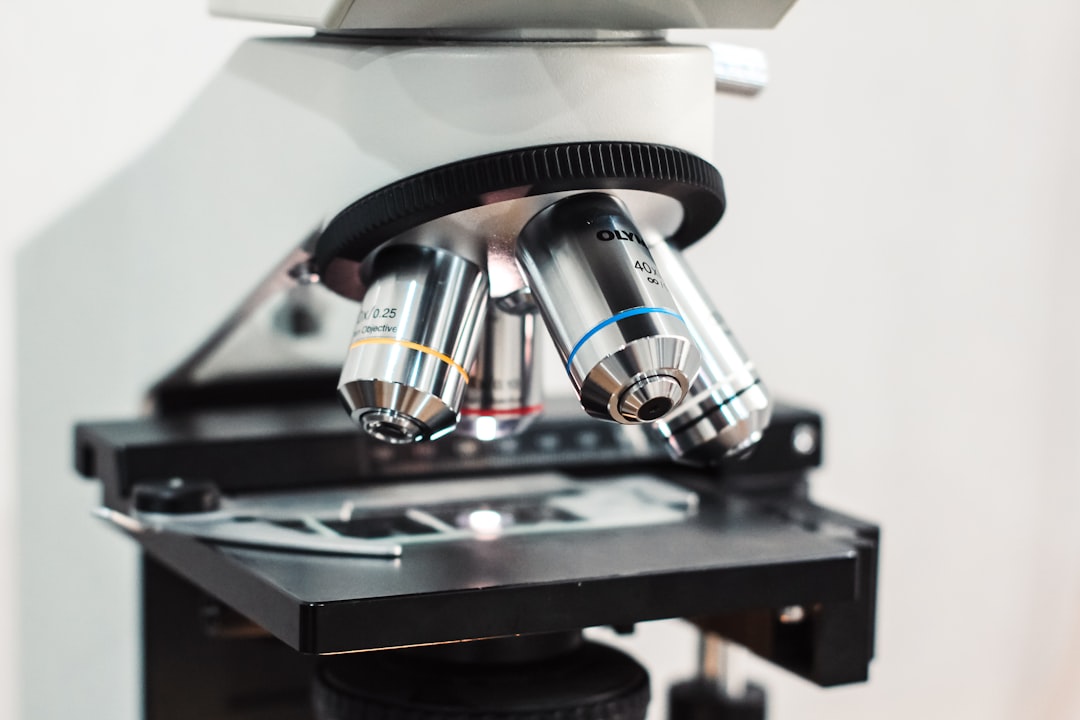
Compound microscopes (20x-1000x) use a fixed slide, multiple glass objective lenses, and an eyepiece. You prepare a thin specimen, place it on a slide under a cover slip, adjust the focus knob, and peer into two eyepieces at 100x-400x magnification. Cells, blood, micro-organisms. Age fit: 8 and up.
Stereo/dissecting microscopes (5x-40x) use a wide working distance and deliver true 3D images. Pick up a bug, a coin, a rock, place it under the lens, look—no slide prep, no waiting. Age fit: 5 and up, especially 5-8.
Handheld pocket microscopes (60x-120x) are single-lens, portable, LED-lit, and ideal for field exploration. Instant gratification, minimal setup.
Here's the clincher: a child under age 8 asking "can I see the bug?" will be thrilled by a stereo scope at 10x. A compound microscope at 400x—even if the bug were visible, which it isn't in that form—feels like a failure. Research from education-focused retailers confirms: stereo is more engaging for the under-9 crowd. Compound scopes thrive at age 8-9 and up, when patience and fine-motor control align with the focus knob and slide-making ritual.
Pick the type first. Brand second.
The 1200x magnification myth (and why it matters)
A cheap toy microscope claims "up to 1200x magnification." A parent buys it thinking "that's almost a professional scope." The kid peers through, sees a blurry smear, and decides microscopy is boring.
This is the empty magnification trap. Here's what happens:
Optical resolution is limited by the wavelength of light and the quality of the lenses. A well-designed compound scope with quality objectives reaches useful magnification around 400x-600x. Beyond that, you're magnifying fuzziness. A plastic-lens budget scope claims 1200x, but the image is so blurry it's worthless.
Live Science's kids microscope guide states it plainly: "Most kids don't need more than 400x magnification, as 1200x claims on toy microscopes are usually misleading and produce blurry, disappointing images." MicrobeHunter, an authority on optical resolution, emphasizes: "Advertised 1200x magnification values should be disregarded — meaningful magnifications of 1000x are already difficult to achieve and anything above it will be useless empty magnification."
The rule: 40x-400x with quality glass lenses beats 1200x plastic hype every single time. Check the product spec for a realistic magnification range, not the max claim.
Microscope comparison at a glance
| Microscope | Type | Age | Magnification | Optics | Price Tier | Best For |
|---|---|---|---|---|---|---|
| GeoSafari Jr. Talking | Stereo (preschool) | 3-6 | 5x | Plastic (focus-free) | ~$30-40 | Youngest kids, audio fun, no prep |
| Carson MicroBrite Plus | Handheld/Pocket | 6+ | 60x, 120x | Optical glass | ~$25-35 | Field work, portable, instant start |
| National Geographic Dual LED | Low-power (dual LED) | 8-12 | 20x, 50x | Optical glass | ~$40-60 | Best entry-level value, dual lighting |
| My First Lab Duo-Scope | 2-in-1 Compound + Stereo | 6-12 | 40x, 100x, 400x | Glass optics | ~$70-90 | Type versatility, premium features |
| AmScope M30-ABS-KT2 | Compound | 5-12 | 120x-1200x (claims) | Plastic lenses | ~$50-70 | Budget hunters (but avoid this choice) |
| Omano JuniorScope | Compound | 8+ | 40x, 100x, 400x | Glass optics, coaxial fine focus | ~$80-100 | Premium entry-level, best focus mechanism |
GeoSafari Jr. Talking Microscope: Preschooler entry
For the youngest scope seekers, the Educational Insights GeoSafari Jr. is the only microscope designed specifically for ages 3+. At $30-40, it features 5x fixed magnification, focus-free dual eyepieces, and 20 pre-made slides with 60 specimens (plants, animals, household items). The draw: it's narrated by "Wildlife Warrior Bindi Irwin" with audio facts playing as kids rotate the slide dial. No reading required. No preparation. Peer, listen, learn.
Plastic optics at 5x aren't "high quality," but 5x is enough to see a bug's eye structure, a leaf's veins, or a human hair. The talking feature solves a real problem for pre-readers: without narration, many 3-year-olds get frustrated ("why am I looking at this?"). The voice answers that.
Who it's for: Preschoolers, children just beginning to develop curiosity about "what's that tiny thing." Not for compound microscopy or high magnification. Skip it if you want a microscope that grows with the child into elementary school.
Carson MicroBrite Plus: Pocket option for ages 6+
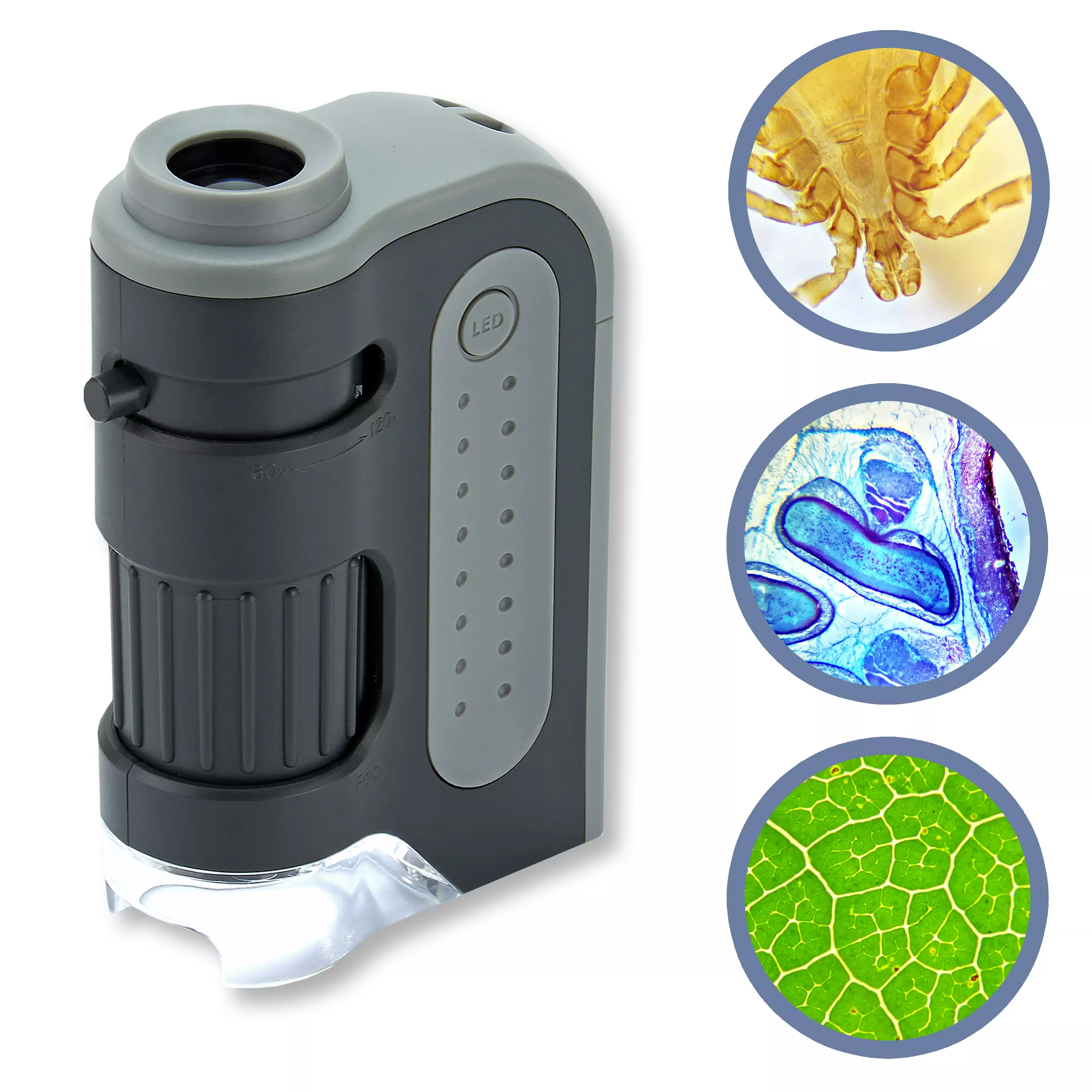
The Carson MicroBrite Plus is the budget pick and the one that teaches fieldwork habits. At $25-35, this pocket-sized handheld has 60x-120x zoom magnification, an aspheric lens system, an LED light, and fits in a backpack. It uses a simple focus wheel rather than the stage-and-knob setup of a desktop scope, and it needs no prepared slides. Pick up a leaf, a bug, a coin, hold it under the lens, look—results in 10 seconds.
Across buyer feedback, the recurring theme is portability and ease — this is the rare kids' microscope that actually leaves the house and gets used outdoors, rather than ending up in a drawer. The common complaint: 120x is the limit before optical blur kicks in, so the crisp viewing happens at 60x.
Who it's for: Ages 6+, especially kids who want to explore outdoors (insects, plant leaves, rocks, coins). Budget-conscious families or a second microscope after a starter scope. Skip it if the goal is cellular detail or prepared-slide microscopy—this is macro/dissecting territory.
National Geographic Dual LED Kids Microscope: Best entry-level all-rounder
For a first slide-capable microscope, the National Geographic Dual LED is the clearest recommendation. At $40-60, it delivers 20x and 50x magnification with optical glass lenses, dual LED illumination (top and bottom), 10 pre-made prepared slides, and 50+ specimen and accessory kit pieces. At 20x-50x it's a low-power scope rather than a high-magnification compound, but that's the point: the bottom LED lights prepared slides like a compound, while the top LED lets a child examine 3D objects like a stereo scope. That dual-purpose flexibility is exactly what a beginner needs, and glass optics keep the images crisp.
Across buyer feedback, the optical glass and sustained engagement come up repeatedly as what sets it apart from cheaper kits. Some buyers note the plastic body feels lighter than pro models, but that's a feature for unsupervised kids—less damage risk if dropped.
Who it's for: Ages 8-12, a first slide-capable scope, families prioritizing optical quality and value. Skip it if you want higher magnification (100x+ for cellular detail) or if your child is under 7—a stereo scope will engage them faster.
My First Lab Duo-Scope: The versatility pick
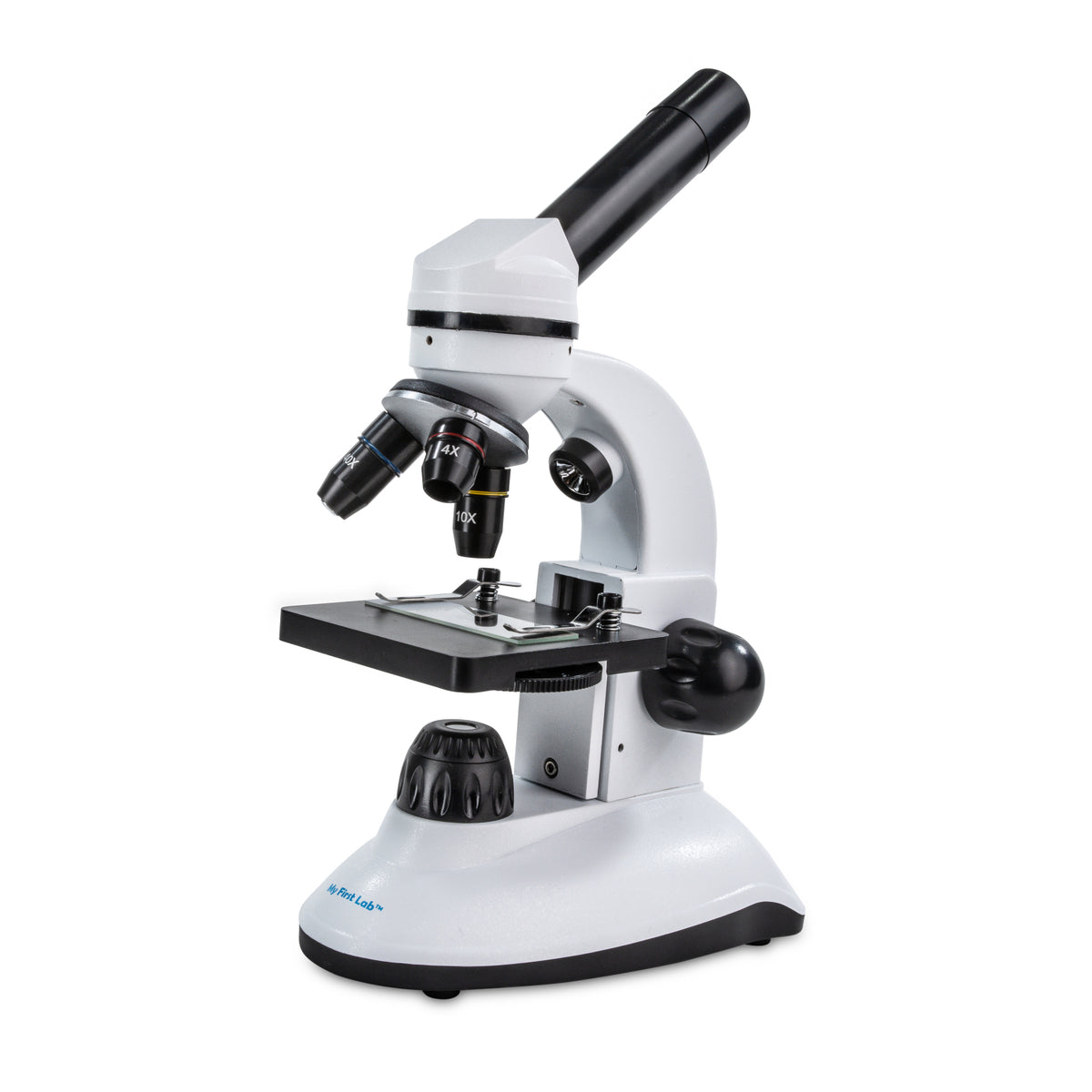
If you're uncertain whether your child wants compound or stereo, the My First Lab Duo-Scope solves the problem by offering both. At $70-90, one unit switches between stereo mode (40x for 3D viewing of bugs, rocks, coins) and compound mode (100x, 400x via prepared slides). Real glass optics, two separate light sources, and a 2007 Top Toy Award pedigree behind it.
This is the only microscope in this roundup that removes the type-choice gamble. A 6-year-old can explore bugs in stereo mode; by age 8, the same unit opens prepared-slide discovery. Mid-range cost is justified by that dual utility.
Across buyer feedback, the two-in-one design and glass optics are the recurring reasons families say their kids didn't outgrow it. The recurring downside: switching between modes takes a minute, and the instruction manual assumes patience.
Who it's for: Families with multiple kids spanning ages 6-12, or households unsure about the type preference. Best value for parents willing to pay $20 more to avoid a wrong choice.
AmScope M30-ABS-KT2: The budget trap to avoid
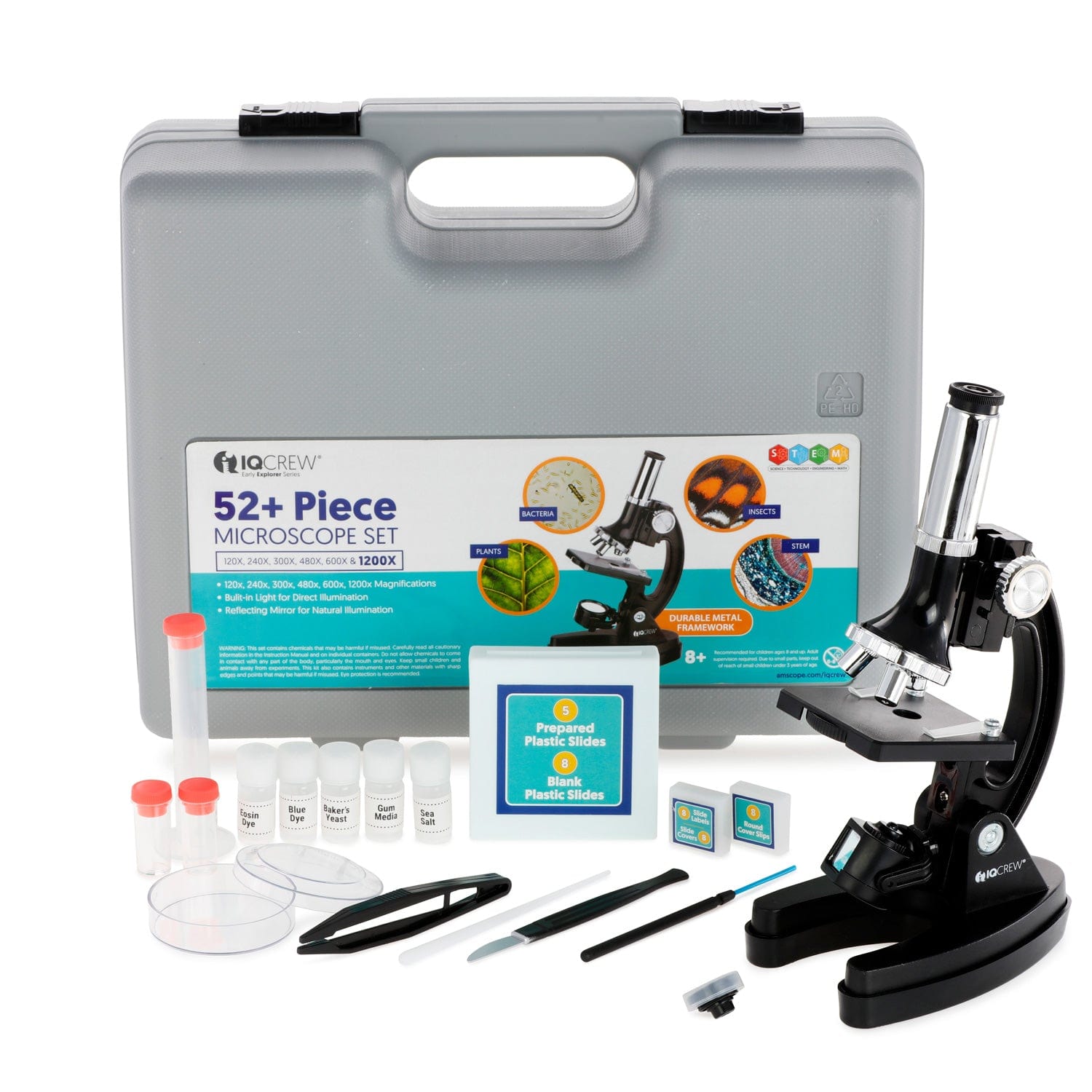
Skip the AmScope M30 plastic-lens compound microscope, despite its $50-70 price and 1200x claims. This is the textbook case of empty magnification marketing. Plastic lenses, no optical quality, advertised up to 1200x but realistically usable only around 300x-400x before image blur kills detail. Buyer feedback is mixed: some find it acceptable for the price, but the recurring complaints are blurry images, a stiff focus wheel, and a 1200x setting that delivers nothing usable.
You'll save $10-15 by skipping this and buying the National Geographic Dual LED instead—and get glass optics, dual LED lights, and a better focus experience. The AmScope M30 is the microscope that ends up in a closet.
Omano JuniorScope: Premium entry-level alternative
For budget-unlimited families, the Omano JuniorScope delivers excellent focus and optics. At $80-100, it features 40x, 100x, 400x magnification with optical glass lenses and a coaxial fine-focus knob, the smoothest focus mechanism in this guide. It is consistently well-rated by buyers and earns "best kids' microscope" roundup nods. The price premium is justified by that focus experience: children adjust it easily, hit sharp images quickly, and develop good technique.
Who it's for: Families with the budget and a child serious about microscopy. Premium pick over National Geographic if focus smoothness and award recognition matter.
Safety: Glass slides, small parts, and supervision
Every microscope guide must address safety because kids + glass slides + small parts = real hazards.
Choking hazard. Glass slides, cover slips, and small specimen tools (tweezers, petri caps, specimen scrapers) are tiny enough to fit in the CPSC 1.25-inch choking-hazard cylinder. Federal regulation 16 CFR §1501 bans these parts for children under 3. For ages 3-8, manufacturers must label "WARNING: CHOKING HAZARD — Small parts. Not for children under 3 years."
Mitigation: Supervise slide preparation. Store glass and small parts out of reach of younger siblings. Teach proper handling and cleanup of breakage. Consider stereo microscopes for ages 3-6 (fewer loose parts).
Glass cuts. Broken slides and cover slips produce sharp edges. ASTM F963-23 (the mandatory toy safety standard as of April 2024) covers sharp-edge and point testing. All recommended scopes in this guide meet ASTM F963-23 compliance. Still: handle glass slides with care, and teach your child to alert an adult immediately if a slide cracks.
Eye strain. No screen-time risk here (unlike digital microscopes), but improper eyepiece distance or very bright LED light can cause temporary eye strain. Stereo scopes are gentler on the eyes than compound scopes at high magnification. Take 15-minute breaks on long sessions.
Button batteries and LED safety. Some scopes use button-cell batteries for LED light. AAP button-battery guidance emphasizes that swallowing a button cell causes serious internal burns. Verify that battery compartments lock. AA batteries (larger, lower aspiration risk) are safer than CR2032 coin cells.
Next steps: If microscopy hooks them
If a child finishes their starter scope and asks for more, here's the next rung:
- Prepared-slide sampler sets. After the included slides run out, kits with 25-50 pre-made slides (plant cells, human tissues, microorganisms) cost $15-30 and extend engagement for months.
- DIY slide prep tools. Tweezers, petri dishes, cover slips, and specimen scrapers teach kids to prepare their own slides. A kit of these costs under $20 and shifts the learning curve.
- Compound scope upgrade. If a child masters 50x, a mid-range scope with 100x-400x and coaxial fine focus (like the Omano) opens bacterial and cellular discovery.
- Pair it with a chemistry set. A microscope and a chemistry set cover the two halves of hands-on science: one shows structure, the other shows reactions. They are a natural gift pairing.
- Solar-powered building. For a kid who likes engineering as much as observation, our best solar robot kits for kids guide compares four sun-powered builds, plus the sunlight-dependency catch most listings skip.
- Hands-off option: a science subscription box. If you would rather a curated experiment arrive monthly, the KiwiCo vs MEL Science vs Little Passports comparison covers the boxes that keep curiosity going without you sourcing kits.
- Nature pairing. Combine microscopy with bug collecting, leaf pressing, or pond-water sampling. For broader gift ideas at this age, see our best STEM toys for 6-to-8-year-olds. The microscope plus field kit combo is where discovery accelerates.
Bottom line verdict
For most families with kids ages 8-12 starting out, buy the National Geographic Dual LED Kids Microscope (4.5/5). Real optical glass, dual LEDs, clear images, 50+ pieces, and proven entry-level value at $40-60. If you're uncertain about the compound-vs.-stereo choice, add $30 and buy the My First Lab Duo-Scope instead — one unit, two types, type-uncertainty solved. For the youngest kids (3-6), start with stereo: the GeoSafari Jr. Talking Microscope or Carson MicroBrite Plus. Skip empty magnification hype, pick the type that matches the age, and go with glass optics — the $10-20 premium for quality lenses is the best microscope money you'll spend.