STEM and science · Ages 5-16
Best Science Kits for Kids: 7 Picks by Age, Type, and Budget (2026)
Seven real science kits for kids compared by age, type, and budget: electronics, chemistry, earth science, and monthly subscription boxes.
Published Jun 28, 2026 · 11 min read
As an Amazon Associate, I earn from qualifying purchases. Your price stays the same.

TL;DR
- Best overall (most reusable, real electronics, no chemicals): Snap Circuits Jr. (SC-100) (~$30–40). 100+ working projects, ages 5+, lasts for years.
- Best budget pick: 4M KidzLabs Volcano + Crystal Mining Kit (~$12–18). Hands-on earth science, 4.4 stars from 8,555 Amazon reviews. Ages 8+.
- Best for younger kids (zero toxic risk): Thames & Kosmos Kids First Chemistry Set (~$20–30). 12 household-only experiments, ages 5+, Parents' Choice Gold Award.
- Best subscription (monthly novelty): MEL Chemistry (
$35/month) or KiwiCo Tinker Crate ($24/month).
How we evaluated: This guide draws on manufacturer specifications, Amazon verified-buyer reviews, the CPSC recalls database, education-standards bodies (NGSS), and published expert reviews, not hands-on testing of every kit.
The #1 thing parents get wrong: ambition outruns follow-through
The box promises "45 experiments" or "100 projects." A kid tries three, loses the instructions, and the kit ends up in a drawer.
The real science-kit killer isn't safety or cost. It's the mismatch between what the box advertises and what a child will actually sit still for. A 100-project electronics kit is brilliant if your kid loves building. A 12-experiment chemistry set is perfect if your child doesn't need dramatic eruptions to stay engaged. A subscription box works only if your child doesn't lose interest the moment the novelty fades.
So before you buy, answer two honest questions. Does my child finish projects, or abandon them halfway? And does this kid want drama (eruptions, reactions) or patience (crystals growing over days)? The wrong kit isn't broken. It's just the wrong match. Owner reviews repeat the pattern: amazing kit, but my kid lost interest after the first experiment.
Match the kit's ambition to your child's actual follow-through.
How to choose: age, science type, chemistry risk, and one-time vs subscription
Four decisions guide your pick.
Age. Kits span 5+ to 10+, but age alone misleads. Thames & Kosmos and Snap Circuits start at 5+; MEL Chemistry begins at 10+. Real fit depends on fine-motor control, reading level, and attention span.
Science type. Electronics (Snap Circuits) needs no chemicals and no adult intervention: snap, build, run. Chemistry (Thames & Kosmos, National Geographic, MEL) needs goggles, supervision, and comfort with reactions. Earth science (4M Volcano, 4M Crystals) is slow, with results that take hours to days, so patience matters more than age. Pick the science your child gravitates toward, not the one that sounds most impressive.
Chemistry risk. One-time chemistry kits (National Geographic, Thames & Kosmos) use household items (salt, baking soda, food coloring) that are genuinely safe but limited. MEL Chemistry uses EN 71-4 compliant pre-measured chemicals with zero explosives. The CPSC recalls database shows fire and burn hazards in older chemistry kits, so supervision stays non-negotiable.
One-time vs subscription. A one-time kit costs $15–40 and works until materials run out. A subscription (MEL ~$35/month, KiwiCo ~$24/month) costs ~$300–400 a year but delivers novelty every month and kills the "what do we do next?" fatigue.
An honest match beats impressive packaging every time.
National Geographic Science Magic Kit: 45 experiments, broad scope, a depletion catch
The National Geographic Science Magic Kit (~$25–35) packs 45 experiments across chemistry, earth science, and magic tricks into one box. It's a strong Amazon seller with 5,600+ verified reviews and ratings that swing 4.0–4.8 by batch. The kit covers color reactions, crystal mixing, slime, and a simulated volcano.
What works: broad appeal keeps kids choosing and engaged, the results are colorful, and the price is moderate. Instructions are clear and photo-led. No dangerous chemicals, just food coloring, salt, baking soda, and water-based compounds.
The honest downside: instructions assume sequential order, and reordering exhausts materials unpredictably. Reviewers report color reactions that don't match the promo photos because of humidity and temperature sensitivity. After 8–12 experiments the materials run out. This is a consumable kit, not a reusable one.
Who it's for: kids 8+ who want variety and visual reward, families willing to follow the instruction order, and parents ready for the occasional "that didn't look like the picture."
Snap Circuits Jr. (SC-100): 100+ real electronics, no chemicals, ages 5+
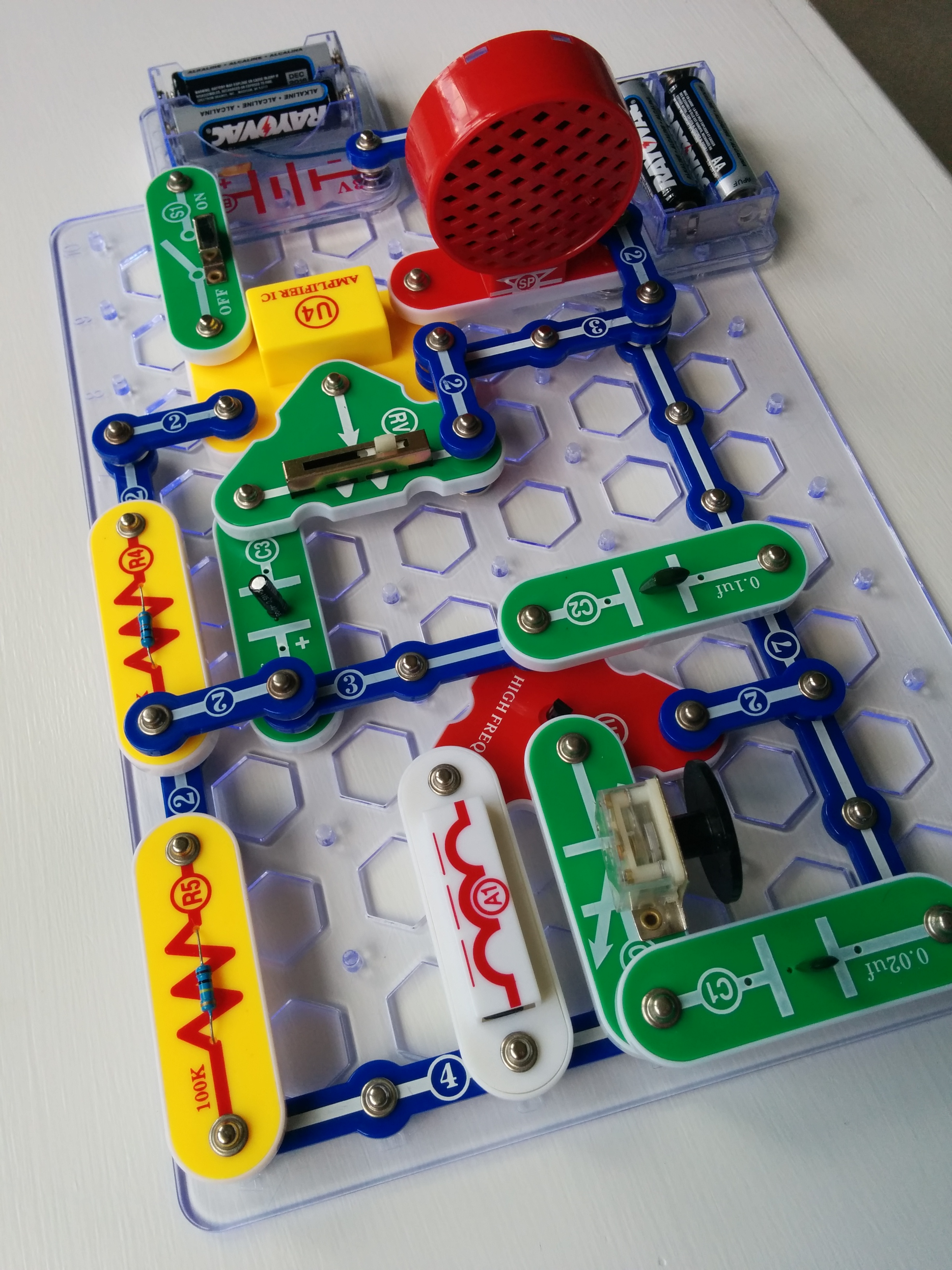
The Snap Circuits Jr. (SC-100) (~$30–40) is the safest and most reusable pick for a child drawn to electronics. Elenco snap-locks 100+ components (LEDs, switches, buzzers, motors, an FM radio module) into real working circuits. Educational reviewers consistently rank it for rigor: kids aren't mixing potions, they're building tangible electronics.
No chemicals, no toxic parts, and the snap-together pieces are large rather than small gearbox rivets. Assembly is intuitive: color-coded snap points and visual guides work for non-readers. A child follows the 101 projects in the manual or invents their own. The visible payoff is immediate and reinforcing: a light comes on, a motor spins.
The downside: pure electronics only, no chemistry or earth science. Once a child masters the snap-and-connect model, the projects can feel repetitive (same parts, new layout). Some older kids (10+) outgrow the Jr. set quickly and want the larger SC-300. But ratings stay high, and nothing else here lasts as long.
Who it's for: kids 5–12 with mechanical curiosity, safety-first families, and children who love seeing a project actually work. Beginner circuits suit 5–9; advanced builds scale to 15+.
Thames & Kosmos Kids First Chemistry Set: 12 safe experiments, parents' choice
The Thames & Kosmos Kids First Chemistry Set (~$20–30) is the gentlest entry into chemistry, built for risk-averse families. Thames & Kosmos uses only household items (water, salt, baking soda, food coloring) for all 12 experiments. Every reaction is genuinely safe: no caustic acids, no toxic compounds, no supervision required for a single experiment.
The kit teaches real principles (acid-base reactions, saturation, crystal nucleation) using items every parent already owns. A Parents' Choice Gold Award reflects the educational care. The 20+ tools (droppers, test tubes, spatulas) are sized for small hands and stay useful across future kits.
The catch: only 12 experiments, a lower count than rivals. Results are subtle (gentle fizzing, pale color shifts) rather than dramatic, so a child expecting volcano eruptions may be underwhelmed. The first few experiments go better when an adult reads along.
Who it's for: ages 5+, families prioritizing safety over spectacle, first-time chemistry learners, and parents who want zero anxiety about accidental exposure.
4M KidzLabs Volcano + Crystal Mining Kit: budget earth science, 8,555 reviews
The 4M KidzLabs Volcano + Crystal Mining Kit (~$12–18) is the most affordable pick, backed by 8,555 Amazon reviews averaging 4.4 stars. It bundles two earth-science experiments: vulcanology (plaster molding, eruption mechanics) and mineralogy (crystal mining from a plaster block). Real customer consensus, not marketing hype.
The volcano uses water, baking soda, and food coloring to simulate an eruption. The mining section hides pre-formed crystals in a plaster block kids excavate, teaching geologic concepts through tactile play. No batteries, no chemicals beyond household items.
The downside: only 1–2 eruption cycles per kit (the mold breaks on each one), so replay is limited. Crystal mining and growing reward patience, not speed. Paint quality is basic and dries dull. Reviewers note humidity affects results, and plaster mixing wants adult help (it can irritate skin if not rinsed quickly).
Who it's for: budget-conscious families, ages 8+, geology-loving kids, and parents comfortable with "not as vibrant as the box" results.
MEL Chemistry Subscription: advanced chemistry with AR/VR, ages 10+
MEL Chemistry (~$35/month, or ~$25/month on the annual plan) is the premium chemistry subscription, 2–3 real experiments per monthly box plus AR/VR molecular visualization. Each shipment includes pre-measured compounds, a home-lab setup (flask, measuring tools, macro lens), and a VR headset on the first box to show reactions at the molecular level.
This is deeper than any one-time kit: students run actual reactions with real compounds that are EN 71-4 compliant and explosive-free. Monthly novelty heads off burnout, and parental guidance videos walk adults through each reaction.
The catch: the 10+ minimum age reflects the reading and fine-motor demands. At ~$35/month, the annual cost is about $419 before shipping, which is premium territory. It needs reliable shipping, and dropping mid-subscription can feel wasteful. The VR headset is redundant if your child already owns one.
Who it's for: families committed to long-term STEM depth, kids 10+ with strong follow-through, and households with budget for a monthly subscription. Best for the kid who asks "why" constantly.
KiwiCo Tinker Crate: engineering and design, no chemistry, ages 9+
KiwiCo Tinker Crate (~$24/month base, ~$19/month on the annual plan) is the engineering-focused subscription for makers and builders. Each month ships one major project: robotics, mechanical systems, circuit design, built to teach design thinking. No chemistry, no earth science, pure maker culture.
Projects vary widely (a marble-run machine one month, a motorized walker the next), and the brand leans into "no single right answer" engineering: kids design, build, iterate. Materials are age-appropriate and non-toxic, and you can pause or cancel anytime with no penalty.
The downside: it skews hard toward engineering and design, so it's weak if your child wants chemistry or earth science. The $24/month adds up (~$288/year), finished projects need storage space, and 2–3 hour builds can frustrate the younger end of the range.
Who it's for: maker-minded kids 9+, families that value ongoing engagement over novelty, and households where tinkering is already an interest.
4M Crystal Growing Science Kit: geology, patience, and a slow payoff
The 4M Crystal Growing Science Kit (~$15–20) teaches mineral formation through 7 crystal-growing experiments in one low-cost box. Each uses pre-measured compounds (a monoammonium phosphate base, non-toxic but not edible) mixed with hot water to grow crystals over 3–7 days. Observation is the science: kids track daily growth and sketch the formations.
What works: it teaches real crystal chemistry and geology (saturation, evaporation, atomic arrangement), the seven runs build pattern recognition, and the price is rock-bottom for multi-week engagement. Screen-free, no batteries.
The real catch: results are slow and fragile. Crystals take 3–7 days and must sit untouched in a stable spot, ideal for patient kids, torture for restless ones. They break easily, and outcomes depend heavily on water temperature and humidity, so dry climates see more failures. Boiling water means an adult does the first step.
Who it's for: ages 10+, observation-focused learners, geology fans, and families in humid climates. Not for kids who expect fast, flashy results.
Science kits compared at a glance
| Kit | Age range | Type | Price tier | Screen-free? | Best for |
|---|---|---|---|---|---|
| Snap Circuits Jr. (SC-100) | 5–9; scales to 15+ | Electronics | ~$30–40 | Yes | Tech-minded kids; reusable for years |
| Thames & Kosmos Kids First Chemistry | 5+ | Chemistry (household-only) | ~$20–30 | Yes | Younger learners; zero toxic risk |
| 4M Volcano + Crystal Mining | 8+ | Earth science | ~$12–18 | Yes | Budget; tactile geology lovers |
| National Geographic Science Magic | 8+ | Multi (chem/earth/magic) | ~$25–35 | Yes | Variety seekers; visual learners |
| MEL Chemistry (subscription) | 10+ | Chemistry (advanced, AR/VR) | ~$35/mo | Hybrid | Long-term, serious chemistry |
| KiwiCo Tinker Crate (subscription) | 9–16+ | Engineering/design | ~$24/mo | Yes | Makers; ongoing creative challenge |
| 4M Crystal Growing | 10+ | Earth science/minerals | ~$15–20 | Yes | Patient, observation-focused kids |
One-time kits vs monthly subscriptions
One-time kits (National Geographic, Thames & Kosmos, the two 4M kits, Snap Circuits) cost $12–40 upfront and run until the materials deplete or interest fades, usually 4–12 weeks of engagement, except Snap Circuits, which is reusable indefinitely.
Subscriptions (MEL Chemistry, KiwiCo) cost ~$24–35/month, or roughly $288–419 a year. The math is simple: after about eight months, a subscription costs more than several one-time kits combined. What you buy for that premium is monthly novelty and a built-in answer to "what do we do next?"
Pick a one-time kit if you're testing whether your child loves science kits, your budget is under $100 a year, or your kid doesn't care about the ritual of a delivery. Pick a subscription if your child loves novelty, you have $300+ a year to spend, and you're committed to building a steady STEM habit.
Safety: chemicals, small parts, and recall status
Choking hazard. The electronics and earth-science kits (Snap Circuits, both 4M kits) contain parts under 1.25 inches. CPSC's small-parts ban, 16 CFR 1501, requires the age label, and manufacturers apply it correctly. Supervise assembly and parts storage with any sibling under 3 in the home.
Chemistry compounds. Thames & Kosmos uses food-safe household items. National Geographic adds non-toxic dyes (safe at usage levels). MEL Chemistry uses EN 71-4 compliant pre-measured compounds with no explosives. The 4M kits use fast-drying plaster and a monoammonium phosphate base (non-toxic but not edible). None pose a toxicity risk when handled per instructions.
Historical recalls. The CPSC recalls database records two notable chemistry-kit hazards: a 1995 fire hazard in Professor Wacko's Chemistry Kit (switched bottle caps, ~5,100 units, two house fires) and a 2017 battery-pack burn hazard in Little Passports Science Kits. No active 2026 recalls were found for the specific kits in this guide. The historical failures were manufacturing errors, not design flaws, and modern kits have tighter quality control.
Supervision. The chemistry kits benefit from an adult during the first experiments: reading instructions aloud, confirming measurements. Snap Circuits and the 4M kits are self-guided after setup.
FAQ: what parents ask before buying
Q: My kid has a short attention span. Which science kit is best?
Thames & Kosmos Kids First (12 quick experiments) or the 4M Volcano kit (2–3 experiments in an afternoon) finish fast. Snap Circuits lets a kid pick one 15-minute project from 100 and control the pace. Avoid the National Geographic kit (45 experiments is choice overload) and 4M Crystals (a 3–7 day wait kills momentum for a restless child).
Q: Are chemistry kits actually safe for a 7-year-old?
The Thames & Kosmos Kids First Chemistry Set is genuinely safe at 5+: household items, no toxic compounds, no required supervision per experiment. National Geographic is safe but messier (food coloring, baking soda). MEL Chemistry starts at 10+ for its reading and fine-motor demands. When in doubt for a young child, choose Thames & Kosmos.
Q: How long do these kits actually last?
Snap Circuits lasts years (fully reusable). National Geographic runs 4–8 weeks until materials deplete; Thames & Kosmos 3–4 weeks; the 4M Volcano is 1–2 eruptions; 4M Crystals span 4–6 weeks grown one at a time. MEL and KiwiCo run indefinitely while you subscribe. If longevity is the priority, Snap Circuits wins.
Q: Do the results actually look like the promotional pictures?
Rarely, for the budget kits. National Geographic reactions depend on water temperature and humidity, so reviewers report pale colors. 4M volcano eruptions are gentle, and crystal growth fails more often in dry climates. Snap Circuits always works (instant feedback), and MEL Chemistry is reliable (pre-measured, guided). Set realistic expectations for the cheaper kits.
Q: What if my kid loses interest mid-subscription?
MEL Chemistry has no cancellation penalty, but you forfeit the current month's box. KiwiCo lets you pause or cancel anytime with no fee. Both are flexible. If you're unsure, buy a one-time kit first to test the interest before committing.
Q: Which kit teaches the most real science?
Snap Circuits (real electronics), MEL Chemistry (real reactions plus molecular visualization), and 4M Crystals (real mineralogy) carry the highest rigor. Thames & Kosmos is real but introductory. National Geographic mixes real reactions with trick-based "magic," and the 4M Volcano is a simplified, plaster-based simulation.
The verdict: match the child, not the most impressive box
Bottom line: For a child drawn to electronics, buy the Snap Circuits Jr. (SC-100) (
$30–40), real engineering, zero chemical risk, and it lasts for years. For a safety-first family with a younger child (5–8), the Thames & Kosmos Kids First Chemistry Set ($20–30) gives genuine chemistry with no toxic risk and a Parents' Choice Award.
For budget-conscious families wanting earth science, the 4M KidzLabs Volcano + Crystal Mining Kit ($12–18) has 8,555 reviews and won't break the bank. For kids who love variety, the National Geographic Science Magic Kit ($25–35) offers 45 experiments; just follow the instruction order to avoid burning through materials.
For long-term engagement with monthly novelty, MEL Chemistry ($35/month) delivers serious chemistry with AR/VR, or KiwiCo Tinker Crate ($24/month) focuses on engineering and design. For a patient, observation-minded kid, the 4M Crystal Growing Science Kit (~$15–20) teaches mineralogy with a 3–7 day payoff.
The rule that overrides every spec: know your child's follow-through. The best kit is the one they'll finish, not the one with the biggest number on the box.
Science kits pair well with the rest of a young scientist's shelf. See our best microscopes for kids 2026 and best telescopes for kids 2026 for two more curiosity-driven picks, or our best solar robot kits for kids guide if your kid wants an engineering build that runs on sunlight instead of a beaker.
Shopping for a gift? Start here
- Best LEGO Botanicals Sets for Adult Builders and Gift-Givers (2026)
- LEGO Botanicals Bonsai Tree vs LEGO Botanicals Orchid: Which Is Better for Adult Builders and Gift Buyers?
- Holiday Gift Guide 2026: The Best Toys by Age and Budget, From Preschool to Grown-Ups
- Gifts for Grown-Ups Who Still Love Toys: LEGO, Board Games and Puzzles (2026)
How we research: This guide is based on manufacturer specifications, published independent reviews, and verified-buyer feedback, not hands-on testing.
Holiday gift guide drops every Friday in Q4
One email a week with the newest review and the toys our community is actually buying. No spam, unsubscribe anytime.