Building sets · Ages 4-12
Best Marble Run Sets for Kids (2026): An Engineer-Parent's Age-Bucketed Review
Honest, age-bucketed verdicts on six marble runs: GraviTrax, Hape Quadrilla, Marble Genius, Q-BA-Maze, NatGeo and ThinkFun. Engineer-parent lens.
Published Jul 6, 2026 · 11 min read
As an Amazon Associate, I earn from qualifying purchases. Your price stays the same.
TL;DR
- Across the best marble run sets for kids in 2026, GraviTrax Starter Set (around $60, ages 8+) is our top pick, the only true physics-STEM system on this list. 4.7 stars across 21,622 verified Amazon ratings.
- For under-8s: Marble Genius Super Set (budget plastic, 4 to 8) for accessibility, or Hape Quadrilla Cyclone (premium wooden, 4+, around $160) for heirloom quality with an adult's hands.
- Skip the whole category if you have an under-3 in the house. Marbles are a choking hazard per CPSC 16 CFR 1501. None of these six are right for a three-year-old.
How we evaluated: each kit's manufacturer specs, published expert reviews (NYT Wirecutter, GeekDad, RocknRollerBaby, Toys Are Tools), the CPSC small-parts rule 16 CFR §1501 and ASTM F963 toy-safety standard, AAP HealthyChildren.org choking guidance, and verified-buyer feedback patterns, not personal lab testing.
The marble run arrives on a Tuesday. By Wednesday lunch it is under the sofa in four pieces, the marbles in the dog's water bowl, your seven-year-old declaring it "boring." The promise is real: gravity, momentum, cause and effect. But most parents end up with a plastic construction site and a kid who needed an adult to build it.
The honest question is not "which is best?" It is "which is right for THIS age, with THIS much parent time?" Here is a research-backed walk through six options, from a $30 logic puzzle to a $160 wooden heirloom. (Already have construction toys covered? See our best magnetic tiles roundup.)
Quick pick: GraviTrax Starter Set. Best for families with kids aged 8 and up who want a physics STEM marble run. See it on Amazon (affiliate link)
Which marble run is right for your kid's age?
| Kit | Price | Pieces | Mfr age | Mechanism | Best for |
|---|---|---|---|---|---|
| GraviTrax Starter | ~$60 | 122 | 8+ | Magnetic + kinetic, steel balls | 8+ physics-STEM runway |
| Hape Quadrilla Cyclone | ~$160 | 198 | 4+ | FSC beechwood, glass marbles | Premium wooden, with adult |
| Marble Genius Super Set | ~$35-45 | ~85-150 (varies) | 4-8 | Translucent plastic snap-fit | Budget accessible entry |
| MindWare Q-BA-Maze 2.0 Big Box | ~$40-50 | 72 | 6+ | Interlocking cube mazes | Sculptural open-ended builders |
| NatGeo Glowing 150-pc | ~$35-45 | 85 + 26 action + 30 marbles | 8+ | Glow-in-dark plastic tubes | Glow-gadget hook (8+) |
| ThinkFun Roller Coaster Challenge | ~$30 | 21 track + 36 posts | 6+ | 40-challenge logic puzzle | Single-player logic kids |
Is GraviTrax the right marble run for ages 8 and up?
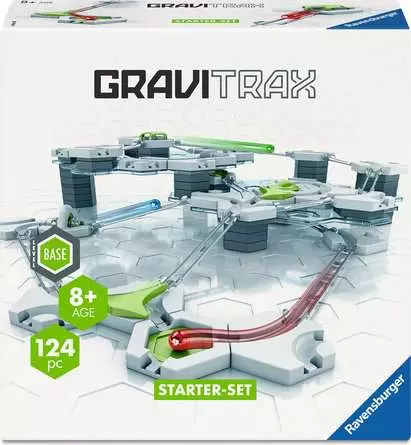
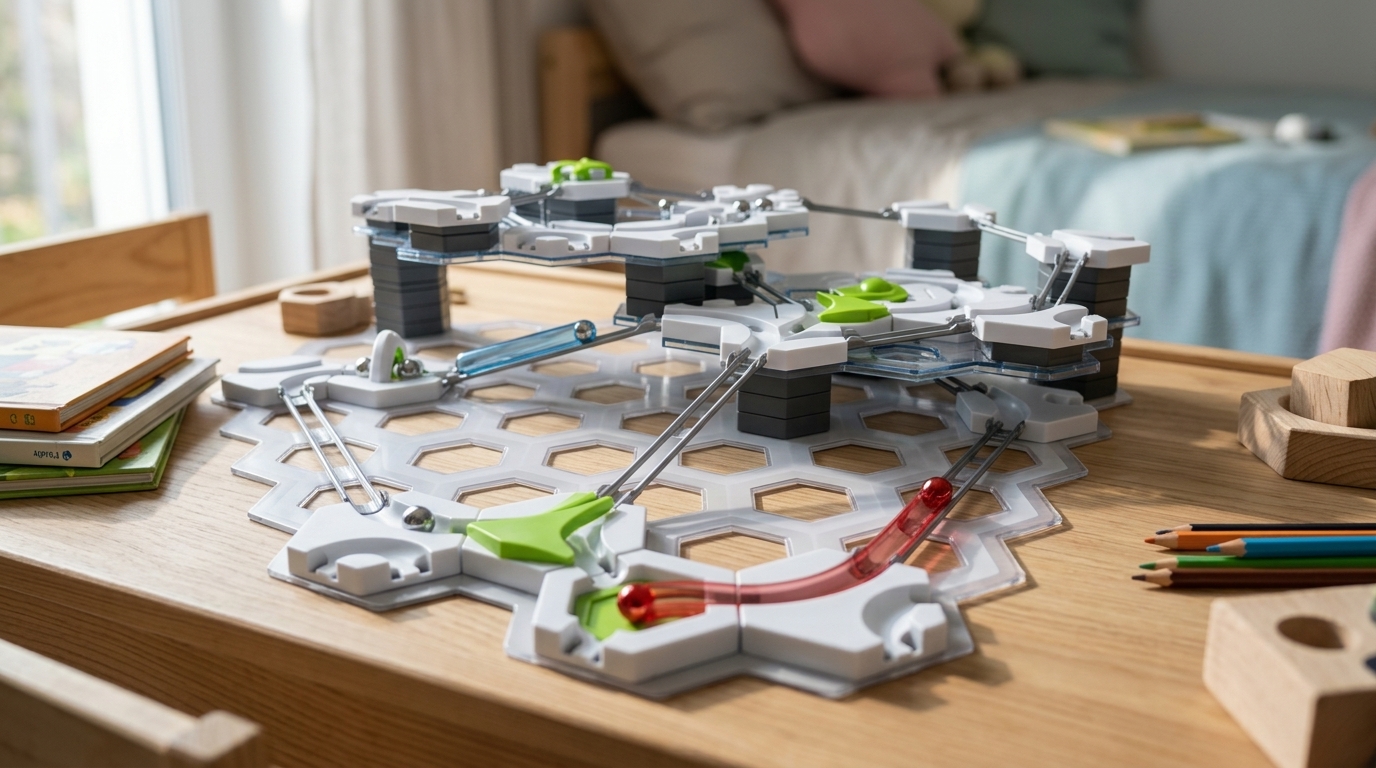
The case for GraviTrax is that it is the only option here that actually teaches physics. Not "marble goes down" physics. Magnetism, momentum, kinetic energy. The 122-piece Starter kit uses a snap-fit hexagonal grid with steel balls (not glass marbles) and six gravity and magnetic stunt elements: a magnetic cannon, a vortex, a launchpad. It is endlessly expandable, MESH-accredited, and a 2019 Toy of the Year Finalist.
The numbers back it up: 4.7 stars across 21,622 global Amazon ratings, with "gameplay" themes 147 of 150 positive ("hours of entertainment, endless possibilities for designing challenges"). Verified-buyer reviews describe it scaling from age 8 into the early teens. One parent notes "my 12 and 15 year olds love this set."
The honest cons: the hex base plates are cardboard, not metal. A genuine surprise at $60 ("expensive for plastic and cardboard" is a recurring complaint, and the packaging photo is misleading). The snap-fit grid needs dexterity. Under-8s lacking fine motor control knock pieces off and quit. The cannon is "too powerful, shoots balls off track" in some builds. You need roughly 24 inches of flat table space, and expansion packs run around $30 each.
Build quality is mixed. 19 of 40 "durability" themes in verified-buyer feedback were negative ("one piece broken in two days"). This is the pick for a patient eight-and-up builder who treats it as a STEM instrument, not a rumbly toddler toy. If your kid is 8+ and you want one system that lasts into the early teens, GraviTrax Starter Set is the answer. If GraviTrax's guided puzzles feel too structured for your kid, our best Rube Goldberg machine kits guide covers open-ended chain-reaction alternatives like KEVA planks and the Klutz LEGO set for the same 8-14 age band.
Is Hape Quadrilla worth $160 for a wooden marble run?
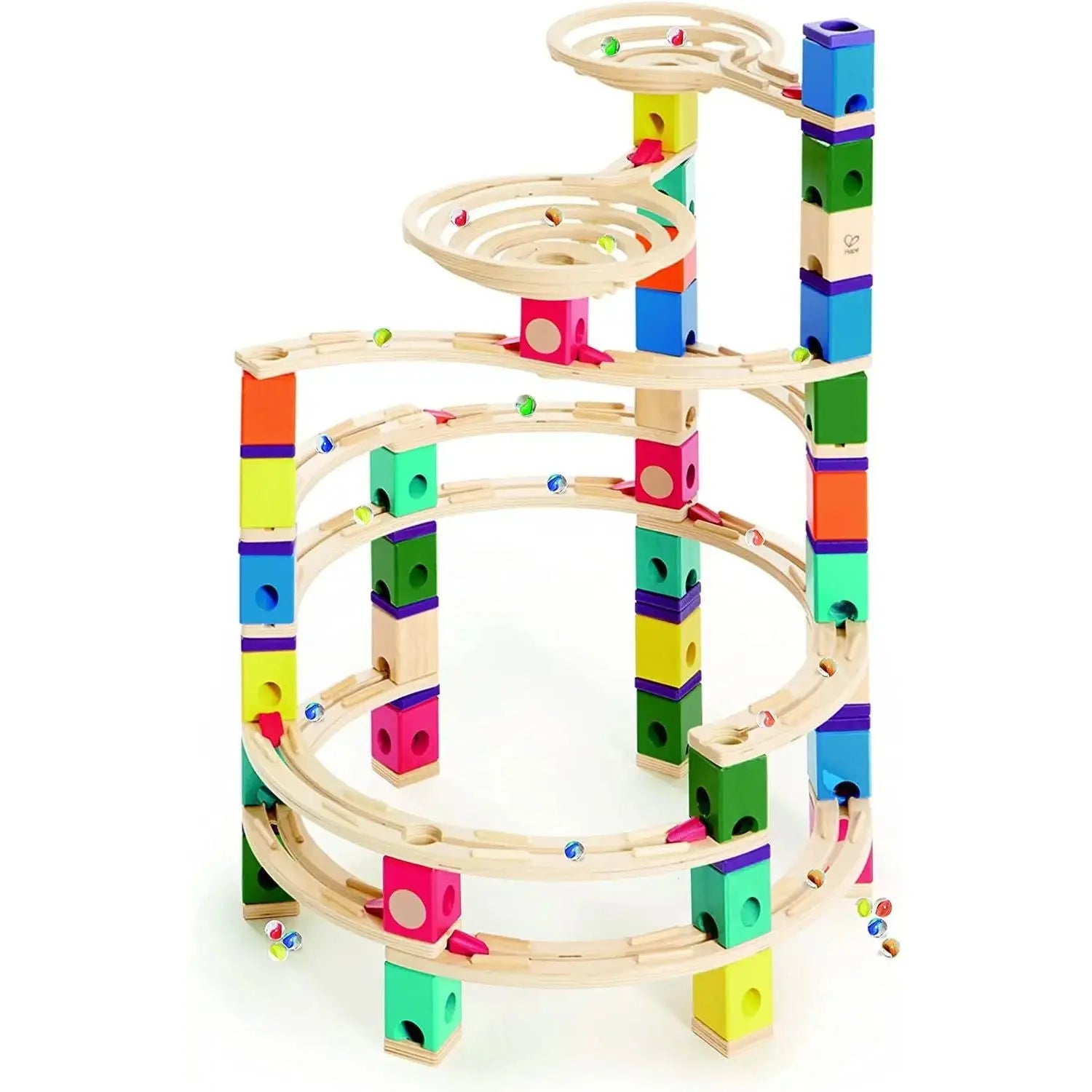
If you want wooden, the Hape Quadrilla Cyclone is the heirloom choice. 198 pieces of FSC-certified beechwood: two spiral funnels, twelve curved rails, ten power-boosting accelerators, more than a hundred marbles, and seven color-coded block types where each color signals a different function. At around $160 street (list ~$230) it is the most expensive option here. It carries a Spiel Gut award and an Oppenheim Toy Portfolio Platinum. Hape's own reviews are 9 of 10 five-star.
The catch is the 4+ label. A four-year-old can play with marbles on the tracks you build, but the build itself is adult work. Verified-buyer feedback repeatedly notes "5 year old son is hard to build the Quadrilla by himself, so he needs patience." This is a wooden kit you build WITH a young child, not one you hand them.
It is NOT compatible with Hape's cheaper Marble Run E1100/E1101/E1102 lines, only with other Quadrilla sets. That is a real trap if you already own Hape. 198 pieces is a lot to store, and availability fluctuates (Hape's official store was OOS in July 2026; Amazon and Target carried it).
The verdict: the right pick for a family that wants a wooden, keep-it-for-a-decade marble run and will build alongside a four-to-six-year-old. Skip it if you want solo play from a young child, or if the $160 floor gives you pause. The Marble Genius Super Set below is the budget alternative.
Is the Marble Genius Super Set the right budget marble run?
The Marble Genius Marble Run Super Set is the accessible, mainstream pick: around $35 to $45, snap-fit translucent plastic tubing, ages 4 to 8. The translucent pieces are the genuine STEM hook for younger kids. They can watch a marble travel through the tubes, which is concrete cause-and-effect for a five-year-old in a way GraviTrax's hidden hex grid is not. The brand-level rating is 4.6 stars from more than 10,000 Amazon ratings, and it is a long-running category best-seller (5,000-plus orders in a recent three-month window). NYT Wirecutter reviewed the related Marble Genius Extreme Set favorably as the largest marble run they tested.
The honest cons start with the piece-count confusion. Listings market the kit variously as 100 to 150 pieces; composition is roughly 85 track pieces plus action pieces plus glass marbles, but the marble count is cited as 15 in some sources and 65 in others. Structures can topple if the surface is not perfectly flat, and the action pieces (spinners, funnels) occasionally jam. There is less physics depth than GraviTrax, and kids tend to outgrow it by age 8 to 9.
The quality is honestly "mainstream plastic," not premium. The payoff is accessibility: a four-to-seven-year-old can actually build this themselves, which is not true of GraviTrax or Hape Quadrilla. For a household with an under-8 and a budget under $50, it is the rational entry point. Step up to GraviTrax when the kid is old enough; see our STEM toys for 6-to-8-year-olds roundup for the broader ladder.
Is MindWare Q-BA-Maze 2.0 right for a construction-loving kid?
MindWare Q-BA-Maze 2.0 is the odd one on this list. It is not really a "track" marble run. The 72 colorful interlocking cubes (five colors, three exit designs: single, double, bottom) ARE the track. Each cube is a scaffolding, a ramp, a branch. Kids build cubical mazes with multiple random exits per marble, which makes this a genuine probability-and-physics toy rather than a "marble racing" toy. The kit includes 20 steel marbles, a pivot trampoline, and a zoom coaster. BPA- and phthalate-free ABS plastic.
The construction is open-ended like LEGO. Toys Are Tools called it "one of the most enchanting toys I have ever seen." It scales from simple towers to elaborate sculptural mazes, which is replay value the snap-fit plastic options cannot match.
The cons are real. The Big Box has fluctuating Amazon US availability, frequently marked "currently unavailable." Verify before checkout, or look at the in-stock Q-BA-Maze 2.0 Rails Builder Set or Action Stunt Set instead. The cubes are NOT compatible with original Q-BA-Maze 1.0 cubes, a trap for returning buyers. Structures can be wobbly until kids learn the bracing pattern. And it is slower and more sculptural than GraviTrax, which disappoints action-oriented kids. The steel marbles are small and easy to lose, a choking hazard for under-three siblings.
This is the right pick for a six-and-up quiet builder who likes open-ended construction. Skip it if your kid wants speed and racing. That is GraviTrax territory, or see our engineering toys for 5-to-7-year-olds for more in that age band.
Is the National Geographic Glowing Marble Run worth the glow hype?
The National Geographic Glowing Marble Run is the marketing-hook winner: 85 smooth-run tube pieces, 26 action pieces, and 30 glow-in-the-dark glass marbles in six colors, with a UV keychain light to "recharge" the marbles between runs. The glow + UV recharge loop is genuinely novel and a real engagement driver. Kids find the recharge ritual fun in a way that plain plastic marble runs do not match. It ranks #4 in Amazon's Marble Runs Best Sellers; the broader NatGeo glow line has 18,956+ ratings at 4.7 stars on the related 15-marble variant.
The STEM credibility is decent. Blue Marble (formerly Discover With Dr. Cool), the producer, is a reputable STEM-toy licensee with consistent quality across the NatGeo line.
The cons are honest. The glow fades after one or two runs, so kids must re-recharge with the UV light each time. Some parents find this tedious, and the novelty wears off faster than the marketing suggests. Small glass marbles are a hard-floor hazard and a choking hazard for under-threes. The manufacturer age is 8+, so younger kids miss out. Multiple NatGeo marble-run SKUs (150-piece glow, 50-piece glow, magnetic, motorized elevator) confuse buyers; it is easy to buy the wrong variant. "Amazon exclusive" status means price volatility. Only buy sold and shipped by Amazon to avoid counterfeits.
The right pick for an eight-and-up kid who will be delighted by the glow ritual. It is a one-trick pony compared to GraviTrax, but the trick is fun.
Is ThinkFun Roller Coaster Challenge really a marble run?
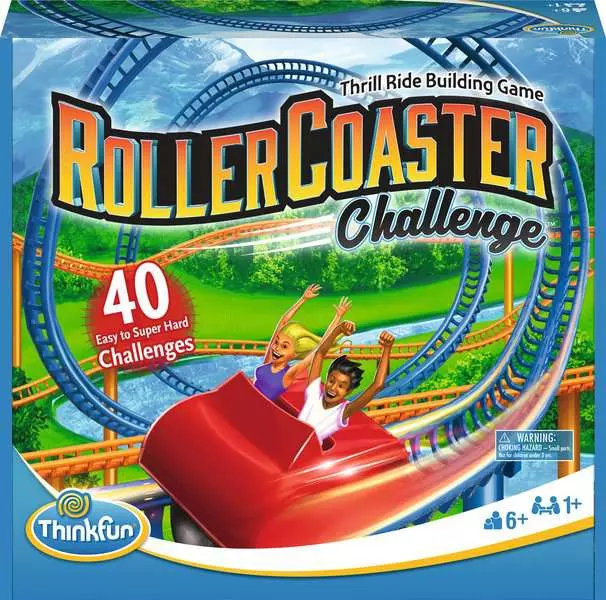
ThinkFun Roller Coaster Challenge is the misfit on this list, and that is its strength. It is not really a marble run. It is a single-player logic puzzle that builds a working roller coaster. The box contains 40 challenge cards (beginner to expert), 21 track pieces, 36 posts, a coaster car, a game grid, and an instruction booklet. Pick a challenge card, set up the pieces shown, then use the remaining pieces to complete a working coaster. Solve all 40 and you have hit the ceiling.
The STEM payoff is real: spatial reasoning, planning, engineering thinking. It was a TOTY 2018 Toy of the Year "Game of the Year" Finalist. GeekDad called it "a rewarding way to play with physics." The concrete payoff keeps kids coming back: once solved, you watch a real coaster car glide down your track with dips, curves, and loops. Verified-buyer feedback: "one of those toys that keeps my kids coming back to it."
The cons are structural. This is a single-player logic PUZZLE with 40 fixed challenges, not an open-ended marble run. Kids who want freeform building hit a hard ceiling after solving the challenges. Some challenges require precise piece placement, frustrating for younger six-year-olds without developed fine motor control. Only one coaster car and limited track; no expansion packs exist, unlike GraviTrax. And it is mis-marketed alongside marble runs; buyers expecting a marble run are surprised it is a puzzle.
The right pick for a six-and-up logic-puzzle kid who wants a brain-teaser, not a build-and-watch. It complements a real marble run rather than replacing one.
The verdict: our pick
Bottom line: For most families with a kid aged 8 and up, GraviTrax Starter Set is the pick (4.7/5), the only true physics-STEM system on this list. Gravity, magnetism, momentum in one snap-fit grid. 4.7 stars across 21,622 ratings. MESH-accredited. Endlessly expandable.
By age band:
- Ages 3 and under: wait. No marble run is safe; marbles are a choking hazard per CPSC 16 CFR §1501. None of these six are right for a three-year-old.
- Ages 4 to 5: Hape Quadrilla Cyclone for premium wooden, or Marble Genius Super Set for budget plastic. Both need adult hands at the low end of the range.
- Ages 6 to 7: MindWare Q-BA-Maze 2.0 Big Box for construction-cube kids, or ThinkFun Roller Coaster Challenge for logic-puzzle kids.
- Ages 8 to 12: GraviTrax Starter Set. The deepest physics-STEM runway on the list, scales into the early teens.
- Budget glow hook (8+): National Geographic Glowing Marble Run, a one-trick pony, but the trick is fun.
Who should NOT buy a marble run at all
Three honest skips. Under-3 households: every option here carries "WARNING: CHOKING HAZARD: Small parts and small balls. Not for children under 3 years" per the CPSC small-parts rule 16 CFR §1501 and the ASTM F963 mandatory US toy-safety standard. Marbles are the hazard. Parents expecting solo play from a four-year-old: every 4+ label still needs an adult's hands at the low end. Anyone chasing "STEM" without parent time: a marble run teaches physics when an adult narrates it. Without that narration, it is plastic tubing and noise; consider a magnetic tile set instead. Re-check the CPSC Recalls database before purchase. No active recalls on any anchor product as of July 2026.
One honest framing: a marble run is not "the one STEM toy." It is one piece of a screen-free learning shelf. See our STEM toys for 6-to-8-year-olds roundup for the rest of the ladder. Shopping for the new school year specifically? Our best STEM toys for back to school guide covers GraviTrax alongside five other picks timed to when back-to-school STEM searches actually peak.
Shopping for a gift? Start here
- Best LEGO Botanicals Sets for Adult Builders and Gift-Givers (2026)
- LEGO Botanicals Bonsai Tree vs LEGO Botanicals Orchid: Which Is Better for Adult Builders and Gift Buyers?
- Holiday Gift Guide 2026: The Best Toys by Age and Budget, From Preschool to Grown-Ups
- Gifts for Grown-Ups Who Still Love Toys: LEGO, Board Games and Puzzles (2026)
How we research: This guide is based on manufacturer specifications, published independent reviews, and verified-buyer feedback, not hands-on testing.
Holiday gift guide drops every Friday in Q4
One email a week with the newest review and the toys our community is actually buying. No spam, unsubscribe anytime.