Building sets · Ages 3-10
Magformers vs Magna-Tiles: Which Magnetic Set Wins? (2026)
Magna-Tiles vs Magformers: flat translucent tiles or hollow geometric frames? Compare specs, magnet strength, durability, price, and age fit with verified data.
Published Jul 17, 2026 · 9 min read
As an Amazon Associate, I earn from qualifying purchases. Your price stays the same.
TL;DR
- Buy Magna-Tiles Classic 100 if you want the safest, most durable magnetic set for ages 3–5+ with light-play appeal and the option to mix with cheaper compatible brands later.
- Buy Magformers Classic 62 if your kid is 5+ and wants to engineer skeletal 3D structures, doesn't care about translucency, and you're comfortable with brand lock-in.
- Skip both if you need 100+ pieces on a strict budget, PicassoTiles 100-piece costs half as much and is compatible with Magna-Tiles.
As an Amazon Associate I earn from qualifying purchases. This guide is based on manufacturer specs, published expert reviews, verified-buyer feedback, CPSC safety standards, and a 25+ year brand history, not hands-on testing. When comparing magnetic tiles, we weight durability data and safety compliance heavily, especially for products marketed to young children.
What's the core design difference between Magna-Tiles and Magformers?
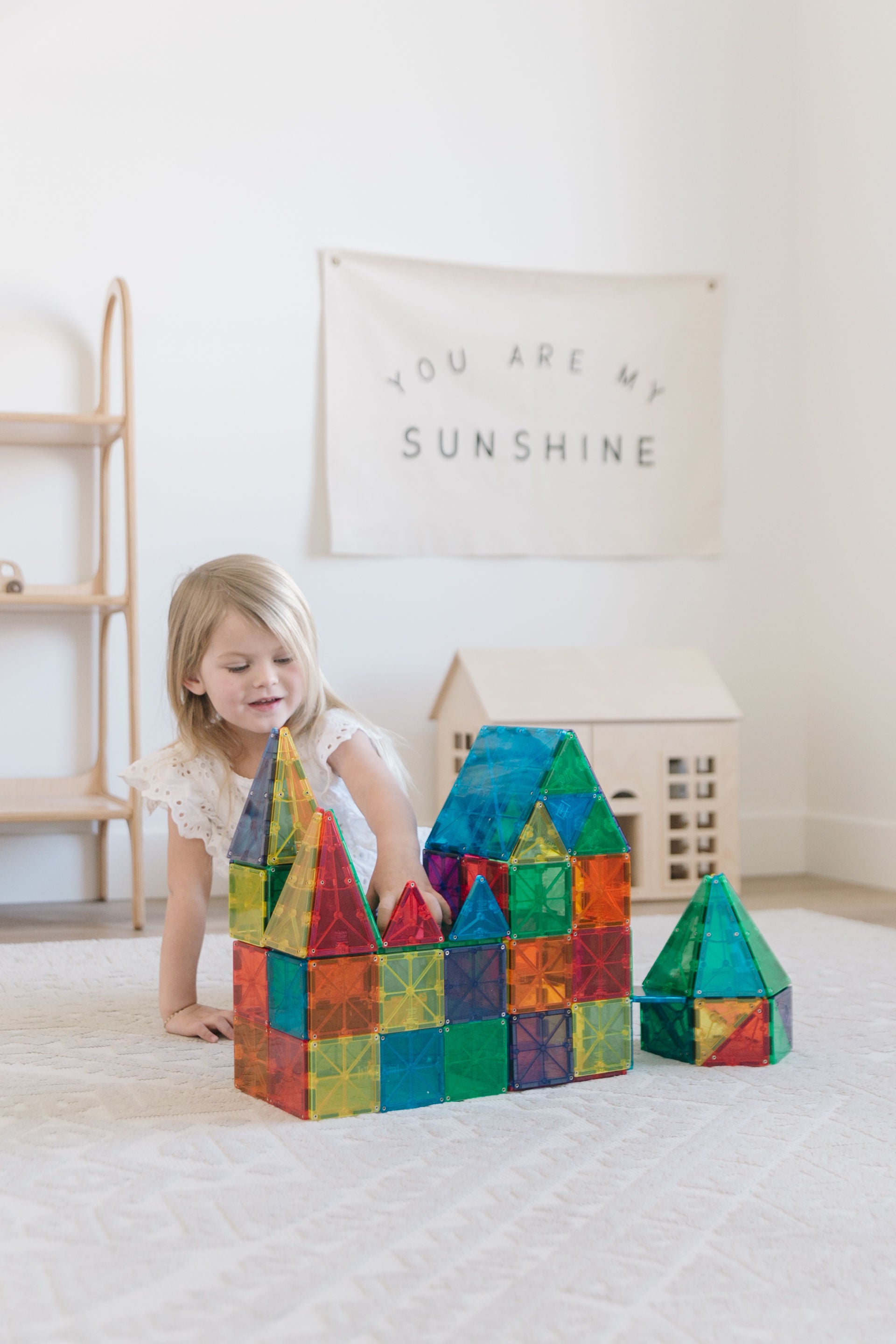
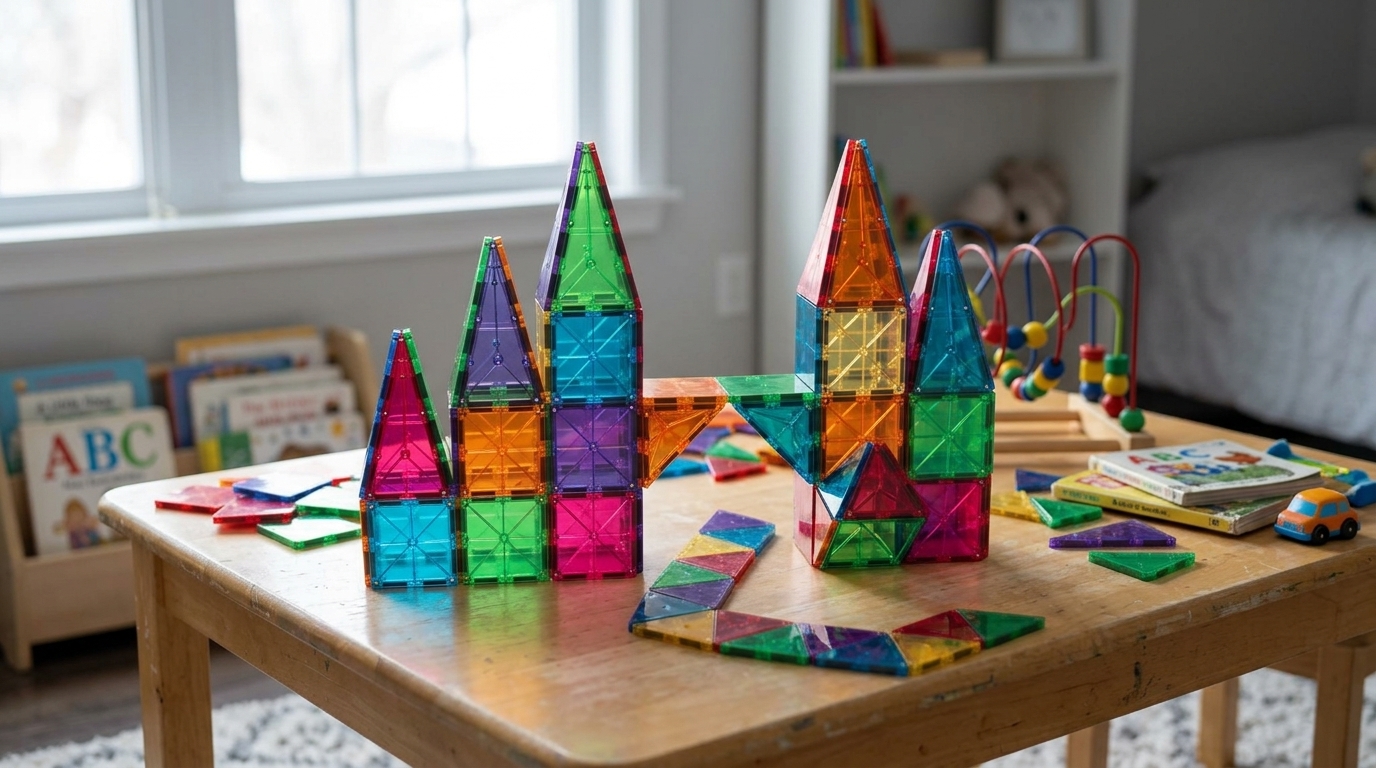
Magna-Tiles are solid, translucent flat panels. Each tile is a filled square or triangle made of clear or colored plastic with 3–4 neodymium magnets embedded and riveted along the edges. When you stack them, you build 2D patterns that assemble into 3D structures. Light shines through the translucent colors, creating a glow-up effect on a light table or in sunlight.
Magformers are hollow geometric frames. Each piece is a wireframe shape (square, triangle, pentagon, hexagon) with a single rotating magnet per edge, encapsulated in plastic tubes. You assemble skeleton-like structures, seeing through the center of each frame, and the emphasis is on geometric shapes and skeletal engineering, not light-play.
That's the fundamental split. One teaches through color and light; the other through frame geometry and spatial reasoning.
Which magnet strength is right for your child's hands?
Magna-Tiles use moderate-strength magnets (~40–50 kG²mm² flux index). A 3-year-old can pull tiles apart with some effort. Separation is intentional, part of the building and rebuilding process. Parents report the magnet strength as "just right" for young hands still developing fine motor control.
Magformers use very strong magnets (~50–60 kG²mm² or higher). The frames stick together hard. Reviewers consistently note that even adults struggle to pull Magformers apart, especially when a tall structure has stress on the connection points. For a kid under 6, this is frustration. For a kid 6+, it's a feature: tall, complex builds don't collapse under their own weight.
Age matters here more than you might think. A 4-year-old will abandon Magformers out of frustration. A 7-year-old will appreciate that their build stays locked in place while they add the next piece.
How do durability and compatibility stack up?
Magna-Tiles durability: The brand has a 25+ year track record with zero recalls. Magnets are riveted and welded into place, a dual seal that reviewers consistently report survives years of rough toddler play, drops, and chewing on tile edges. The plastic is food-grade MABS, non-toxic, and lattice-reinforced. Owners report magnets staying sealed through multi-child use.
Magformers durability: Excellent, but newer. Sonic-sealed (no rivets), with rotating magnet tubes inside. 20 years of history, zero recalls. Reviewers report the design is resilient and handles daily use well. The shorter history means less multigenerational data.
Compatibility: This is where the two brands diverge sharply.
Magna-Tiles are compatible with PicassoTiles, Connetix, and Playmags, all flat-panel brands. If you buy a Magna-Tiles starter set and want to expand cheaply, you can add 100-piece PicassoTiles sets at roughly half the per-piece cost. You're not locked into the Magna-Tiles ecosystem.
Magformers are not compatible with any other brand. The frame design is proprietary. If you choose Magformers, you're committing to expanding only with Magformers sets. No cross-brand mixing, no budget workarounds.
How much does each cost per piece, and is it worth it?
| Dimension | Magna-Tiles | Magformers |
|---|---|---|
| Price per piece | ~$1.50–$1.90 | ~$0.90–$1.50 |
| 32-piece starter | ~$50 | ~$25–32 |
| 100-piece set | ~$120 | N/A (max is 62 or 144) |
| 62-piece set | N/A | ~$39–54 |
| 144-piece set | N/A | ~$199–359 |
| Typical sale frequency | Fixed (no discounts) | Frequent discounts |
| True cost per year of use | Lower (25+ year durability) | Higher (20-year durability, brand lock-in) |
Magformers looks cheaper on the sticker. But Magna-Tiles' durability and compatibility with budget brands like PicassoTiles (~$30–40 for 100 pieces) make the true cost per year of use lower. A parent buying Magna-Tiles + later expanding with PicassoTiles spends less than a parent locked into Magformers' higher per-piece cost for expansion sets.
Which set is better for which age?
| Age Band | Best Fit | Why |
|---|---|---|
| 3–4 | Magna-Tiles | Moderate magnets, large tiles, translucent appeal, easier manipulation |
| 5–6 | Magna-Tiles OR Magformers | Transition zone; both viable. Magna-Tiles for light-play; Magformers for frame engineering |
| 7–10 | Magformers | Frame-based building, stronger magnets, no translucency needed, geometric complexity |
For ages 3–4, the answer is unambiguous: Magna-Tiles. The magnet strength is forgiving, the tiles are large and easier to grip, and the translucent light-play is a sensory hook that keeps kids engaged.
For ages 5–6, either brand works, but for different reasons. If your child loves color and light, Magna-Tiles. If they're already asking "how do I make this taller?" and want to engineer skeletal structures, Magformers.
For ages 7–10, Magformers pulls ahead. Kids at this age see flat-tile building as simpler, and they appreciate the geometric complexity and structural stability that frame building offers.
What about safety and the under-3 question?
Both Magna-Tiles and Magformers carry the federal warning: "Not for children under 3. CHOKING HAZARD: Small magnets." This isn't marketing caution; it's CPSC law. The tile itself is too large to swallow, but the magnet inside is not. If a magnet escapes the tile and is swallowed, especially multiple magnets that can attract through intestinal walls, the outcome can be severe: perforation, blockage, sepsis, or death.
The CPSC tracked five fatal magnet-ingestion incidents between 2005 and 2021. Four involved children age 2 or younger.
Neither brand is suitable for unsupervised under-3 play. If you supervise constantly and your child is close to 3 (28+ months, mouthing behavior declining), Magna-Tiles' larger size and riveted design make magnet escape fractionally harder than Magformers' frame design. But "fractionally" is the operative word. Supervision is non-negotiable either way.
For detailed under-3 guidance, see our best magnetic tiles for toddlers safety-focused guide.
Who should NOT buy either brand?
Skip both if:
-
Budget is under $25 for 100+ pieces. PicassoTiles 100-piece sets cost $30–40 and are compatible with Magna-Tiles. You trade slightly lower plastic quality (glued instead of riveted magnets) for 2–3x piece count at half the price. For a kid whose interest is unproven, this is the smarter first bet.
-
You want mixed-brand expandability and might want Magformers later. If there's any chance you'll want frame-based building down the road, start with Magna-Tiles or PicassoTiles. Magformers' incompatibility means you can't mix later without abandoning one collection.
-
Your child is under 3 without constant supervision. Both carry magnet-ingestion risk. Wait until 3, or invest in supervising heavily if you can't wait.
-
Your child is a solo builder who gets bored fast with 32–62 pieces. Single-player kids need at least 100 pieces to sustain interest beyond two weeks. If budget rules out a 100-piece set, neither brand is the right choice.
Recommended pick
Magna-Tiles Classic 100 is the safer, more durable choice for most families. It suits ages 3–5+ builders across skill levels, plays well with cheaper compatible brands, and has a proven track record that spans generations. The translucent light-play is a sensory dimension Magformers doesn't offer. At $120, it's an investment, but the durability and expandability math works out.
But here's the caveat: If your kid is 5+ and already building complex 3D structures or asking how to make skeletal engineering models, Magformers Classic 62 is the better fit. The frame design teaches geometric thinking that flat tiles don't, and the strong magnets prevent collapse on tall builds. You'll pay more per piece long-term, but the engagement and learning for that age/style is higher.
Bottom line: For ages 3–5 and light-play appeal, Magna-Tiles Classic 100 (4.7/5) is the pick: 25+ years of zero-recall durability and compatible with cheaper brands for expansion. For ages 5–10 and frame-engineering enthusiasm, Magformers Classic 62 is competitive, but you're locking into a proprietary ecosystem. Start with whichever matches your child's age and building style; don't assume more expensive = better fit.
FAQ
Which is better for a 4-year-old?
Magna-Tiles. The moderate magnet strength is far more forgiving for developing hands. A 4-year-old trying to separate Magformers often gives up in frustration. The magnets are simply too strong for that age's grip and patience. Magna-Tiles' light-play also holds attention longer at this age.
Are Magformers and Magna-Tiles compatible?
No. Magna-Tiles are flat panels that slide together on a grid. Magformers are hollow frames that snap on edges. The geometries don't match. If you're considering both someday, start with Magna-Tiles and use compatible budget brands (PicassoTiles, Connetix) to expand. Magformers locks you into its own ecosystem.
Which lasts longer?
Magna-Tiles, by track record. The brand has 25+ years of documented use with zero recalls and riveted-plus-welded magnets that reviewers consistently report staying sealed through years of rough play. Magformers' sonic-sealed design is excellent but has a 20-year history, with less multigenerational data. For long-term value across multiple children, Magna-Tiles' proven durability is the differentiator.
Is either safe for a child under 3?
Both carry CPSC "not for under 3" warnings. Neither is designed for solo under-3 play due to magnet-ingestion hazard. If you supervise constantly and your child is close to 3 (nearing 3 years old, mouthing declining), Magna-Tiles' larger size and dual-seal construction make magnet separation fractionally harder. But "constantly supervised" is the operative requirement either way. For context, see our best magnetic tiles for toddlers guide.
What's the real cost per piece when you factor in durability and compatibility?
Magformers costs less per piece initially (~$0.90–$1.50 vs ~$1.50–$1.90), but Magna-Tiles' true cost per year of use is lower because: (1) it lasts 25+ years across multiple children, and (2) you can expand with PicassoTiles at ~$0.30–$0.50 per piece instead of paying Magformers' higher expansion prices. Magna-Tiles' compatibility with cheaper brands is the hidden advantage.
For more magnetic tile comparisons without the age filter, see our best magnetic tiles for kids guide. For toddler-specific safety context, see best magnetic tiles for toddlers. To explore other STEM building toys, check out our best STEM toys for 6–8 year-olds.
Sources:
Shopping for a gift? Start here
- Best LEGO Botanicals Sets for Adult Builders and Gift-Givers (2026)
- LEGO Botanicals Bonsai Tree vs LEGO Botanicals Orchid: Which Is Better for Adult Builders and Gift Buyers?
- Holiday Gift Guide 2026: The Best Toys by Age and Budget, From Preschool to Grown-Ups
- Gifts for Grown-Ups Who Still Love Toys: LEGO, Board Games and Puzzles (2026)
How we research: This guide is based on manufacturer specifications, published independent reviews, and verified-buyer feedback, not hands-on testing.
Holiday gift guide drops every Friday in Q4
One email a week with the newest review and the toys our community is actually buying. No spam, unsubscribe anytime.