Building sets · Ages 1-3
Best Magnetic Tiles for Toddlers (Ages 1-3): The Honest Safety Guide
No magnetic-tile brand is made for toddlers under 3. Here's the honest, CPSC-backed guide to whether it's safe, when to wait, and which sets are safest if you do.
Published Jul 13, 2026 · 10 min read
As an Amazon Associate, I earn from qualifying purchases. Your price stays the same.
TL;DR
- No magnetic-tile brand (Magna-Tiles, Connetix, Playmags, PicassoTiles) labels a set for under 3. Every major set carries a "not for children under 3, CHOKING HAZARD" warning per CPSC small-parts rules.
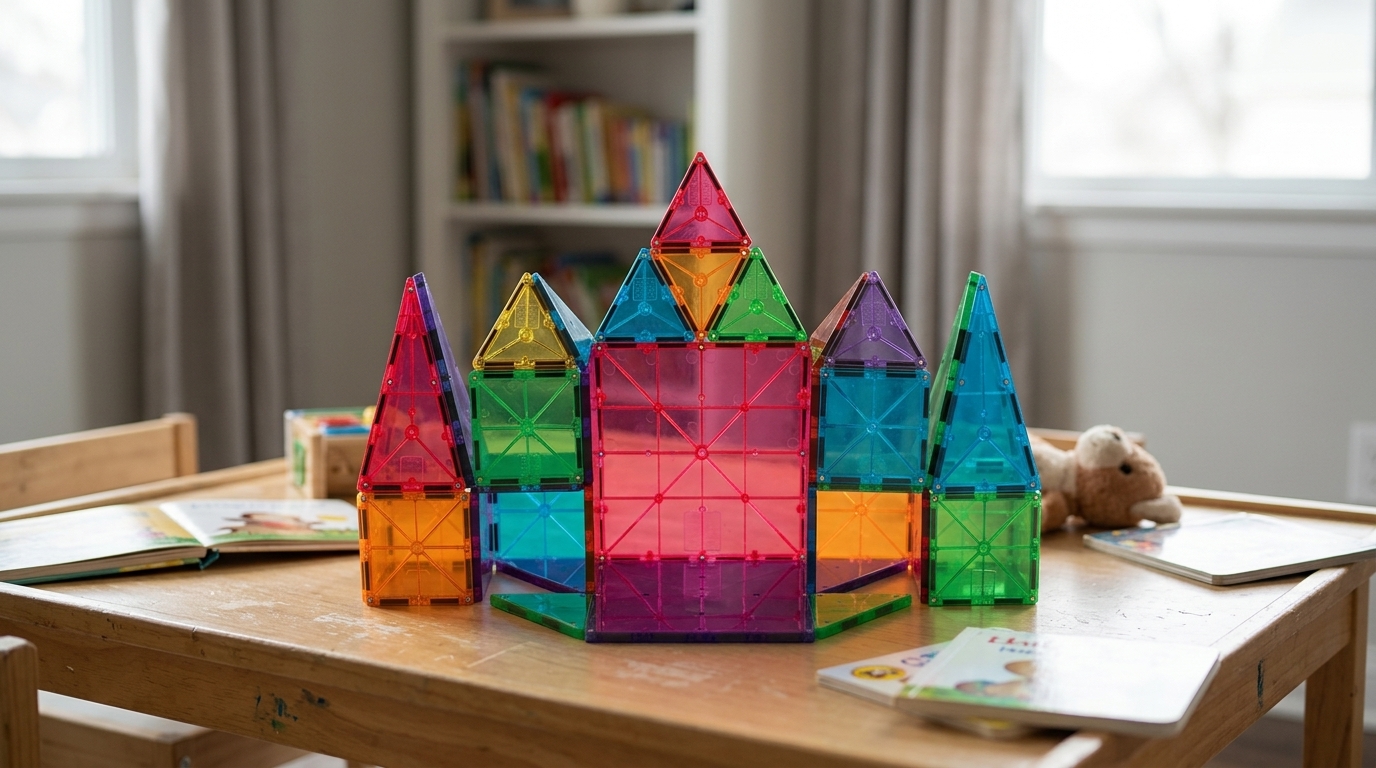
- If your toddler is close to 3 and you supervise constantly, the safest picks are the largest-piece, riveted sets: Magna-Tiles Classic 32 and Connetix Clear Starter 34.
- Skip "toddler-friendly" travel/mini sets like microMAGS: smaller pieces are a BIGGER choking risk for a toddler's mouth, not a smaller one.
There is no such thing as the best magnetic tiles for toddlers under 3 in the way the category markets itself: every brand labels its tiles 3+, so this guide is about whether, when, and which set is safest if you supervise anyway.
How we evaluated: This guide draws on CPSC small-parts regulations and magnet safety standards, published manufacturer safety warnings from the category's largest brands, AAP choking-prevention guidance, and verified-buyer feedback. It is not personal testing. The research focuses on whether magnetic tiles can be used safely by a toddler under 3 with supervision, and if yes, which sets carry the lowest additional risk.
Why doesn't any magnetic-tile brand make a set for ages 1–3?
Because federal law bans small parts from toys marketed for children under 3. The 16 CFR Part 1501 small-parts rule defines a "small part" as anything that fits inside a test cylinder roughly the size of a toddler's throat. Magnetic-tile pieces are too large to be swallowed whole, but the magnets inside them are not. A magnet that escapes the tile absolutely fits the cylinder.
This is why every major brand prints the warning on its box. Magna-Tiles, the category founder, explicitly states "Not for children under 3 yrs. CHOKING HAZARD - Small parts. This product contains small magnets." Connetix, Playmags, and PicassoTiles carry identical language. There is no workaround, no special toddler variant, and no brand that has chosen to market a set for under-3s. The rule isn't a suggestion: it's federal law, enforced by the CPSC.
What's the actual risk: choking versus magnet ingestion?
Choking on a magnetic tile itself is unlikely; the real hazard is a magnet working loose and being swallowed. Here's the chain: Children under 3 are at the highest choking risk because their chewing and swallowing skills are still developing, and mouthing objects is normal exploratory behavior. A magnet small enough to fit the CPSC cylinder meets the legal definition of a choking hazard. But the danger deepens when multiple magnets are swallowed. The CPSC warns that two or more magnets (or a magnet and metal object) can attract each other through intestinal walls, causing perforations, blockage, sepsis, or death.
The numbers are stark. Of five fatal magnet-ingestion incidents the CPSC tracked between 2005 and 2021, four involved children age 2 or younger. These deaths all involved loose magnets that escaped their toy's enclosure. For a toddler nearing 3 who still mouths objects, the question isn't whether to ignore the warning; it's whether to supervise actively and buy a set with the most secure magnet seal, knowing that risk still exists.
How to decide when a toddler is ready for magnetic tiles
If you decide to let a toddler use magnetic tiles under close supervision, break the readiness into age bands:
-
Under 18 months, skip entirely. At this age, mouthing everything is peak developmental behavior. The swallowing reflex is still reflexive, not discriminating. The magnet-ingestion risk is highest, and the supervising challenge is unrealistic. Even a single magnetized tile in the room carries too much hazard. Wait.
-
18 to 30 months, constant 1:1 supervision only. Around 18 months, mouthing begins to decline as chewing skill improves, but it's still frequent. If you introduce tiles at this stage, every second of play must be within arm's reach and direct line of sight. One adult, one toddler, no distractions. At the first sign the child is exploring a tile edge with teeth or trying to pull a magnet out, the session ends. Set a timer for 15 minutes and call it done. This is emotionally exhausting, and that's the whole point: if you can't sustain that level of vigilance, your toddler isn't ready.
-
Nearing 3 (28–36 months), transitioning to independent play, with periodic checks. By 28 months and up, mouthing behavior in many (not all) toddlers drops sharply. Some children can play with magnetic tiles in the room while you're nearby but not hovering. Even here, check in every 2–3 minutes, watch for any attempt to pull a magnet, and remove the tiles the moment play becomes unsupervised or rough. If your toddler is a chronic chewer or has a sibling who is, the risk calculus changes: skip this age band and wait.
The threshold is developmental readiness, not just a birthdate. Every toddler is different.
Which sets are the safest choice once you decide to supervise play?
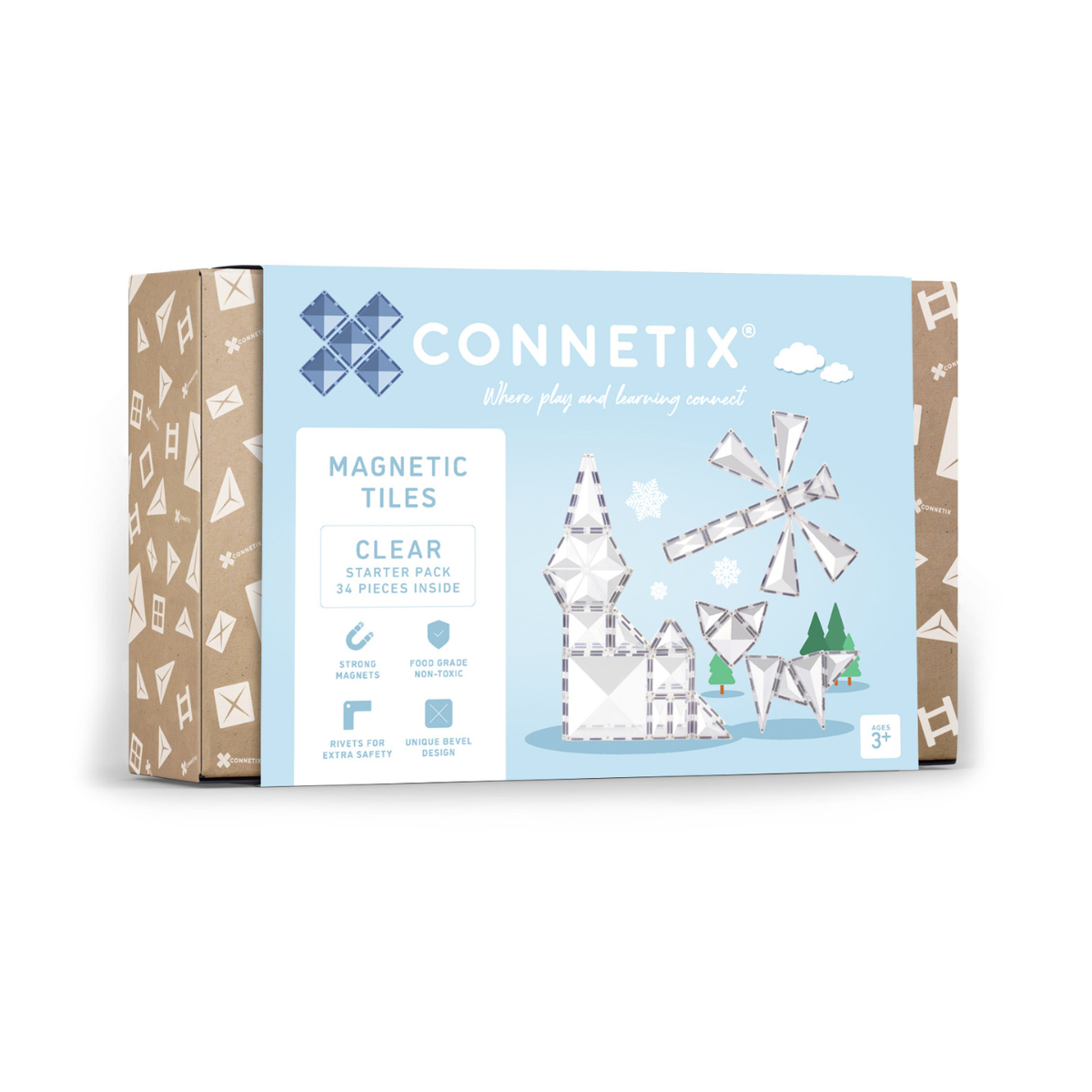
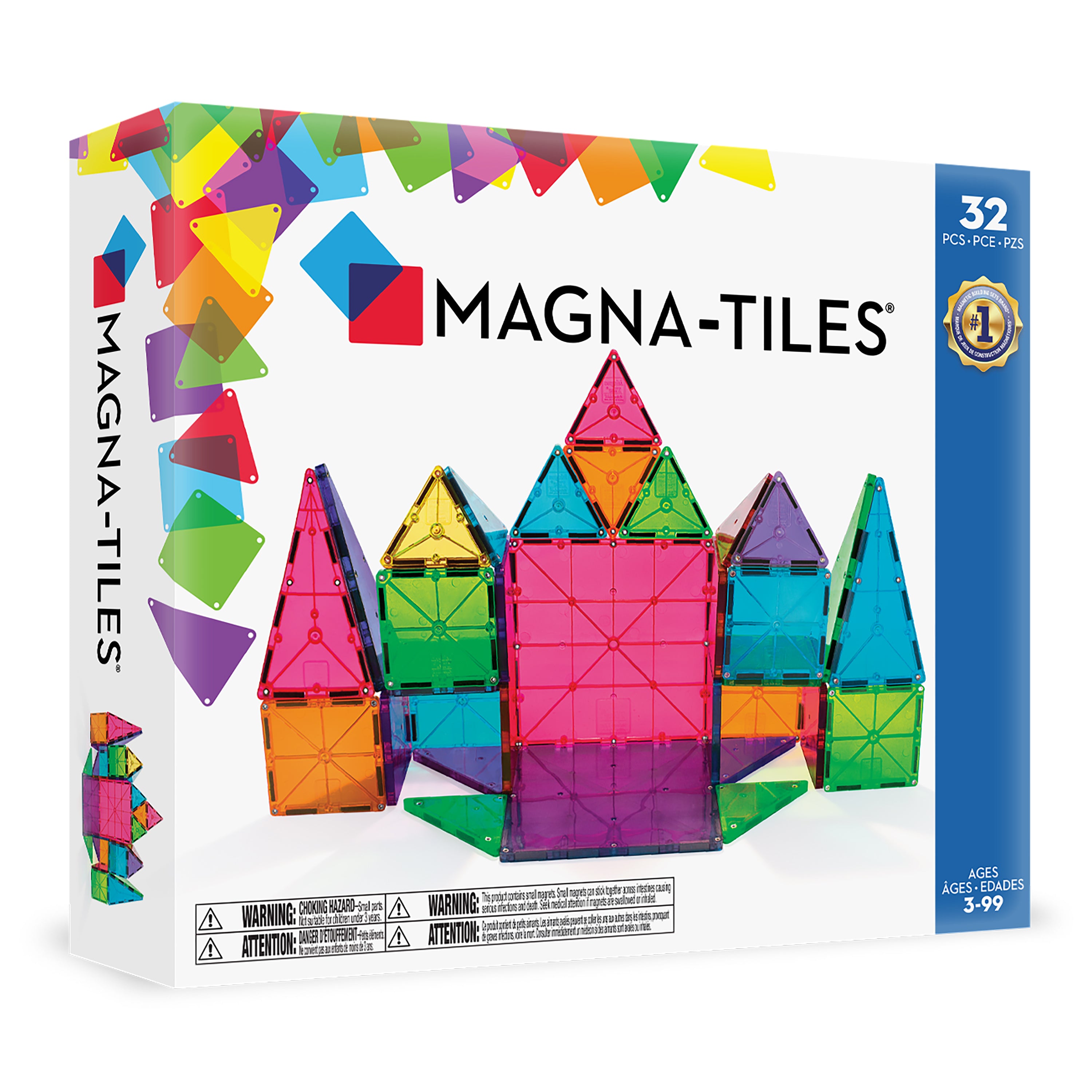
If you've decided to let a toddler near magnetic tiles, magnet encapsulation is the only spec that matters for safety. The magnets must be sealed twice: first by ultrasonic welding (the two plastic halves of the tile bonded under heat), second by a metal rivet through the magnet's center. That dual seal withstands a toddler's abuse (dropping, chewing the tile edge, prying with nails) far better than glued magnets.
Magna-Tiles Classic 32 (4.7/5 stars, 11,380 reviews) and Connetix Clear Starter 34 (4.6/5 stars, but only 37 reviews on this specific listing, too small a sample to lean on alone) both use welded-plus-riveted construction. Between the two, Magna-Tiles has the far longer track record (25+ years, no recalls, tens of thousands of reviews across its set sizes) and owners consistently report magnets staying sealed through years of rough toddler play. Connetix's reputation for heavier, marginally more durable plastic comes from its flagship larger sets, which do have a deeper review history; the small Clear Starter listing hasn't caught up yet. For a toddler under 3, either brand is a safer bet than any budget brand. Pick Magna-Tiles if cost is a factor or you want the most-reviewed option; pick Connetix if you want the sturdiest possible build and don't mind a newer listing.
Playmags Junior 32 (4.8/5 stars, 5,168 reviews) is riveted but less expensive than Magna-Tiles. It's a legitimate middle option, though the brand has less long-term data for under-3 use.
Which "toddler-friendly" marketing should you actually avoid?
Here's the inversion that matters: smaller pieces marketed as "toddler-friendly" or "travel sets" are the WRONG choice for a toddler. microMAGS is a Magna-Tiles product with pieces roughly 75% smaller than the Classic set. That size reduction doesn't make them safer. It makes them riskier. Smaller plastic means smaller magnets. Smaller magnets are easier to pry out. Smaller shapes fit more easily into a toddler's mouth. A well-meaning parent buying microMAGS because they sound "toddler-friendly" is picking the least safe option in the category.
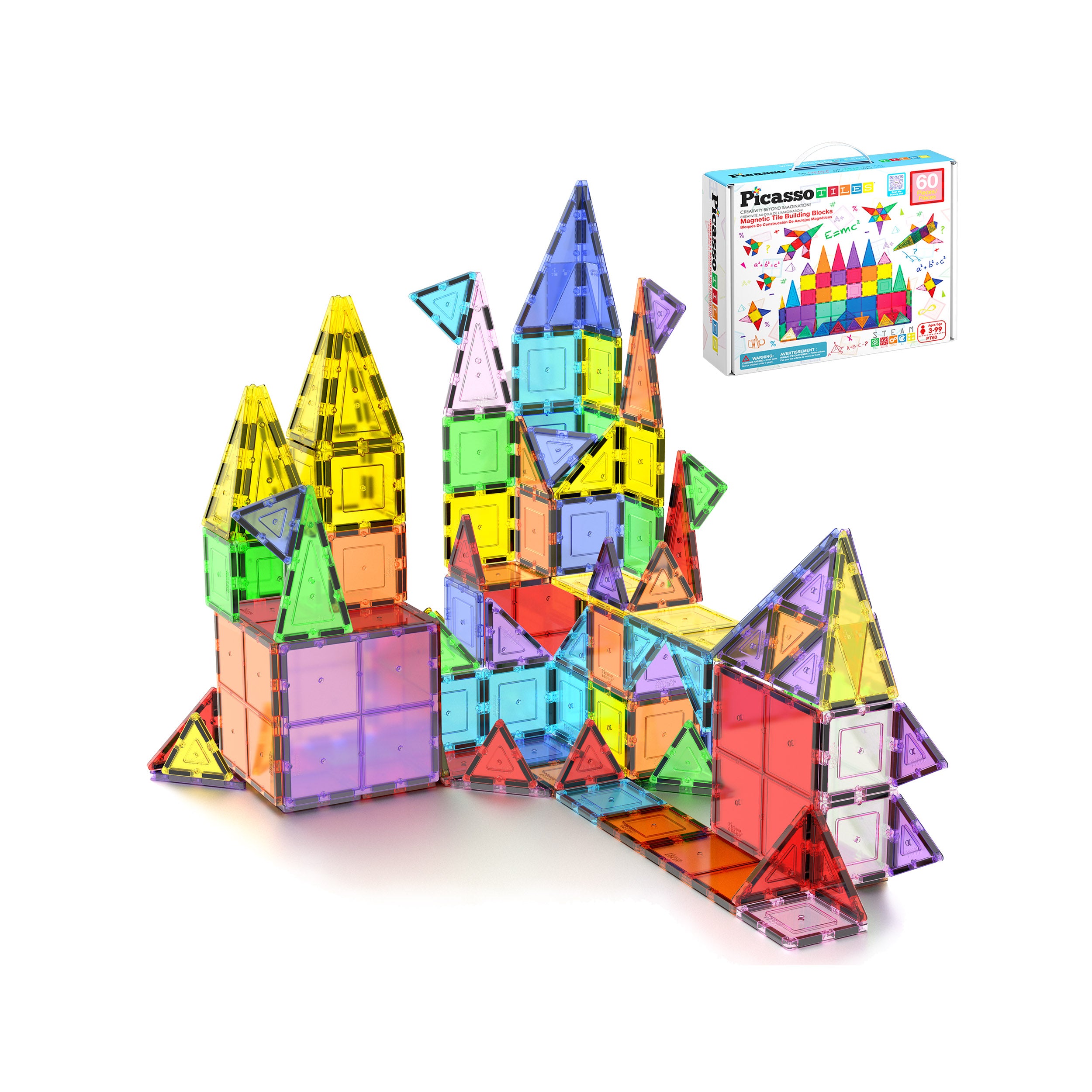
PicassoTiles 60-Piece Set (4.8/5 stars, 40,165 reviews) is popular and inexpensive, but the brand doesn't clearly disclose whether its magnets are welded or glued, the same encapsulation opacity our kids' magnetic-tiles roundup found across its price tier. Across the review base, a small share of owners report loose magnets after 12–18 months of heavy play. That's a durability issue in general, and specifically a safety issue for a toddler. PicassoTiles is fine for a 3-year-old; avoid it for younger ages. For this audience, the undisclosed encapsulation is the dealbreaker, not a confirmed spec.
The comparison matrix: which set carries the lowest risk?
| Set | ~Street price | Piece size vs Classic | Magnet fastening | Manufacturer age label | Amazon rating | Toddler verdict |
|---|---|---|---|---|---|---|
| Magna-Tiles Classic 32 | ~$45–50 | Full size (largest) | Riveted + welded | 3+ | 4.7★ (11,380) | Safest option if supervised |
| Connetix Clear Starter 34 | ~$55–60 | Full size, heavier plastic | Riveted + welded | 3+ | 4.6★ (37) | Most durable vs. drops |
| Playmags Junior 32 | ~$30–35 | Full size | Riveted | 3+ | 4.8★ (5,168) | Solid mid-tier option |
| PicassoTiles 60 | ~$30–40 | Full size | Undisclosed (not confirmed welded+riveted) | 3+ | 4.8★ (40,165) | Avoid for under-3 use |
| microMAGS 26 (travel) | ~$25–30 | ~75% smaller | Riveted | 3+ | n/a | AVOID: smaller = higher risk |
The key column is magnet fastening. For a toddler under 3, riveted-plus-welded is the only acceptable standard. Glued or undisclosed carries the real risk.
FAQ
Are magnetic tiles ever actually safe for a toddler under 3?
Yes, with conditions. The hazard isn't the tile itself: it's a magnet escaping the tile and being swallowed. A large magnetic-building tile is too big to choke on; the magnet inside it is not. If you buy a set with welded-plus-riveted magnets, keep it out of reach except during supervised sessions, and stop immediately if your child tries to pry or chew, the risk is reduced but not eliminated. Never assume a toddler can play unsupervised.
What's the difference between the magnet types in the comparison table?
Riveted magnets are held in place by a metal rivet through the center of the magnet; welded magnets are sealed by ultrasonic heat-bonding the two plastic halves of the tile. The best sets use both, a dual seal. Glued magnets, common in cheaper brands, rely on adhesive that can loosen with drops, temperature changes, and heavy play. For a toddler prone to throwing and chewing, glued is the riskiest option.
If I buy Magna-Tiles Classic 32, can my toddler just play with it like a 3-year-old would?
No. The "3+" label reflects the small-parts rule, not a readiness benchmark. A 2-year-old using a 3+-rated set still has the same developmental mouthing behavior and magnet-ingestion risk. The rivet-and-weld seal lowers the odds a magnet escapes, but if your toddler's primary skill is putting objects in their mouth, the set doesn't belong in their hands unsupervised. Supervision is non-negotiable.
Should I wait until my child is 3 to introduce magnetic tiles?
Yes, for most families. The developmental jump from 30 months to 36 months is real: mouthing drops sharply, following multi-step instructions improves, attention span lengthens. At 3, you can introduce tiles and gradually reduce supervision as the child proves they won't chew or pry. The risk at 2.5 is simply higher. Even if your child is developmentally precocious, the CPSC rule exists for a reason: the fatal magnet-ingestion incidents the agency tracked happened in children 2 and younger. Wait for 3 if you can; if you introduce earlier, accept that supervision means you in the same room, watching constantly, for no more than 15 minutes at a time.
The verdict: our pick
If you decide to let your toddler use magnetic tiles under constant supervision, the safest choices are the sets with the most secure magnet seals and the longest track records.
Magna-Tiles Classic 32 is the pick if your toddler is close to 3 and you can manage active supervision. It has a 25+ year track record, zero recalls on authentic sets, and owners consistently report magnets staying sealed through rough play. The dual weld-plus-rivet seal is the gold standard. For a household with a toddler approaching 3, this is the lowest-additional-risk option.
Connetix Clear Starter 34 is the alternative if you want maximum durability, heavier plastic and stronger magnets, and don't mind spending slightly more. The seal is equally secure, and the tiles will outlast your toddler's use.
Skip microMAGS and PicassoTiles for under-3 use. microMAGS is the wrong choice by design: smaller pieces raise, not lower, choking and magnet-escape risk. PicassoTiles' undisclosed magnet encapsulation is a real unknown that becomes a safety question, not just a durability one, for a toddler.
Better yet: wait until 3. If your child is 18–30 months old and drawn to magnetic tiles, the honest answer is that the risk-to-benefit ratio isn't there yet. At 3, when mouthing declines and comprehension improves, you can introduce a set with minimal supervision and sleep better at night.
If you're hunting for magnetic tiles for an older sibling (3–8), our best magnetic tiles for kids guide covers the broader category without the under-3 safety caveat. And if toy safety in general is on your mind, our smart-toy safety checklist walks through the CPSC hazards parents most often miss.
Bottom line: If your toddler is close to 3 and you're set on magnetic tiles, Magna-Tiles Classic 32 is the safest pick (4.7/5), welded and riveted magnets with a 25-year track record and near-zero seal failures in toddler hands. Constant supervision is non-negotiable; 15-minute sessions are the outer limit. Better option: wait until 3, when the developmental risk drops sharply.
Shopping for a gift? Start here
- Best LEGO Botanicals Sets for Adult Builders and Gift-Givers (2026)
- LEGO Botanicals Bonsai Tree vs LEGO Botanicals Orchid: Which Is Better for Adult Builders and Gift Buyers?
- Holiday Gift Guide 2026: The Best Toys by Age and Budget, From Preschool to Grown-Ups
- Gifts for Grown-Ups Who Still Love Toys: LEGO, Board Games and Puzzles (2026)
How we research: This guide is based on manufacturer specifications, published independent reviews, and verified-buyer feedback, not hands-on testing.
Holiday gift guide drops every Friday in Q4
One email a week with the newest review and the toys our community is actually buying. No spam, unsubscribe anytime.