stem-kits · ages 8-14
Best Rube Goldberg Machine Kits for Creative Engineers (2026): 5 Chain-Reaction Picks Ranked by What They Teach
Most chain-reaction kit guides rank by piece count or price. This research-based guide ranks 5 real Rube Goldberg / chain-reaction kits for ages 8-14 by the physics each one teaches, how open-ended the play is, and what happens when the chain reaction won't trigger. Safety-checked against CPSC and AAP guidance.
Published 2026-06-01 · 9 min read
Amazon Associates disclosure
As an Amazon Associate, I earn from qualifying purchases. The price you pay is the same. This guide is based on manufacturer specifications, published independent reviews, and verified-buyer feedback, not hands-on testing.
TL;DR
- For a kid's first chain-reaction kit, start with Klutz LEGO Chain Reactions (~$30, screen-free, 8+): cheapest real entry, combines a how-to book with LEGO so the engineering thinking is explicit, and it plays nicely with a LEGO bin you already own.
- Want open-ended free-build with no instructions to follow? KEVA Contraptions Reactions (
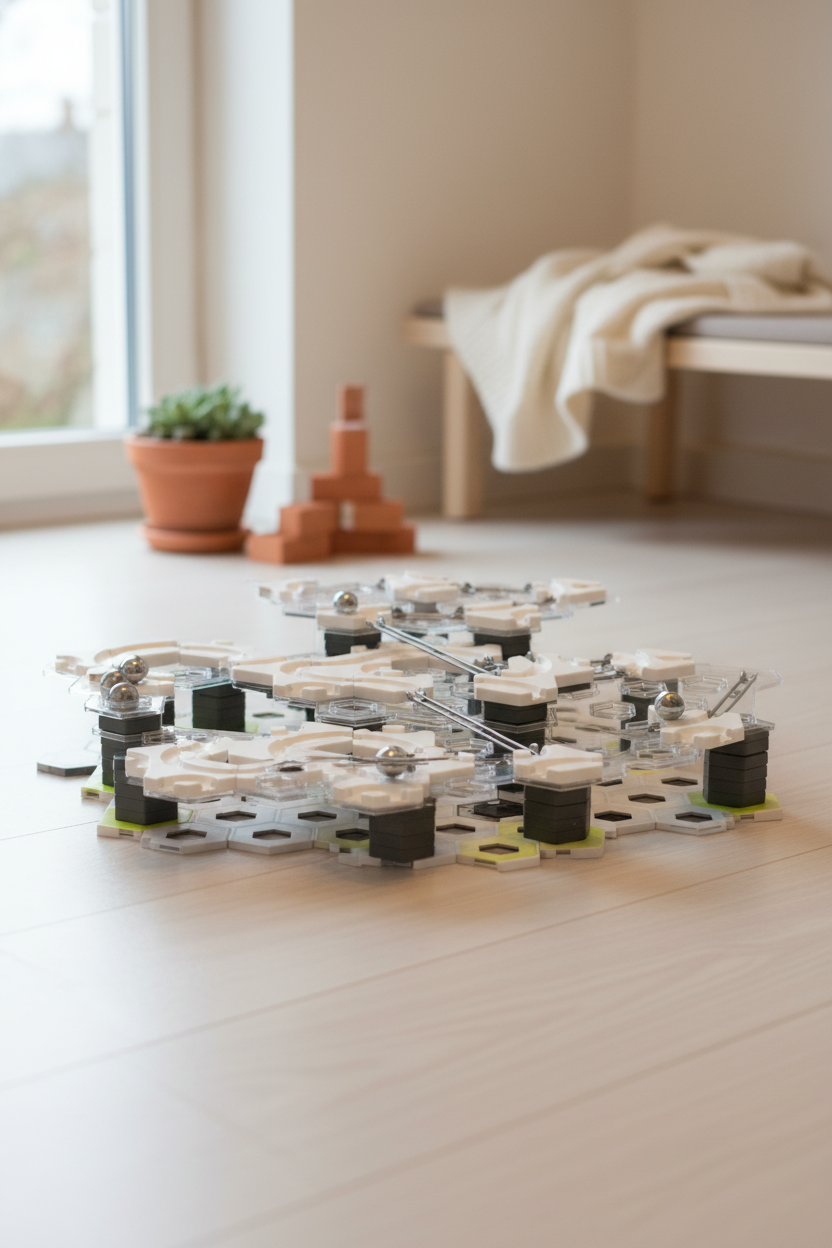
$50, 7+) is the imagination pick. Prefer guided puzzles with right answers? GraviTrax Starter Set ($50, 8+) for gravity/magnetism, or Spintronics Act One (~$80, 8-adult, sold direct) for a tangible model of electrical circuits.- Marble Genius Marble Rails Super Set (~$45, 8+) is the budget marble-run chain: high piece count, lower precision. Pick by temperament: builders who love rules want GraviTrax/Spintronics; builders who love chaos want KEVA/Klutz.
Picking a Rube Goldberg kit is a bet on patience, spatial reasoning, and whether your kid likes following rules or breaking them. This research-based guide ranks five real, age-appropriate chain-reaction kits by the physics each teaches and how open-ended the play is, synthesized from manufacturer specs, maker documentation, and published safety standards, not from a personal hands-on test. Safety claims are checked against the U.S. Consumer Product Safety Commission and the American Academy of Pediatrics.
As an Amazon Associate, I earn from qualifying purchases made through product links in this review. This does not affect the price you pay.
How did these 5 chain-reaction kits make the list?
The shortlist kept only kits that genuinely build a chain reaction (one action triggering the next) for the 8-14 band, that carry a credible signal (STEM accreditation, maker pedigree, or educator vetting), and that each teach a distinct flavor of cause-and-effect so the five do not overlap. That ruled out plain building blocks and single-trick gadgets dressed up as "STEM."
The five: Klutz LEGO Chain Reactions (guided LEGO contraptions), KEVA Contraptions Reactions (open-ended wood planks), Ravensburger GraviTrax Starter Set (gravity/magnetism marble run), Spintronics Act One (mechanical-circuit puzzles), and Marble Genius Marble Rails Super Set (budget marble-run chain). The Klutz LEGO kit is built for ages 8+, KEVA Contraptions Reactions is 7 & up, GraviTrax is 8+ and STEAM-accredited, and Spintronics is 8-to-adult. The band straddles all of them, with the younger end leaning to KEVA and the upper end to Spintronics.
This is a synthesis guide: the verdicts below come from published specs, maker documentation, and safety standards rather than a single reviewer's playroom. Where a claim is about learning value, age fit, or safety, it is cited to a named source so you can check it yourself.
Which chain-reaction kit teaches the most for the money?
The cleanest signal here is what the kit teaches and how open it is, not how many pieces are in the box. Here is the lineup side by side, drawn from each product's listing and learning spec.
| Pick | Age fit | Price tier | Open-ended vs guided | # parts | Screen-free? | What it teaches (physics) |
|---|---|---|---|---|---|---|
| Klutz LEGO Chain Reactions | 8+ | ~$30 | Guided (10 machines) + remix | ~33 LEGO + 6 balls + ramps | Yes | Energy transfer, levers, ramps; explicit "why it works" book |
| KEVA Contraptions Reactions | 7+ | ~$50 | Open-ended (free-form) | 178 planks (191 pc) + balls/bell/pin/car | Yes | Balance, momentum, gravity; trial-and-error structures |
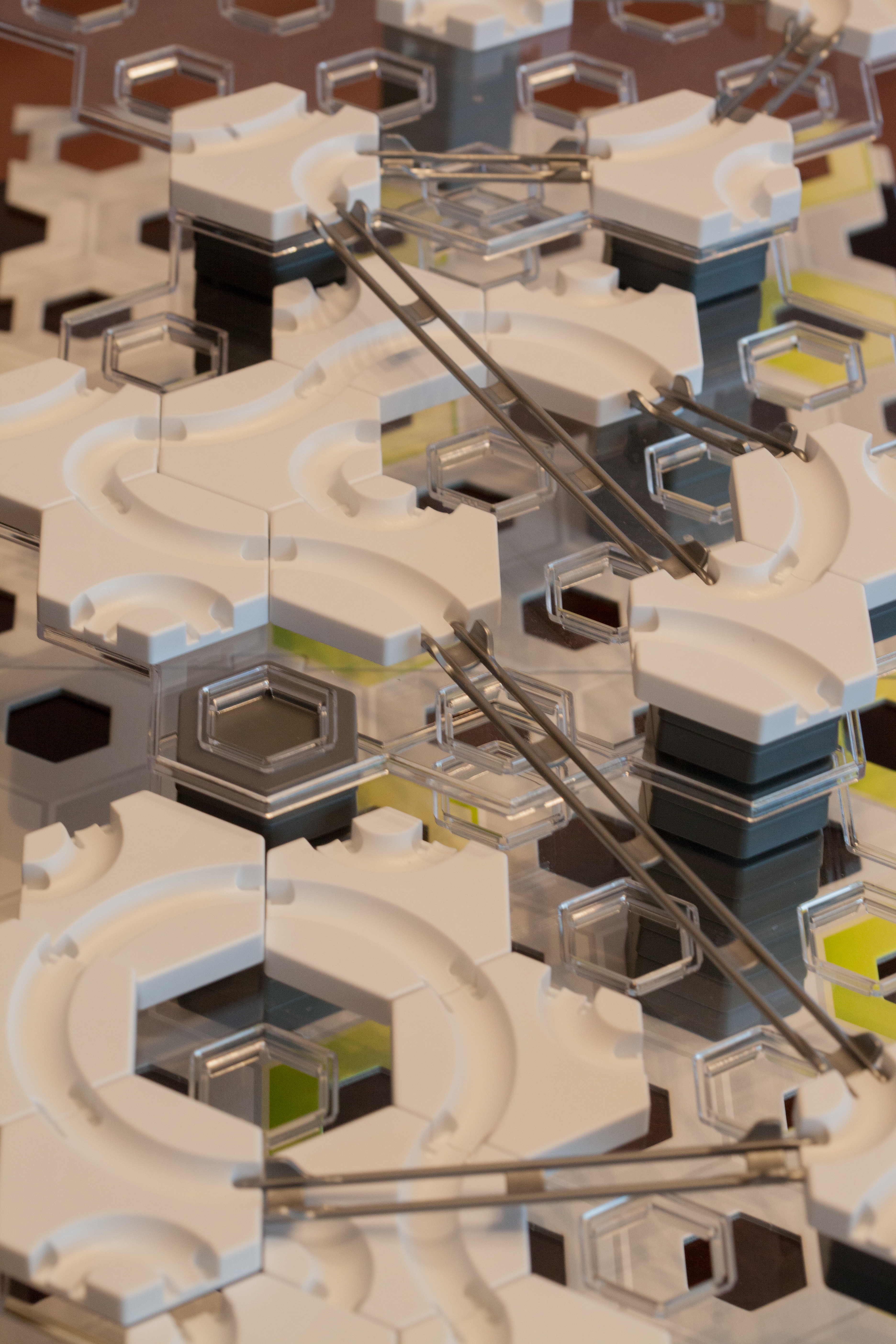
| Ravensburger GraviTrax Starter | 8+ | ~$50 | Guided puzzles + free build | 122 pc | Yes | Gravity, kinetics, magnetism along a marble track |
| Spintronics Act One | 8-adult | ~$80 | Guided (67 puzzles) | ~300 chain links + components | Yes | Analog of electrical circuits: voltage, current, resistance |
| Marble Genius Marble Rails Super | 8+ | ~$45 | Open-ended (free build) | 325 pc (incl. 45 marbles) | Yes (app optional) | Slopes, speed, marble momentum at high piece count |
A few things jump out from the specs alone. The Klutz LEGO kit delivers a how-to book plus the pieces for 10 combinable machines for ~$30, with strong learning-per-dollar because the reasoning is written down, not just the steps. KEVA and Marble Genius win on part count and open-ended runtime, with 178 KEVA planks in a 191-piece set and 325 Marble Genius pieces including 45 marbles. Spintronics costs the most: it teaches the hardest idea, a hands-on model of electrical circuits, and sells direct rather than through Amazon. On learning-per-dollar for a first kit, the book-led Klutz set is hard to beat.
Open-ended free-build or guided puzzles — which suits your kid?
This is the real fork in the road, more than price.
Open-ended (KEVA, Marble Genius). Dump the 178 KEVA planks plus reaction balls, a bell, a bowling pin, and a toy car, or 325 Marble Genius rail pieces, on the floor and invent. There is no "correct" machine. That rewards imagination but offers no built-in "you solved it" payoff. Best for builders who get bored following instructions.
Guided puzzles (GraviTrax, Spintronics). GraviTrax ships challenge cards and track designs that set a start and end point to bridge; Spintronics Act One has 67 puzzles from beginner to intermediate. Each has a right answer. That gives structure and a hit of reward on success, but can feel like homework to a free spirit.
Klutz LEGO sits in the middle: it teaches 10 specific machines (guided), then invites a child to recombine them into a longer chain (open-ended). For a first kit, that scaffold-then-free arc is why it leads the TL;DR.
What happens when the chain reaction won't trigger?
Every Rube Goldberg machine eventually stalls: a marble stops in a gap, a domino misses, a lever doesn't quite tip the next piece. The difference is whether the failure teaches anything. This is the pedagogical heart of the whole category, and it follows directly from how each kit surfaces an error.
With KEVA and Marble Genius, the failure is gloriously visible. The structure is right there: when a marble stalls at exactly the slope that was too shallow, a builder can raise it and watch it run. The mistake is the physics lesson — momentum and gravity made tangible. GraviTrax is similar but more precise: because its track pieces seat into sockets, a stall usually means a piece didn't click in, so a child learns to debug connections, not just slopes. Klutz LEGO teaches debugging through its book: when a machine won't pass the baton, you re-read why that lever should move and adjust. Spintronics is the most abstract failure: a puzzle that won't "complete the circuit" mirrors a real short or open circuit, harder to see but deeper once understood, since the maker frames the spinning chains as a tangible model of voltage and current. If your kid gets frustrated easily, the visible-error kits (KEVA, Marble Genius, GraviTrax) are the safer bet.
How safe are these for an 8-14 year old (and a younger sibling in the house)?
Two safety facts matter here, both well-documented.
Small parts, marbles, and choking. Every kit here contains marbles or small balls, and Ravensburger ships GraviTrax with a choking-hazard warning on its small parts. Under CPSC's small-parts rule, 16 CFR Part 1501, a part is "small" if it fits a test cylinder 2.25 in long by 1.25 in wide (16 CFR § 1501.4). Marbles clear that easily, so the marbles and balls in all five kits are choking hazards for any child under 3 in the home. Kits labeled 7-8+ are not required to pass the under-3 test. With a toddler sibling, treat the box warning as binding and do a marble headcount before pack-up.
Materials and edges. KEVA is solid maple planks (splinter risk is low but real on rough handling); GraviTrax and Marble Genius are rigid plastic. None of the five use batteries or button cells in the base kit, which removes the highest-risk ingestion hazard. The current CPSC toy-safety guidance still calls for any battery compartment in an accessory to be secured against small children, so check any add-on you buy later.
Screen time. All five are screen-free to build and play. Marble Genius offers an optional companion app for instructions and challenges but does not require it. For the rare screen-adjacent moment, the AAP no longer sets a fixed daily minute limit for ages 6+ and instead recommends consistent limits via a Family Media Plan (relevant only if you let the kid watch inspiration videos).
Is Spintronics worth double the price of a marble run?
Spintronics is the outlier. It costs the most (~$80) and is sold direct by Upper Story, not on Amazon. What you pay for is a genuinely novel idea: it is, per the maker, a way to discover electronics in a tangible, deeply intuitive way, where spinning chains transmit force the way wires transmit electricity, so a builder can feel voltage as tension and see current as flow. The Act One set includes 67 puzzles from beginner to intermediate, from the makers of Turing Tumble.
Where it fits: a child 10+ who has outgrown marble runs and is heading toward real electronics or coding. For a younger 8, the abstraction (current as spin, resistance as friction) may land before the electrical concept does, teaching a model they will connect to real circuits years later. The trade-off is price and the no-Amazon purchase path; link it through the Upper Story store, not an Amazon affiliate tag.
Honest cons — what each pick gets wrong
- Klutz LEGO Chain Reactions: the in-box LEGO count (~33) is modest, so the longest chains really need a LEGO bin you already own; the paper ramps and funnels are the wear-out parts. The book-led format also assumes a child who will read and follow it.
- KEVA Contraptions Reactions: pure open-ended means zero instructions beyond a thin idea booklet. A kid who needs a goal can stall, and because planks just stack, a single missing plank in a pile is invisible.
- Ravensburger GraviTrax Starter: track pieces must seat precisely in sockets, which frustrates antsy younger builders; the 122-piece starter set is small enough that kids quickly want pricey expansions.
- Spintronics Act One: priciest, no Amazon listing (direct from Upper Story only), and the electrical analogy is abstract for a young 8; later acts are separate purchases, so budget for that if your kid is hooked.
- Marble Genius Marble Rails Super Set: high piece count but lower build precision than GraviTrax, so connections can pop loose. Note the 8+ "Marble Rails" Super Set is a different, more advanced product than the simpler 4-8 "Marble Run" starter: match the ASIN to the age before you buy.
For cross-checking these picks against adjacent categories, see our best STEM toys for 6 to 8 year olds guide for the younger end of this band, and our Eitech vs Meccano classic construction kits comparison for kids who prefer bolting metal over chaining marbles.
So which chain-reaction kit should you actually buy?
For most families with one kid aged 8-14 buying their first chain-reaction kit: start with Klutz LEGO Chain Reactions. It is the cheapest real entry, the book makes the engineering thinking explicit instead of implicit, and it scaffolds from guided machines to open-ended remixing, making it the lowest-regret introduction to the category.
Then branch by temperament. For inventing with no rules: KEVA Contraptions Reactions (or Marble Genius Marble Rails Super Set on a tighter budget). For solving puzzles with right answers: GraviTrax Starter Set for gravity and magnetism. And for a 10+ builder ready for the hardest, most abstract idea (a tangible model of electrical circuits): Spintronics Act One, eyes open about price and the direct-purchase path.