stem-kits · ages 8-12
Snap Circuits Jr. vs Pro: Which Electronics Kit Should You Buy First?
Jr. is $52.99 and Pro is $148.49, but the real difference is six specific parts. A sourced guide to which Snap Circuits kit to buy first, and which to skip.
Published 2026-09-11 · 9 min read
Amazon Associates disclosure
As an Amazon Associate, I earn from qualifying purchases. The price you pay is the same. This guide is based on manufacturer specifications, published independent reviews, and verified-buyer feedback, not hands-on testing.

TL;DR
- Buy Jr. SC-100 first ($52.99 direct) for a first-time 8-to-10-year-old. It is the cheapest real entry point into the system and it is completely screen-free.
- Pro SC-500 ($148.49 direct, $99.99 on Amazon when we checked) is a step-up kit, not a starter. Buy it for the voice recorder, FM radio and 7-segment display specifically, after Jr. or Classic.
- Classic SC-300 is the honest middle: a strict superset of Jr.'s projects at roughly triple the count.
- Skip Jr. Select SC-130 if your goal is to build up from Jr. It costs the same $52.99 and is a sideways set, not a bigger one.
How we evaluated: this comparison is built from Elenco's own product and spec pages, Purdue University's INSPIRE pre-college engineering gift-guide reviews, U.S. CPSC small-parts rules, and the published findings of two independent reviewers who state they built through the kits themselves. It is not a personal hands-on test of any kit, and where a hands-on finding appears below it is attributed to whoever actually did the building. All prices were checked on 2026-09-11 and toy prices move.
What are the five Snap Circuits kits, side by side?
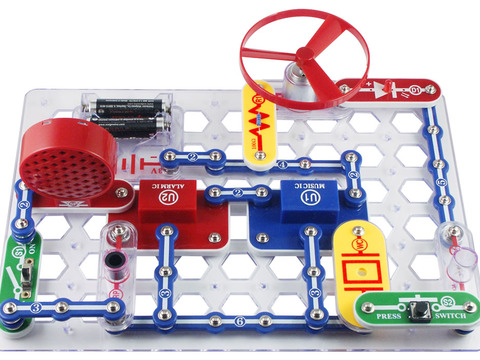
Elenco sells Snap Circuits as a ladder, and the rungs are much closer together than the price list suggests. Every figure below comes from Elenco's own shop pages, checked on 2026-09-11.
| Kit | SKU | Parts | Projects | Age label | Batteries | Elenco direct | Cheapest we found |
|---|---|---|---|---|---|---|---|
| Beginner | SCB-20 | 14 | 20+ | 5-8 | 3 AA | $35.49 | $29.95 |
| Jr. | SC-100 | 30 | 100+ | 8+ | 2 AA | $52.99 | $52.95 |
| Jr. Select | SC-130 | 30 | 133 | 8+ | 2 AA | $52.99 | $45.80 |
| Classic | SC-300 | 60+ | 300+ | 8+ | 4 AA | $98.99 | $79.95 |
| Pro | SC-500 | 75+ | 500+ | 8+ | 4 AA | $148.49 | $99.99 |
Two things in that table do most of the work in this decision.
First, four of the five kits carry the identical 8+ age label. Only Beginner is pitched lower, at 5-8. So age cannot be how you choose between Jr., Select, Classic and Pro — something the packaging does not make obvious.
Second, Jr. and Jr. Select are the same price. That is not a rounding artifact; Elenco lists both at $52.99. It matters because their names strongly imply one is the upgrade, and it is not.
One rung above Pro, Elenco also sells Snap Circuits Extreme SC-750 (80-plus parts, 750-plus projects) at $219.99. It is outside the question this post answers, but worth knowing the ladder does not stop at Pro.
What does Pro actually add that Jr. doesn't have?
This is the real question, and "400 more projects" is not the answer. A project count is a manual-writing decision. Components are what set a ceiling on what can be built at all.
Jr. SC-100 contains a battery holder, a switch, a slide switch, a speaker, a motor with a fan blade, a lamp, resistors, a capacitor, an LED and jumper wires. That is a genuinely good starter set, and it is also the whole set: every one of the 100-plus builds is a variation on switch, then component, then indicator.
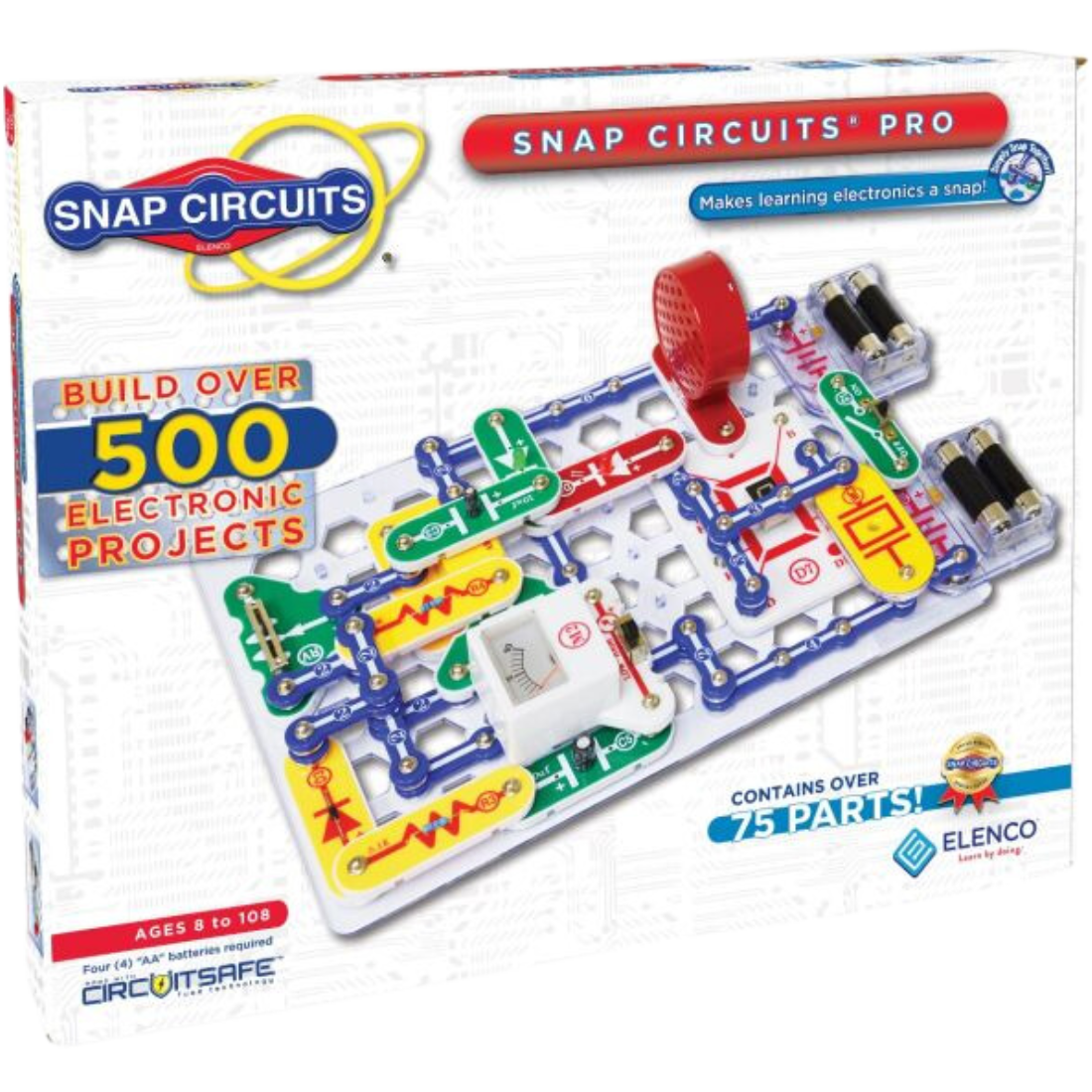
Pro SC-500 adds six components Jr. has no version of. From Elenco's own spec copy for the kit: a voice-recording IC, an FM radio module, an analog meter, a transformer, a relay and a 7-segment LED display — on top of everything Classic contains.
Those six parts are the purchase decision. They are what lets a kid record and play back their own voice, tune in an actual radio station, and watch a number appear on a display rather than a lamp simply turning on. If none of them is the reason you are reaching for Pro, you are paying $95 over Jr. for manual pages.
One caveat we could not resolve, and which is worth checking on the specific listing before you buy. Elenco's current Pro page advertises "73 computer interfaced experiments" as a bare feature bullet. But Elenco's own 2019 and 2020 accessory documents price a CI-73 Computer Interface as a separate $19.95 accessory and list a distinct bundle SKU, SC-500S, described as "SC-500 plus CI-73" — which implies the interface historically did not ship inside a plain SC-500 box. We could not confirm whether current production changed that. If those computer-interfaced projects are why you want Pro, check the box contents on the listing you are actually buying, because they may need hardware sold separately.
Which kit should you buy first?
For a kid who has never built a circuit: Snap Circuits Jr. SC-100.
The reasoning is about risk, not enthusiasm. You do not yet know whether electronics will hold this particular kid's attention, and Jr. is the cheapest honest way to find out inside the system you would grow into. Because Classic and Pro both build on the same snap-block platform, nothing is wasted if it does stick.
Durability is the part that would justify spending more, and the independent evidence points the other way. ScienceBasedKids, who state they ran Jr. with children aged 8-11 for three months, report that "snap connectors are firm and satisfying" and that across that period "no components broke, no connections degraded." They describe the difficulty curve as well designed, with most 8-year-olds finishing the first 30 projects without help. Whatever else Jr. is, it is not the flimsy version.
The sequencing argument against starting at Pro comes from the people who built Pro. Kivios, reviewing SC-500 hands-on, write that "the Pro lands best after a child has already worked through the Jr. SC-100 or the Classic SC-300," and that "jumping straight into the Pro's advanced sections as a first kit is a lot, and a younger child can stall on the busier builds." Two separate reviewers, working on two different kits, arrive at the same advice.
If your child is younger than the 8+ floor, the kit designed for that is Beginner SCB-20 (14 parts, 20-plus projects, labeled 5-8, $35.49 direct). Do not buy it as a cheaper Jr. for an eight-year-old — its 20-project ceiling gets passed almost immediately. Elenco's own age bands overlap by exactly one year, and at age 8 the answer is Jr.
For the wider question of how Snap Circuits compares to other systems at this price, we put Jr. up against a very different kit in Snap Circuits vs littleBits, and gathered the cheaper end of the category in the best circuit kits under $50.
Is Classic the smarter middle buy?
Often, yes — and it is the rung most buyers step over on their way from Jr. to Pro.
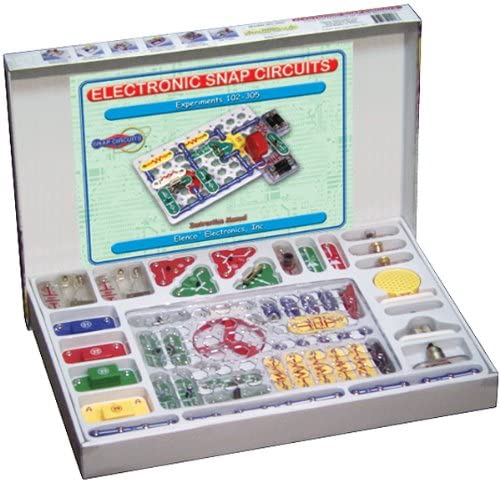
Classic SC-300 is 60-plus parts and 300-plus projects for $98.99 direct, and it is a strict superset of Jr.: every Jr. project is in there, plus roughly 200 more. It is also the first rung to add a microphone and AM-radio-class builds, which is the point where the kit starts to feel less like switches and lamps.
It carries the strongest independent credential of anything in the line. Purdue University's INSPIRE Research Institute for Pre-College Engineering reviewed this exact kit for its engineering gift guide. Their reviewer, D. C. Coble, wrote that it "offers endless fun" and is "a great introduction to electronics and other science-related concepts in a manner that's easy to understand," noting that "children will use many design and problem-solving skills to build circuits from the booklet and their imagination." Purdue tags the kit for design process, engineering thinking, and engineering tools. That is a university outreach programme, not an affiliate roundup.
Classic also has the clearest real discount of any kit here: we found it at $79.95 from an independent Elenco stockist against Elenco's own $98.99. That is about 19% under list, and it looks like genuine discounting rather than a manufactured markdown — two independent retailers landed within five cents of Elenco's own price on every SKU we checked, which is what a real list price looks like.
The case for Classic over Pro is simply that it delivers the "three times more to do" jump most families actually want, for $50 less, without betting on whether the voice recorder and FM module get used.
Why is Jr. Select the one to skip?
Because its name promises an upgrade it does not deliver.
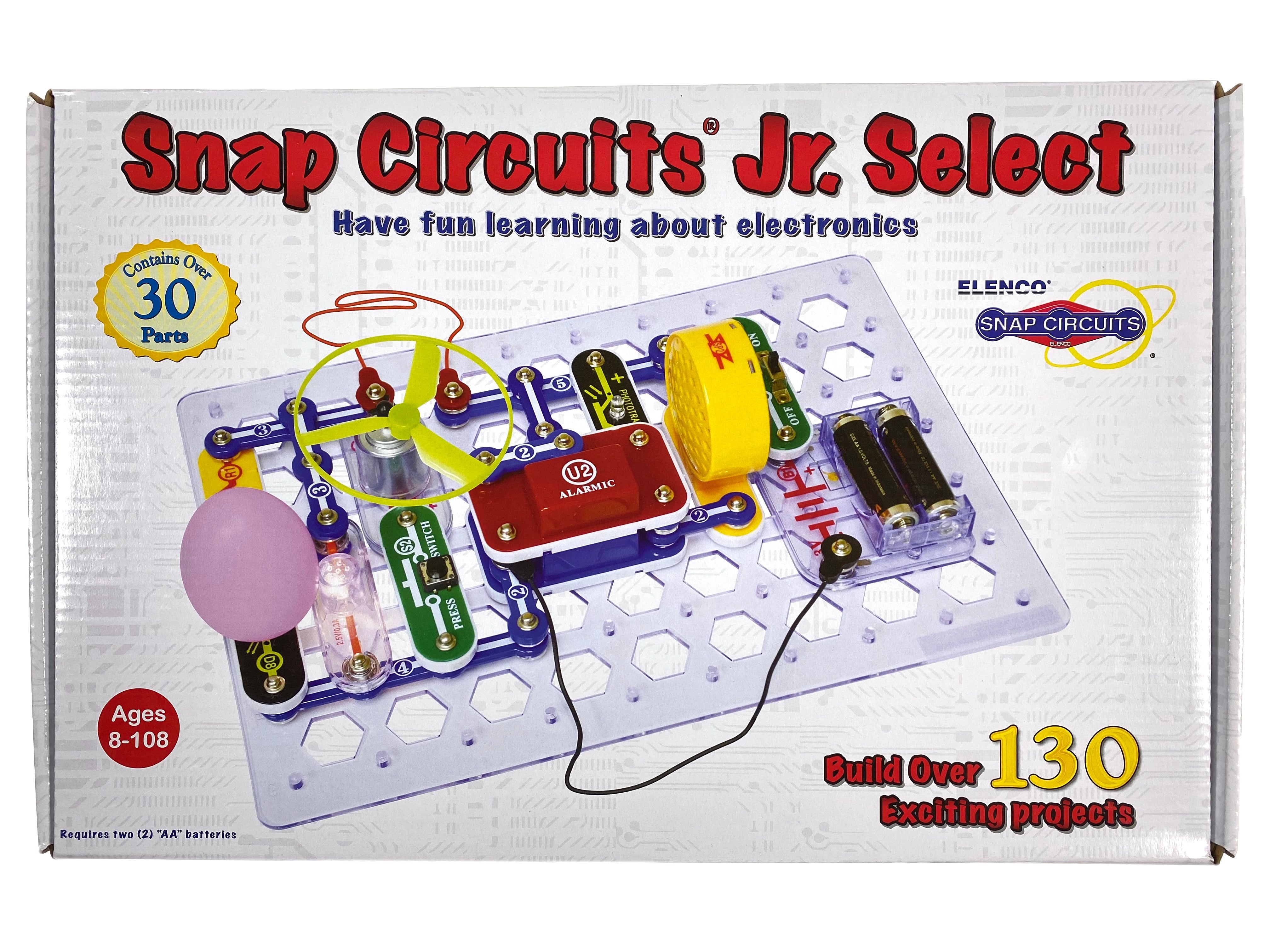
Jr. Select SC-130 is 30 parts, 133 projects, 2 AA, labeled 8+ — the same tier as Jr. on every structural measure, at the same $52.99 on Elenco's shop. What differs is the manual. Select's projects use a glow-in-the-dark flying propeller and a phototransistor, which Jr. does not have; Jr.'s motor-and-fan, speaker and lamp builds are not reproduced in Select. Elenco's own copy describes it as "fully compatible with all Snap Circuits sets," which is the giveaway: it is designed to sit beside another kit, not above it.
So if you already own Jr. and want more of the same but bigger, Select is the wrong purchase and Classic is the right one. Select earns its place in exactly one situation — as a second kit bought as a gift that will not duplicate what is already on the shelf.
Worth noting it is also the one kit here with a review figure we could verify cleanly: 4.6 out of 5 from 303 ratings on its Amazon listing. We are not quoting star ratings for the other three kits, and the reason is in the honesty section below.
What age is each kit really for?
The labels say 8+ for Jr., Select, Classic and Pro, and 5-8 for Beginner. The reviewers who used them say something more specific.
ScienceBasedKids put Jr.'s real sweet spot at 8 to 10, and flag the manual as reading at roughly a grade 3-4 level, using words like "resistance" and "capacitance" without always defining them. Their conclusion is that "an adult or older sibling who can translate technical terms into plain language significantly improves the experience for 8-year-olds." They also note the explanations get thinner as the projects get harder, past roughly project 50.
The friction is reading and conceptual scaffolding, not hand strength. ScienceBasedKids describe the connectors as deliberately tuned to need "enough resistance to stay put, but not so much that small fingers struggle," and neither review we read reports a fine-motor barrier at 8+.
At the top of the range, Kivios reach the same place from the other direction: "the harder question is sequence, not age." Which is the single most useful sentence for anyone choosing between these boxes.
Above about 10, a kid with real electronics interest will move through Jr. quickly — ScienceBasedKids say as much. For that reader, Classic or Pro is the right entry, and past the Snap Circuits system entirely there are electronics starter kits aimed at high schoolers.
How safe are these kits, and what is in the small print?
All four of the 8+ kits carry the same warning, verbatim from Elenco's listings: "WARNING CHOKING HAZARD — Small parts. Toy contains a cord. Not for Children under 3 yrs." Beginner's warning is the same minus the cord line. That is the U.S. small-parts regime for toys (16 CFR Part 1501) doing its job, and it is the reason a curious toddler sibling is a real consideration with a 75-part kit on a low table.
A targeted search of the CPSC's database turned up no recall for Snap Circuits or Elenco as of 2026-09-11. That is a negative result rather than a certificate — it means we found nothing, not that nothing exists.
On standards, ScienceBasedKids state that Jr. "meets ASTM F963 and CPSIA safety standards." We are attributing that rather than asserting it: those are the baseline statute and standard every toy sold in the U.S. must meet, and we could not find an Elenco-published certificate to corroborate the specific claim.
Two purchasing traps that are not safety issues but will cost you money. SC-110 appears in older lists as a Jr. variant; Elenco's own product summary marks it "ONLY AVAILABLE IN THE UK." Likewise SC-510 "Pro Plus" (510 projects, revised manual) sells on Amazon UK and Germany but not in the U.S. If you are buying in the U.S., the SKUs are SC-100 and SC-500.
Honest cons — what each kit gets wrong
Jr.'s weak point is the battery holder. ScienceBasedKids, after three months: "spring contacts for AA batteries can weaken over extended use, creating intermittent connections that mimic circuit errors." That failure mode is nastier than it sounds, because a kid debugging a correct circuit learns the wrong lesson.
Pro's weak point is the manual's silence about why. Kivios put it bluntly, agreeing with an earlier write-up: "great concept, terrible execution: a child can finish a working circuit without ever learning why it works." They also flag the reading-heavy manuals as a hurdle for younger or struggling readers, and note that "loose small parts and a large, heavy base beg for a parts organizer." None of that makes Pro a bad kit — Kivios' own highlights were the voice recorder, which their kids "ran over and over," and an FM radio that took about 45 minutes to build and "actually pulled in local stations." It makes Pro a bad unattended kit.
The line-wide con is that nothing includes batteries. Budget 2 AA for Jr. or Select and 4 AA for Classic or Pro, on the day you buy.
And a transparency note on the numbers we are not giving you. We could not confirm Amazon's live price for Jr. or Classic, and we are not quoting Amazon review counts for Jr., Classic or Pro, because the same figure appeared on all three of those listings when we fetched them. Three different products cannot share one review count, so we treated it as a rendering artifact and dropped it rather than publish a number that looks authoritative and is not. The Select figure above survived because it came back distinct. There is also a minor unresolved discrepancy on Jr.: Amazon's listing title says 28 snap-together parts where Elenco's own spec field says 30. We are noting it rather than quietly picking one.
So which Snap Circuits kit should you actually buy?
Our pick: Snap Circuits Jr. SC-100, $52.99. It is the kit to buy first for any child who has not built a circuit before, and the verdict rests on two independent findings rather than on price alone: three months of testing by ScienceBasedKids with no part failures, and two separate reviewers concluding that Pro belongs after Jr. or Classic rather than instead of them. Buy Classic SC-300 instead only if Jr. is already finished, and Pro SC-500 only if the voice recorder, FM radio or 7-segment display is the specific reason.
- First kit, 8-10, never built a circuit: Jr. SC-100, $52.99 direct. Cheapest honest test of whether this sticks, and nothing is wasted if it does.
- Already finished Jr., wants much more: Classic SC-300, $98.99 direct and findable near $80. A true superset, and the one kit here a university programme reviewed.
- Specifically wants the radio, the voice recorder or the display: Pro SC-500, $148.49 direct and $99.99 on Amazon when we looked. Check whether the CI-73 interface is in the box if the computer projects matter.
- Second kit as a non-duplicating gift: Jr. Select SC-130. Not an upgrade from Jr. — a sideways set.
- Genuinely younger than 8: Beginner SCB-20, $35.49 direct. Not a budget Jr.
The decision compresses to one line: the kits are separated by sequence and by six components, not by age or by project count. If your kid has never built a circuit, that sequence starts at Jr., whatever the box art on the bigger boxes suggests.
One last route worth knowing before you buy twice. Elenco sells upgrade kits that convert a kit you already own — UC-30 takes SC-100 to SC-300, UC-40 takes SC-100 to SC-500, and UC-50 takes SC-300 to SC-500. The order form we found listing them is dated 2019, so treat its prices as historical and check current cost before assuming an upgrade beats a fresh box.
▶ Elenco's own overview of the Snap Circuits line