stem-kits
ThinkFun Gravity Maze vs GraviTrax for a 7-Year-Old
Gravity Maze suits focused solo puzzles; GraviTrax favors open-ended building. Here is how to choose for a 7-year-old.
Publié le 2026-09-13 · 5 min de lecture
Traduction non disponible pour l'instant — affichage de l'article original en anglais.
Amazon Associates disclosure
As an Amazon Associate, I earn from qualifying purchases. The price you pay is the same. This guide is based on manufacturer specifications, published independent reviews, and verified-buyer feedback, not hands-on testing.
As an Amazon Associate, I earn from qualifying purchases. The price you pay is the same. This guide is based on manufacturer specifications, published independent reviews, and verified-buyer feedback, not hands-on testing.
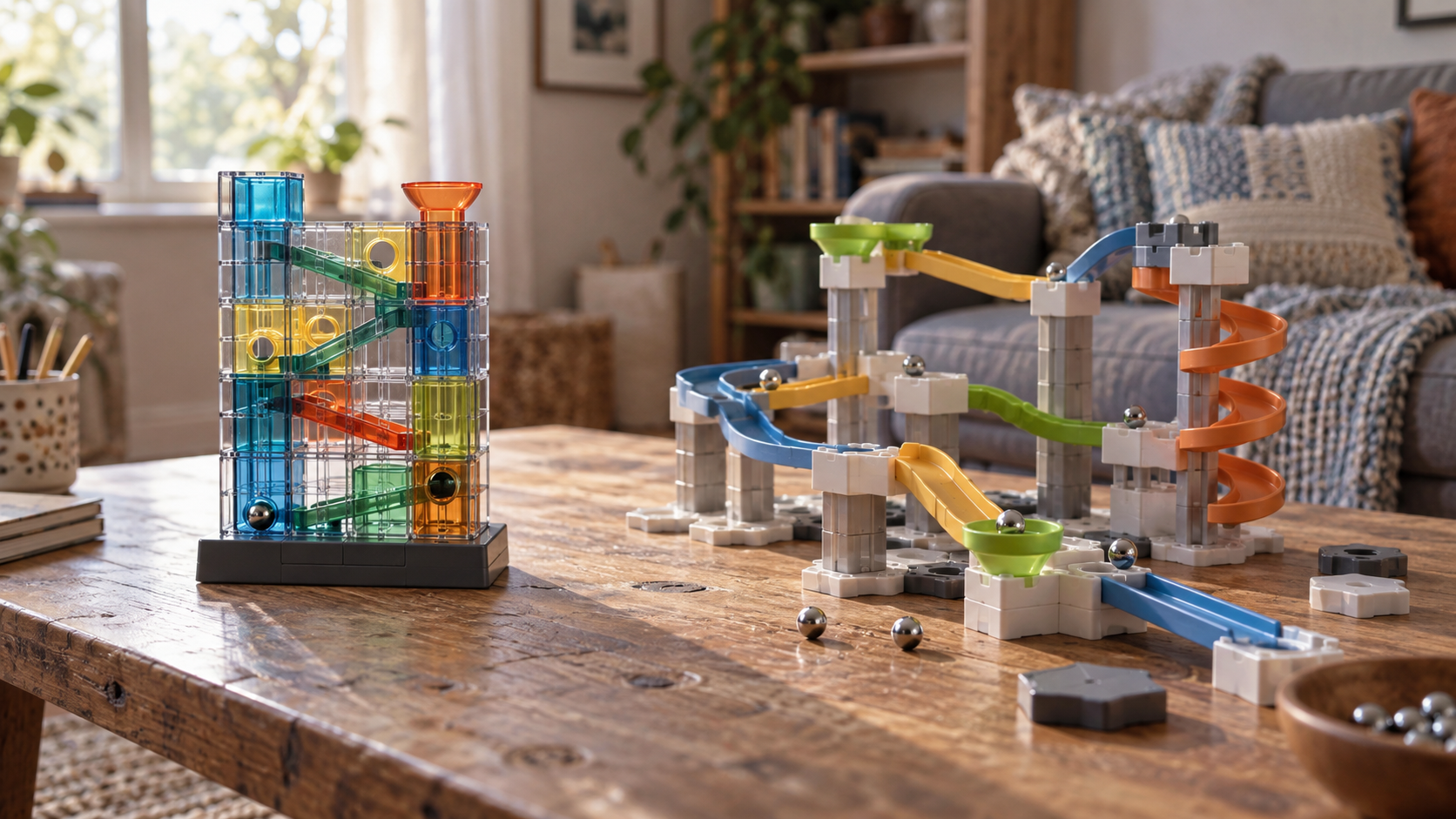
For most 7-year-olds who enjoy solving a defined challenge, I would choose ThinkFun Gravity Maze. Choose the Ravensburger GraviTrax Starter Set instead for a child who would rather build, adjust, and rebuild an open-ended marble course. The deciding factor is not which set looks more impressive; it is whether the child prefers puzzles with a goal or construction with room to experiment.
| Product | Best for | Trade-off |
|---|---|---|
| ThinkFun Gravity Maze | A child who likes defined logic challenges and focused solo play | Less freedom for sprawling, self-directed construction |
| Ravensburger GraviTrax Starter Set | A child who likes designing, rebuilding, and experimenting with marble paths | Can require more setup and self-direction before play feels rewarding |
The short answer for a 7-year-old
ThinkFun Gravity Maze is the safer pick when the child already enjoys mazes, visual puzzles, or activities with a clear right answer. Its core appeal is the satisfaction of working toward a solution. That structure can help a child begin independently because the play session starts with a specific problem rather than an empty building area.
GraviTrax is a better fit when the child routinely turns blocks, tracks, or household objects into elaborate constructions. It invites a different kind of reasoning: build a route, observe what happens, identify the weak point, and revise the design. The result is less about completing a prescribed puzzle and more about exploring cause and effect.
Neither style is automatically more educational. A toy earns its place by matching the way a particular child likes to think. A structured puzzle left untouched teaches less than an open-ended set that gets rebuilt regularly, and the reverse is equally true.
How the play styles differ
Gravity Maze starts with a problem
Gravity Maze is primarily a logic puzzle presented through a physical maze. The child is not simply watching a marble move; the movement provides feedback about whether the proposed solution works. That makes failure relatively easy to interpret: if the route does not work, the arrangement needs another look.
This format suits children who appreciate boundaries. A defined challenge reduces the pressure of deciding what to build from scratch, while the physical pieces make the reasoning more concrete than a puzzle printed only on paper. It is also easier to frame a short play session around one challenge and stop at a natural endpoint.
GraviTrax starts with possibilities
GraviTrax approaches marble play as a construction system. The child’s first question is more likely to be “What can I make?” than “What is the correct solution?” Experimentation becomes the activity: changing the route, testing an idea, and rebuilding sections that do not behave as expected.
That freedom can sustain interest for a builder, but it can also create friction for a child who needs a prompt. Some 7-year-olds immediately invent a layout; others stare at a collection of components and wait for an adult to establish the first goal. Consider how the child reacts to an empty box of construction pieces before assuming that greater flexibility is always better.
Which set is easier to use independently?
Gravity Maze has the advantage for independent play when a child can follow visual instructions and persist through a puzzle. The challenge itself provides direction, so a parent does not have to invent an activity every time the box opens. However, a difficult puzzle may still prompt requests for hints.
GraviTrax independence depends more heavily on the child’s building habits. A confident constructor may stay occupied by repeated revisions. A child who becomes frustrated when a large plan fails may need an adult to help break the build into smaller experiments.
I would not judge independence only by whether the child can assemble something without help. Cleanup, finding pieces, following the manufacturer’s directions, and accepting failed attempts all affect whether either set works as a genuinely independent activity.
Which works better for family or sibling play?
GraviTrax has the more natural group-play format. Children and adults can propose different sections of a course, predict what will happen, and revise the design together. The open layout creates several possible jobs, although disagreements over who controls the build can still occur.
Gravity Maze is more naturally centered on one solver. A second person can offer hints or discuss possible routes, but too much assistance can remove the satisfaction of reaching the answer. It works well for quiet parent-child problem solving when the adult asks questions instead of placing pieces.
For siblings, think about their preferred roles. If both want to manipulate the same puzzle, Gravity Maze may produce waiting. If they enjoy dividing a construction project, GraviTrax offers more room for collaboration.
What may frustrate a 7-year-old?
- Choose carefully for persistence: Gravity Maze can stall a child who treats an unsuccessful attempt as defeat rather than information.
- Watch for blank-page frustration: GraviTrax may feel directionless to a child who prefers explicit tasks.
- Plan for setup: Open-ended construction generally asks for more decisions before the satisfying marble run begins.
- Consider storage habits: Either set is less inviting when components are difficult to find or the play area must be cleared immediately.
- Check expectations: A child asking for a “marble run” may want free building, while a child asking for a “puzzle” may expect defined solutions.
Who should skip each set?
Skip Gravity Maze if the child strongly resists rule-based puzzles or mainly wants to invent large courses. A beautifully designed challenge set is still a poor match when the child views each card or prescribed goal as homework.
Skip GraviTrax if the child loses interest during setup, dislikes reconstructing failed designs, or needs every activity to provide a clear finish line. It may also be the wrong first choice when the available play space makes ongoing builds impractical.
If neither description feels right, a more traditional marble-run format may be easier to assess. The site’s marble run guide covers alternatives without limiting the decision to these two play styles.
Safety record and age check
I checked the CPSC recall data on September 13, 2026, across 1,483 recalls. No recall affecting ThinkFun Gravity Maze or the Ravensburger GraviTrax Starter Set appeared in the supplied results. For surrounding context, the database showed 57 recalls under “magnet” since 2023, 88 under “choking,” and 3 under “building block.”
A clean result in this search is useful context, not a substitute for current product instructions. Before buying, check the manufacturer’s age rating and follow its setup, play, storage, and supervision guidance.
Final verdict
Choose ThinkFun Gravity Maze for a 7-year-old who likes focused solo puzzles, visible goals, and the satisfaction of finding a correct route. Choose the Ravensburger GraviTrax Starter Set for a child who prefers building, testing, and redesigning an original course.
If you remain unsure, ask one practical question: does the child usually request a challenge to solve or materials to build with? Match the purchase to that answer, then confirm the current manufacturer age guidance before ordering.