stem-kits
What a Toymaker’s Summer Cottage Can Teach Us About Toy Testing
A Fisher-Price co-founder’s former cottage is for sale, offering parents a useful prompt: what makes a toy worth keeping?
Publié le 2026-08-27 · 5 min de lecture
Traduction non disponible pour l'instant — affichage de l'article original en anglais.
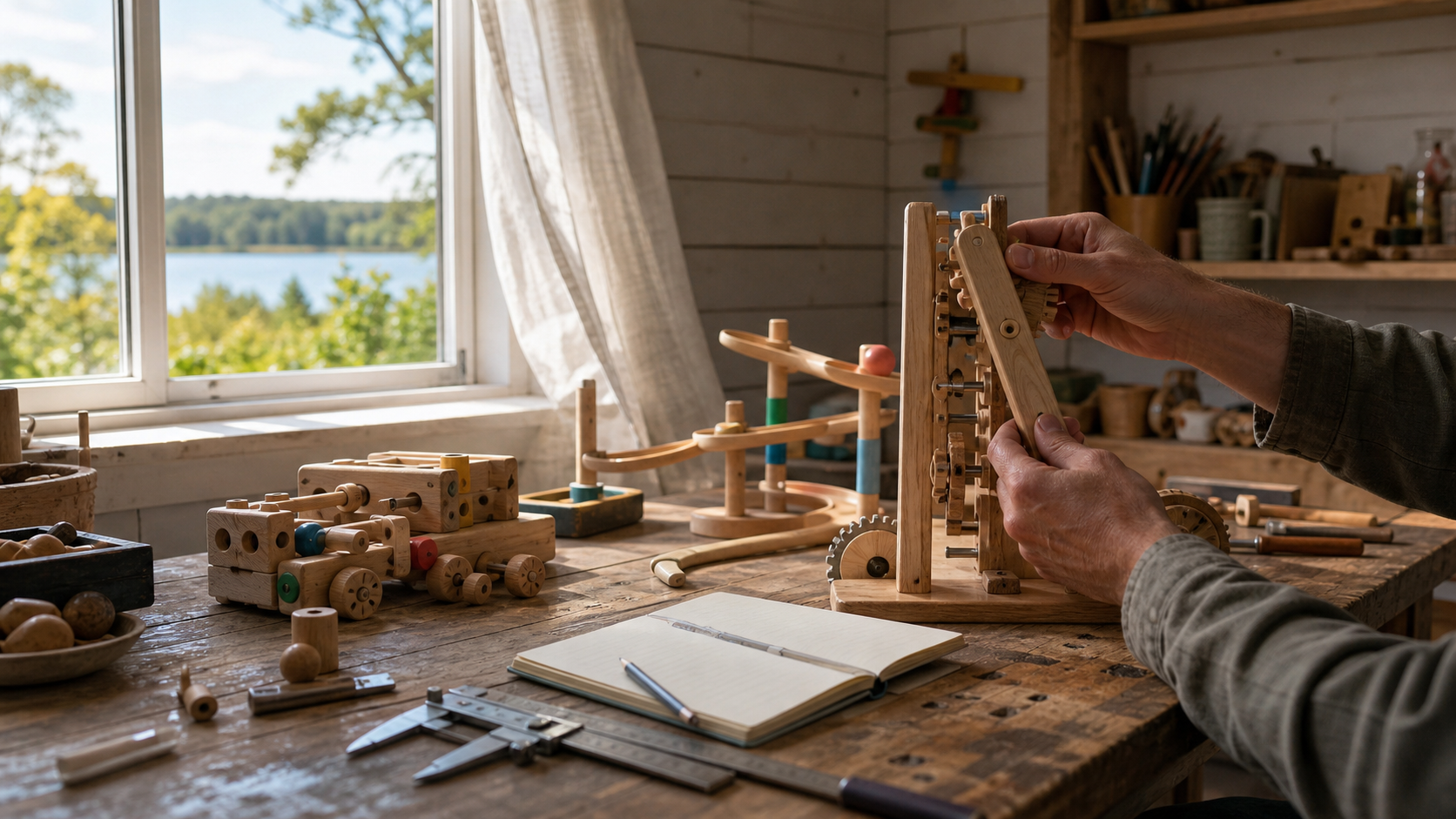
A lakefront summer cottage associated with a Fisher-Price co-founder has been listed for under $400,000. The property is notable because he reportedly used the cottage as a place to test new toys, as reported by Toy Industry News (Google News).
For parents, the useful part of this story is not the real estate listing. It is the reminder that a toy’s real value becomes clearer when someone watches how it fits into ordinary play. A product can look clever in its packaging and still be confusing, repetitive, or quickly forgotten once the initial excitement fades.
Most families cannot recreate a toy company’s development process, and they do not need to. A few practical questions can help parents evaluate a toy before buying it and decide whether an existing toy deserves more time, a different setup, or a place in the donation box.
Testing a toy starts with a specific question
“Is this a good toy?” is too broad to produce a useful answer. A better question connects the toy to the child and the setting. For example: Can a child begin playing without an adult explaining every step? Does the activity allow more than one outcome? Will the pieces be manageable in the space where the toy will actually live?
I use the same approach when comparing published specifications and owner feedback. The goal is not to declare that one type of toy works for every family. It is to identify the conditions under which it makes sense.
Before buying, choose the question that matters most in your household:
- Can the child use it independently after the first introduction?
- Does it suit quiet solo play, shared play, or both?
- How much adult setup is likely to be required?
- Will it still offer choices after the main activity is completed?
- Does the manufacturer’s age rating match the intended recipient?
- Is there a practical place to use and store it?
A toy does not need to succeed in every category. A detailed building kit may require adult help and still be a worthwhile weekend project. A simple outdoor toy may have a narrow purpose but get frequent use. The important thing is knowing which tradeoff you are accepting.
Watch the first ten minutes of play
The beginning of a play session reveals more than a list of marketing features. Notice what the child does before offering instructions. Do they understand where to start? Do they investigate the parts? Do they ask a focused question, or do they immediately leave?
This is not about judging a child’s ability or forcing engagement. It is about spotting friction. Sometimes the problem is the toy. Sometimes the child is tired, the environment is distracting, or the activity arrived at the wrong moment. One short session should not be treated as a final verdict.
If interest stalls, change one variable rather than delivering a long demonstration. Put out fewer pieces. Move the activity to a table. Read only the first instruction. For an open-ended set, suggest a small challenge instead of explaining what the finished creation should look like.
Separate assembly from repeat play
Many STEM kits and construction toys provide two different experiences: making the model and doing something with it afterward. Parents should consider both. A child may enjoy following a sequence but have little interest in the completed object. Another child may tolerate assembly because the finished model creates new opportunities for experimentation.
This distinction is particularly useful with solar robot kits. Sunlight conditions, assembly complexity, and the number of possible builds can affect whether a kit suits a particular child and home. Parents considering that category can start with this guide to solar robot kits for kids, which compares the practical buying considerations rather than assuming every kit fits every beginner.
Before purchasing any project kit, ask what happens after completion. Can the model be rebuilt? Can the child change part of the design? Is the finished result mainly for display? None of those outcomes is automatically bad, but they support different kinds of play.
Look for return play, not constant attention
A worthwhile toy does not have to hold a child’s attention for hours on the first day. In fact, initial session length can be a poor measure of long-term value. Return play is often more informative.
Over several ordinary opportunities, notice whether the child comes back without being prompted. If they return, see whether they repeat the same action or develop new ideas. Repetition can be satisfying and useful, while variation suggests that the toy has room to grow with the child.
Parents can use a simple three-part check:
- Did the child know how to begin?
- Did the toy support a choice or small discovery?
- Did the child return to it later?
A “no” does not always mean the purchase was a mistake. Some toys need better organization, fresh batteries, missing instructions, a suitable play surface, or an adult to introduce the core idea. But repeated lack of interest is useful information. It may be better to pass the toy along than to keep it because the box promised educational value.
Test the fit with family life
A toy can be engaging and still be a poor household fit. A sprawling construction set may be frustrating in a room that must be cleared every evening. A project requiring frequent adult assistance may not work during a busy school week. An outdoor activity may be used only occasionally because the necessary conditions are unpredictable.
This is why practical constraints belong in a buying decision. Think about setup, cleanup, storage, supervision, and the likely play location. Check the manufacturer’s age rating, especially when buying for a younger child or a household with children of different ages.
Price also deserves context. A budget toy used regularly can offer better value than a premium kit abandoned after one session. Conversely, a more expensive reusable set may make sense when it supports several kinds of play and can be shared. The number on the receipt matters, but it does not reveal how well the toy will fit a child’s interests or a family’s routine.
The practical lesson behind the cottage story
The image of a toy-company co-founder evaluating new ideas at a summer cottage is compelling because it places toy development in an everyday setting rather than a showroom. Parents can borrow that principle without pretending to run a formal product test: observe how a toy starts, what choices it offers, and whether the child voluntarily returns.
Before the next purchase, write down one question the toy must answer for your family. Then compare its published details and independent feedback against that question, rather than relying on the front of the box alone.