Codenames (2nd Edition) Buying Guide: Is This Refreshed Party Game Worth Your Shelf Space?
Everything you need to know before buying Codenames 2nd Edition: what changed, who it suits, and how it compares to the original and its spin-offs.
Publicado em 11 de out. de 2026 · 8 min de leitura
Este guia ainda não foi traduzido, por isso você está lendo a versão original em inglês.
As an Amazon Associate, I earn from qualifying purchases. Your price stays the same.
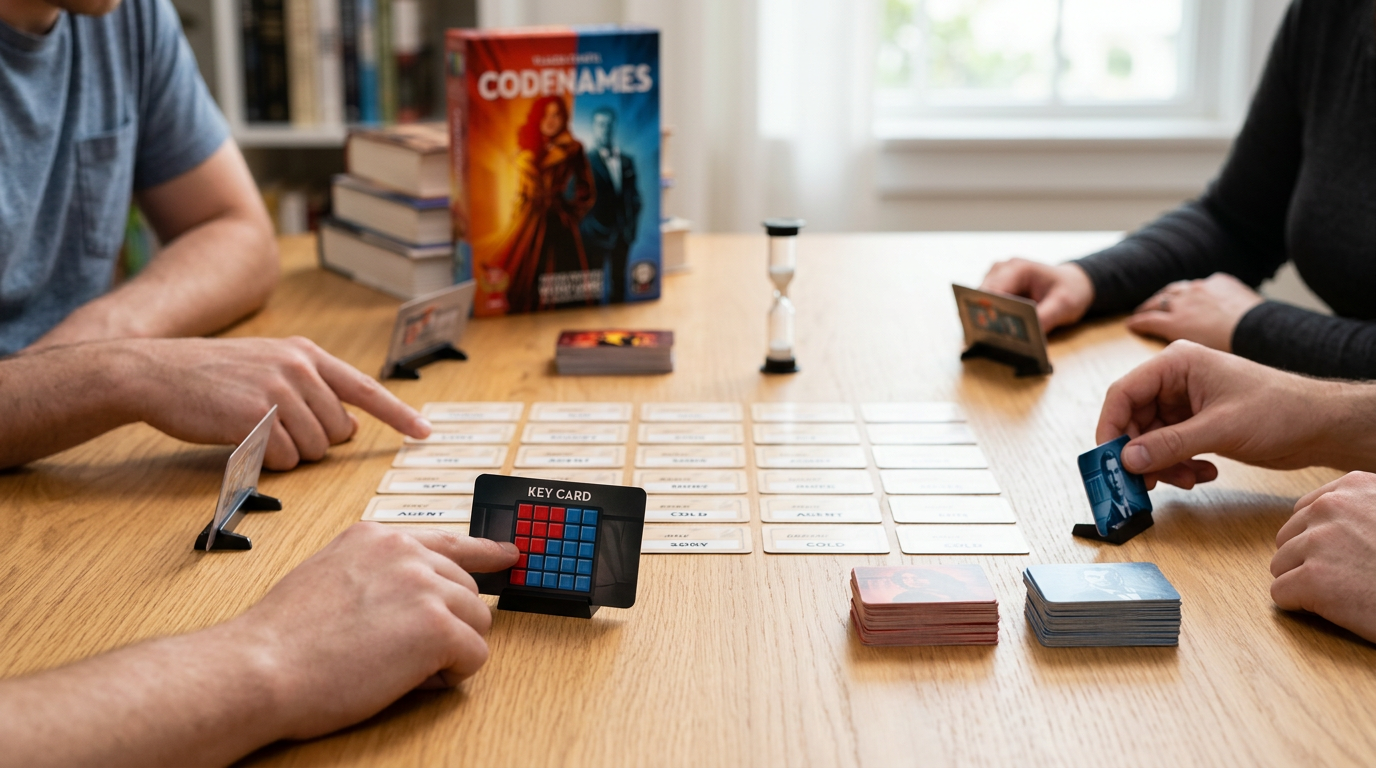
Codenames has been a party game staple since its 2015 debut, winning the Spiel des Jahres in 2016 and earning a 7.6 rating on BoardGameGeek from over 100,000 players. Czech Games Edition released a second edition in 2025 that refreshes the word list, art, insert, and rulebook without touching the core rules. If you are wondering whether the update justifies buying (or rebuying) the game, this guide walks through what changed, who it suits best, and what to check before you order.
Quick pick: Codenames (2nd Edition). Best for groups of four or more who want a fast, low-setup word game that works across ages. See it on Amazon (affiliate link).
What Is Codenames and How Does It Play?
Codenames is a team-based word association game designed by Vlaada Chvátil and published by Czech Games Edition. Two teams compete over a 5×5 grid of word cards laid out on the table. Each team has a spymaster who can see a secret map showing which words belong to their side. The spymasters take turns giving a single-word clue plus a number, trying to guide their teammates to tap the correct words while avoiding neutral bystanders and the one instant-loss assassin card (source: coopboardgames.com).
A round might play out like this: the spymaster says "Ocean, 3," hoping the team will connect "Fish," "Wave," and "Blue." If the team guesses a neutral word, their turn ends. If they guess the assassin, the game ends immediately. That tension between ambition and caution is what makes each round feel consequential without dragging on.
The game officially supports 2 to 8 players, though it works best with at least four so each team has a spymaster and at least one guesser. Rounds run about 15 minutes, making it easy to play multiple games in a single sitting (source: coopboardgames.com).
What Changed in the Second Edition?
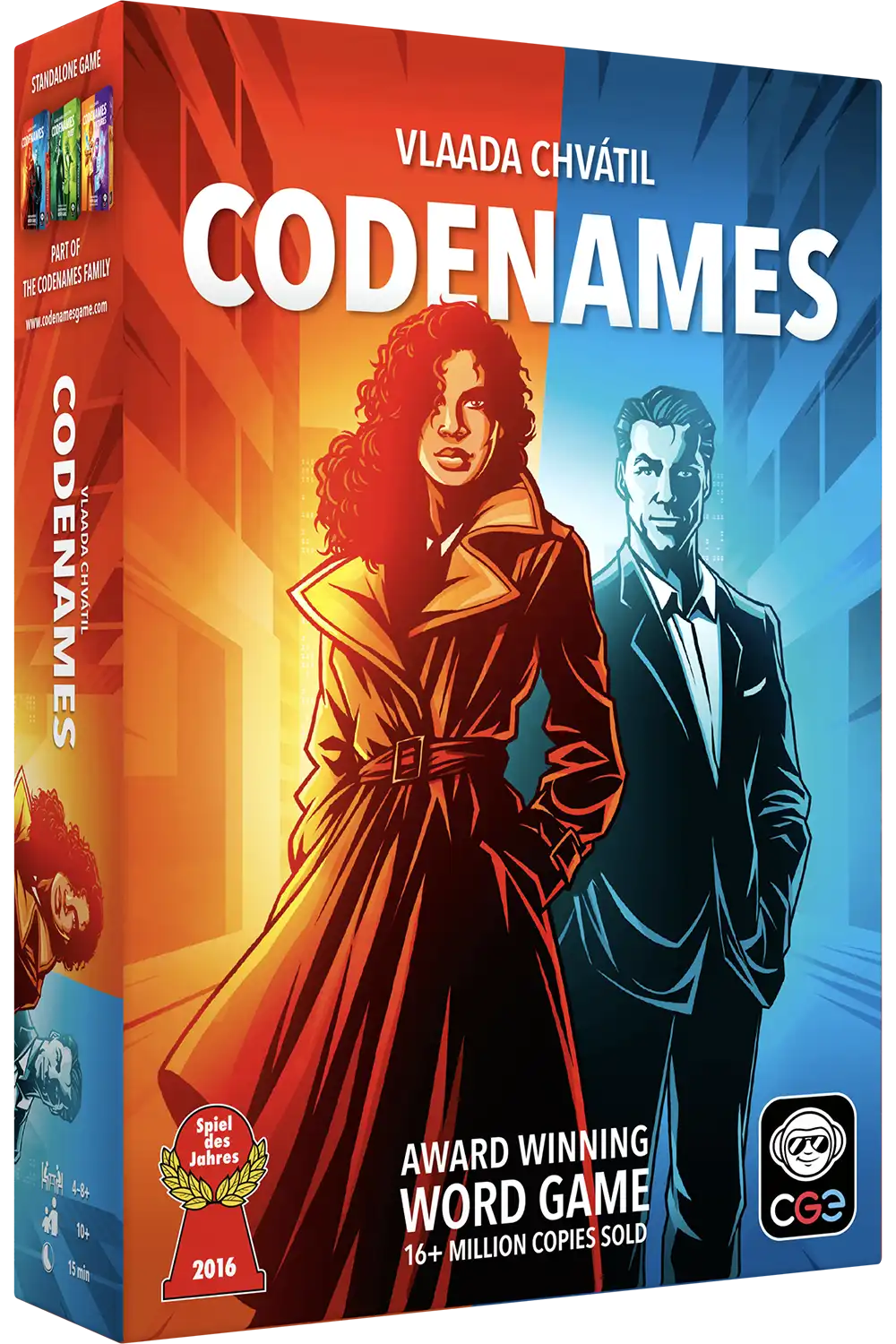
Czech Games Edition has been clear that the rules of Codenames remain the same in the second edition. If you already know how to play, you can sit down and start immediately. The updates focus on presentation and variety (source: luvemgames.com).
Revised Word List
The biggest change for returning players is a new set of word cards. The original shipped with 200 double-sided word cards, and a reviewer at Boards Eye View noted that CGE had never released standalone word packs before the second edition. The new word list aims to improve gameplay variety and reduce words that led to awkward or overly ambiguous clues (source: boardseyeview.net).
If you already own the first edition, the new word cards alone give you a reason to consider the upgrade, because fresh words change the puzzle more than any cosmetic tweak could.
Updated Art and Components
The second edition includes refreshed card art and a redesigned insert that keeps cards and components organized in the box. The rulebook has also been streamlined to make teaching the game faster, which matters if you plan to introduce Codenames to people who have never played a modern board game (source: BoardGameGeek version page).
What Did Not Change
The core mechanics, win conditions, and player counts are identical. The 5×5 grid, the spymaster role, the assassin penalty: all carry over. If you are buying Codenames for the first time, you are not missing anything from the original that the second edition dropped (source: luvemgames.com).
Who Is Codenames (2nd Edition) Best For?
Codenames fits a wide range of players, but certain groups will get the most out of it.
Families with kids aged 10 and up. The recommended age is 10+, and the rules are simple enough that a child can grasp the basics in a single round. The spymaster role does require more abstract thinking, so younger players may prefer being guessers at first (source: coopboardgames.com).
Mixed-age groups and party settings. Because the game relies on vocabulary and word associations rather than dexterity or trivia memorization, adults and teenagers can compete on roughly equal footing. A 15-minute round time means you can rotate players in and out without long waits.
Casual gamers who do not play many board games. Codenames has a fraction-of-a-minute teach time compared to strategy-heavy titles. The updated rulebook in the second edition makes this even smoother (source: BoardGameGeek version page).
Players who already own the first edition. The new word cards provide a meaningful refresh. If you have played hundreds of rounds and the original clues feel stale, the second edition solves that problem without requiring you to learn new rules.
Who Might Want Something Different?
Codenames is not the right fit for every situation. Here are cases where an alternative might serve you better.
Two-player households. The base game technically supports two players, but the experience works best with four or more. If you mostly play with one other person, Codenames Duet (a separate cooperative two-player version with its own word card set) was designed specifically for that scenario. The Puzzlewick guide to Codenames editions covers Duet alongside the base game in detail (source: puzzlewick.com).
Groups that prefer strategic depth over quick rounds. Codenames is a party game at its core. A detailed review at BoardGameGeek describes it as far removed from component-heavy designs but still engaging, with social interaction driving the experience (source: BoardGameGeek review thread). If your group gravitates toward longer, more mechanically complex games, Codenames may feel too light as a main event (though it still works well as an opener or closer for a game night).
Players sensitive to language barriers. Because the entire game revolves around English words and their associations, players who are not comfortable with English will struggle as spymasters. This is worth noting for multilingual households.
What to Verify Before Buying
Before you add Codenames (2nd Edition) to your cart, confirm these points.
Player count in your typical group. The game shines at four to eight players. If you regularly have three or fewer, make sure you are comfortable with the two- and three-player variants, or consider Codenames Duet instead.
Age of the youngest player. The 10+ age recommendation holds up for the spymaster role, but younger children can participate as guessers with some coaching. Decide whether that partial participation works for your family.
Language and vocabulary comfort. Every player needs a working vocabulary in the language of the word cards. Confirm you are ordering the English-language edition if that is what your group needs.
Edition you are receiving. The second edition is the current release. If you are buying from a third-party seller, verify that the listing specifies the second edition to avoid receiving old stock with the previous word list.
Codenames Editions at a Glance
The Codenames family has grown over the years. Here is how the main options compare based on what the search results confirm.
| Edition | Player Count | Core Mechanic | Best For | Word Cards |
|---|---|---|---|---|
| Codenames (2nd Edition) | 2–8 (best at 4+) | Team word association, competitive | Large groups, families, parties | New revised set (BoardGameGeek) |
| Codenames (1st Edition) | 2–8 (best at 4+) | Same rules as 2nd Edition | Players who want the original word set | 200 double-sided cards (boardseyeview.net) |
| Codenames Duet | 2 (cooperative) | Cooperative word association | Couples, two-player households | Separate word set (puzzlewick.com) |
| Codenames Pictures | 2–8+ | Picture-based clues instead of words | Families with younger kids, language learners | Image cards |
Note: Codenames Pictures is mentioned in the Puzzlewick edition guide but detailed specs were not available in the search results for this article. Confirm features before purchasing that version.
Trade-offs to Consider
Every game involves trade-offs. Here are the ones that matter most for Codenames (2nd Edition).
Replayability versus the original. The second edition's revised word list gives experienced players new puzzles. However, if you rarely play, the practical difference between the two editions is small. You are paying for an update that rewards frequent play.
Party game simplicity versus strategic depth. Codenames is easy to teach and fast to play, but it does not offer the kind of mechanical depth that Euro-style strategy games provide. For a game night focused on deep decision-making, this is a palate cleanser, not the main course. That said, Pixel Blockbuster describes it as "still the best party game" and notes its sustained popularity among over 100,000 BoardGameGeek voters (source: pixelblockbuster.com).
Team reliance. The spymaster role carries most of the cognitive load. A strong spymaster can make a round feel effortless; a struggling one can frustrate both teams. This is not a flaw so much as a design trait to understand before sitting down. Rotating the spymaster role across rounds helps keep everyone engaged.
Component quality versus price. The second edition introduces a better insert and refreshed art, but Codenames has always been a card-driven game with minimal components. You are not getting miniatures or a lavish board. The value comes from the gameplay, not the physical production, and the updated insert at least keeps things tidy between sessions (source: BoardGameGeek version page).
Practical Alternatives
If Codenames does not quite fit your group, here are other options worth researching.
Codenames Duet. For two players who want the cooperative experience. It uses its own word card set, so it complements rather than replaces the base game.
Just One. A cooperative party game where players write one-word clues simultaneously to help a guesser. It removes the competitive team structure and works well at three to seven players.
Wavelength. A party game about gauging where your team falls on a spectrum (for example, "hot" versus "cold"). It rewards discussion and is less vocabulary-dependent than Codenames.
Decrypto. A team-versus-team game with a code-breaking twist. It appeals to groups that want more strategic depth than Codenames offers but still enjoy the spymaster dynamic.
Each of these occupies a slightly different niche, so the right pick depends on your group's size, language comfort, and preference for competition versus cooperation.
Our Recommendation
Codenames (2nd Edition) earns its place on the shelf for anyone who regularly hosts groups of four or more people and wants a game that takes minutes to teach and keeps producing memorable moments round after round. The revised word list is a genuine upgrade for existing fans, and the streamlined rulebook lowers the barrier for first-time players. The 15-minute round time and broad age range (10+) make it one of the most accessible party games available.
If you are buying Codenames for the first time, the second edition is the version to get. There is no reason to seek out the original when the updated release is the current standard. If you already own the first edition and play frequently, the new word cards justify the purchase. If you play only occasionally, the original still works fine and you can save your budget for a different game.
For two-player households, look at Codenames Duet before committing to the base game. For groups that want more strategic weight, consider Decrypto as an alternative.
See Codenames (2nd Edition) on Amazon (affiliate link).
Sources
- Codenames (2nd edition) review, Boards Eye View
- Codenames English Second Edition, BoardGameGeek version page
- Codenames 2nd Edition overview, LuvEmGames
- Codenames detailed review, BoardGameGeek community thread
- Codenames board game review, Pixel Blockbuster
- Codenames review, Coop Board Games
- Codenames Complete Guide 2026, Puzzlewick
Procurando um presente? Comece por aqui
- Best LEGO Botanicals Sets for Adult Builders and Gift-Givers (2026)
- LEGO Botanicals Bonsai Tree vs LEGO Botanicals Orchid: Which Is Better for Adult Builders and Gift Buyers?
- Holiday Gift Guide 2026: The Best Toys by Age and Budget, From Preschool to Grown-Ups
- Gifts for Grown-Ups Who Still Love Toys: LEGO, Board Games and Puzzles (2026)
How we research: This guide is based on manufacturer specifications, published independent reviews, and verified-buyer feedback, not hands-on testing.
Guia de presentes de fim de ano toda sexta no Q4
Um e-mail por semana com a avaliação mais recente e os brinquedos que nossa comunidade está realmente comprando. Sem spam, cancele a inscrição quando quiser.