Screen-Free Gift Ideas That Actually Hold Kids’ Attention
Choose screen-free gifts with visible progress, repeatable challenges, and room to experiment. These practical ideas help avoid one-afternoon toys.
公開日:2026/08/23 · 6分で読めます
このガイドはまだ翻訳されていないため、英語の原文を表示しています。
As an Amazon Associate, I earn from qualifying purchases. Your price stays the same.
As an Amazon Associate, I earn from qualifying purchases. The price you pay is the same; the small commission helps fund hands-on testing of every product reviewed here.
The screen-free gifts most likely to hold attention are not necessarily the biggest or most complicated. I look for a clear first activity, visible progress, and more than one way to play. Building kits, open-ended construction sets, creative supplies, puzzles, and role-play materials tend to work well because children can make decisions rather than simply watch a toy perform.
No gift can guarantee weeks of focused play. A child’s interests, patience, and previous experience matter. Still, the following categories give kids useful reasons to return after the wrapping paper is gone.
Quick pick: Solar robot kit. Best for kids who enjoy models, experimentation, and assembly they can manage. See it on Amazon (affiliate link)
What makes a screen-free gift engaging?
Before choosing a theme, I check how the toy creates a play loop. A good loop gives the child a goal, lets them try something, provides immediate feedback, and invites another attempt. That feedback might be a robot moving, a structure standing, a puzzle piece fitting, or a drawing finally matching the idea in the child’s head.
I prioritize four qualities:
A quick starting point: The child should be able to begin without sitting through a long explanation.
Visible progress: Each stage should produce something they can see, hold, test, or change.
Adjustable difficulty: The activity should allow a simpler first attempt and more involved projects later.
Child-led choices: Color, design, strategy, configuration, or story decisions create ownership.
A toy that only has one impressive reveal may attract attention immediately but offer little reason to come back. I would rather give a modest kit with several possible outcomes than a flashy item that does nearly everything by itself.
Building kits with a working result
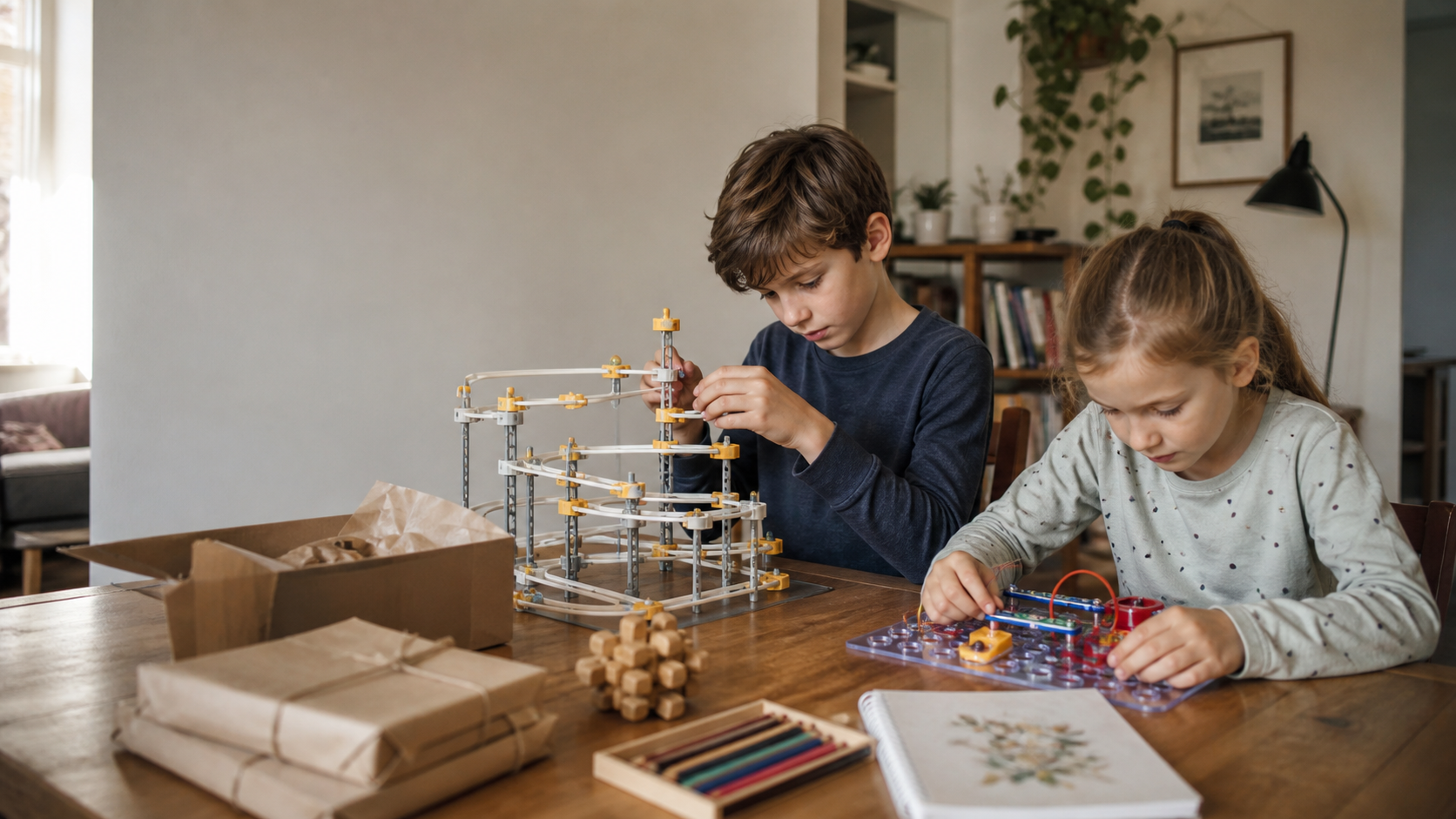
Construction becomes more compelling when the finished model does something. Marble runs, mechanical builds, and robot kits combine assembly with testing, so completion is not necessarily the end of play.
Solar robot kits are a useful example. A child assembles a model, places it in suitable light, observes what happens, and then troubleshoots or rebuilds. The appeal comes from the connection between the construction choices and a visible result.
A beginner solar robot kit is the type I would consider for a child who needs an approachable entry point. For a kid who already enjoys assembling models, a STEM-focused solar building kit offers a project-oriented gift rather than a passive gadget.
For children who like taking creations apart and starting again, a 12-in-1-style solar robot kit can provide more replay value through multiple configurations. The number of possible builds matters less than whether the child will genuinely enjoy following diagrams, handling parts, and testing models.
Check the manufacturer age rating before buying. Also consider whether an adult will be available for the first build. Occasional help can prevent frustration, but taking over the assembly removes much of the satisfaction.
Open-ended construction materials
Blocks, magnetic construction pieces, wooden planks, gears, and reusable connectors work because they do not prescribe a single finished product. A child can copy an example first, then modify it or build something unrelated.
These gifts are especially useful when the recipient’s exact interests are unclear. Instead of guessing whether they want a particular character or vehicle, you give them materials that can become a house, bridge, animal, machine, or invented object.
Look at the pieces rather than the size of the box. Ask whether the set supports both small, quick builds and longer projects. Storage also matters: a simple container makes it easier for children to start playing and easier for parents to keep the gift in regular rotation.
Creative kits with enough freedom
Art gifts hold attention when they provide direction without requiring every project to look identical. A kit with a few prompts, useful materials, and room for personal choices is often more inviting than either a blank page or an activity with only one correct result.
Good options include printmaking, collage, model decoration, reusable stencils, clay projects, and simple craft tools. I avoid kits where the adult must perform most of the precise work. If the child can only choose a color while someone else completes the project, the activity is unlikely to feel like theirs.
Consumable materials are not automatically poor value. Paper, clay, paint, and similar supplies disappear through use, but they can support many distinct sessions. Check whether replacements are easy to find or whether the kit depends on proprietary refills.
Puzzles that invite another round
A traditional jigsaw can be absorbing, but replay may decline once the image is familiar. For longer-term use, consider logic puzzles, tangrams, maze boards, pattern challenges, or physical puzzles with multiple problem cards.
The difficulty needs to be close enough to the child’s current ability that progress feels possible. If every challenge is solved immediately, the gift may be set aside. If the opening challenge feels impossible, it may never get a fair try.
I like puzzle gifts that allow a child to skip one problem and return later. That small amount of flexibility keeps a difficult moment from ending the entire session.
Role-play gifts without electronic scripts
Dress-up pieces, play food, puppets, miniature figures, and simple tool sets can support long sessions because the child supplies the story. The strongest sets use recognizable objects but leave the plot open.
Instead of buying a large themed bundle, consider a few versatile pieces that work with toys already in the home. A cape, clipboard, fabric bag, or set of character figures may be used in many different scenarios. Compatibility with an existing play collection often matters more than novelty.
Movement gifts with a skill to practice
Screen-free does not have to mean sitting at a table. Tossing games, balance activities, target games, beginner sports equipment, and outdoor exploration tools give children a skill they can repeat and improve.
I favor movement gifts that can be used alone as well as with a sibling, friend, or parent. It also helps if the activity has an obvious short version. A child may not want an organized game every time, but they might practice hitting a target or completing a simple course for a few minutes.
Match the gift to the child’s preferred kind of effort
Age labels are only a starting point. Think about what the child voluntarily does when no one assigns an activity. Do they assemble, draw, sort, invent stories, solve problems, or move constantly?
For a builder, choose reusable parts or a working model.
For an experimenter, choose a kit that encourages testing and adjustment.
For an artist, choose flexible materials rather than one rigid project.
For a storyteller, choose props and characters with an open setting.
For an active child, choose equipment that rewards repeated practice.
Also account for setup. A gift stored in a complicated package or requiring extensive adult preparation creates friction every time. Clear instructions, manageable pieces, and practical storage make repeat use easier.
A simple way to choose
Before buying, ask three questions: What can the child do in the first few minutes? What changes on the second attempt? What will bring them back after the first successful result? If the answers are clear, the gift has a stronger chance of holding attention without a screen.
Building kits, creative materials, puzzles, role-play props, and movement activities all work when they give children meaningful control. For a child who enjoys models and experimentation, start by comparing the solar options in this practical guide to solar robot kits, then choose the level of assembly they are likely to enjoy rather than simply endure.
How we research: This guide is based on manufacturer specifications, published independent reviews, and verified-buyer feedback, not hands-on testing.
Q4期間中は毎週金曜日にホリデーギフトガイドをお届け
週1回、最新レビューとコミュニティで実際に購入されているおもちゃをご紹介します。迷惑メールは送りません。いつでも配信停止できます。