Celestron AstroMaster 70AZ Refractor Telescope: A Practical Buying Guide for First-Time Stargazers
Clear guide to the Celestron AstroMaster 70AZ: specs, real-world performance, trade-offs, and whether this entry-level refractor is right for your family.
公開日:2026/10/04 · 9分で読めます
このガイドはまだ翻訳されていないため、英語の原文を表示しています。
As an Amazon Associate, I earn from qualifying purchases. Your price stays the same.
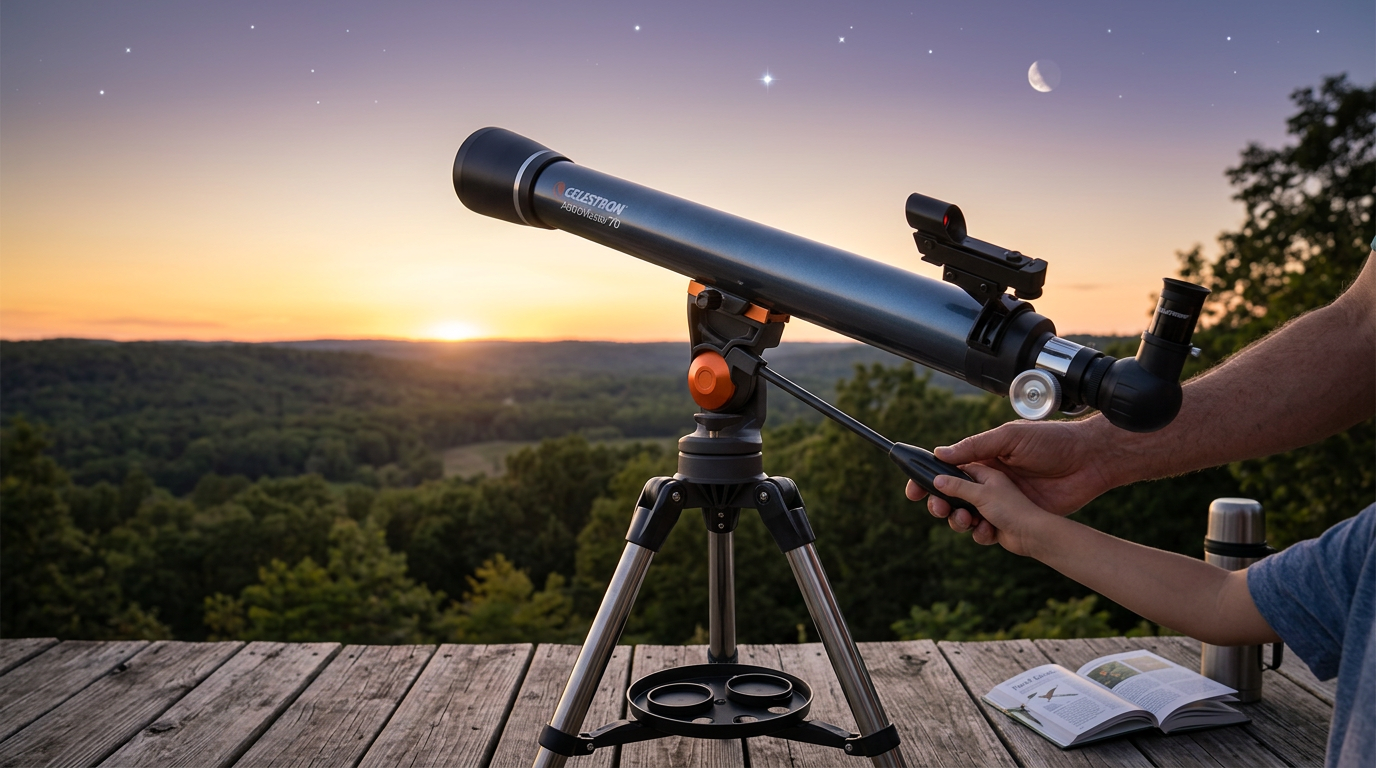
The Celestron AstroMaster 70AZ is one of the most commonly recommended starter telescopes, and for good reason: it's affordable, straightforward to assemble, and capable enough to show you the Moon's craters and a few planets without a steep learning curve. But it's not the right scope for every beginner, and understanding what it does well, and where it hits its limits, before you buy will save you from a frustrating first night outside.
This guide walks through what the AstroMaster 70AZ actually delivers, who it fits, what to check before purchasing, and how it compares to a few alternatives that might suit your situation better.
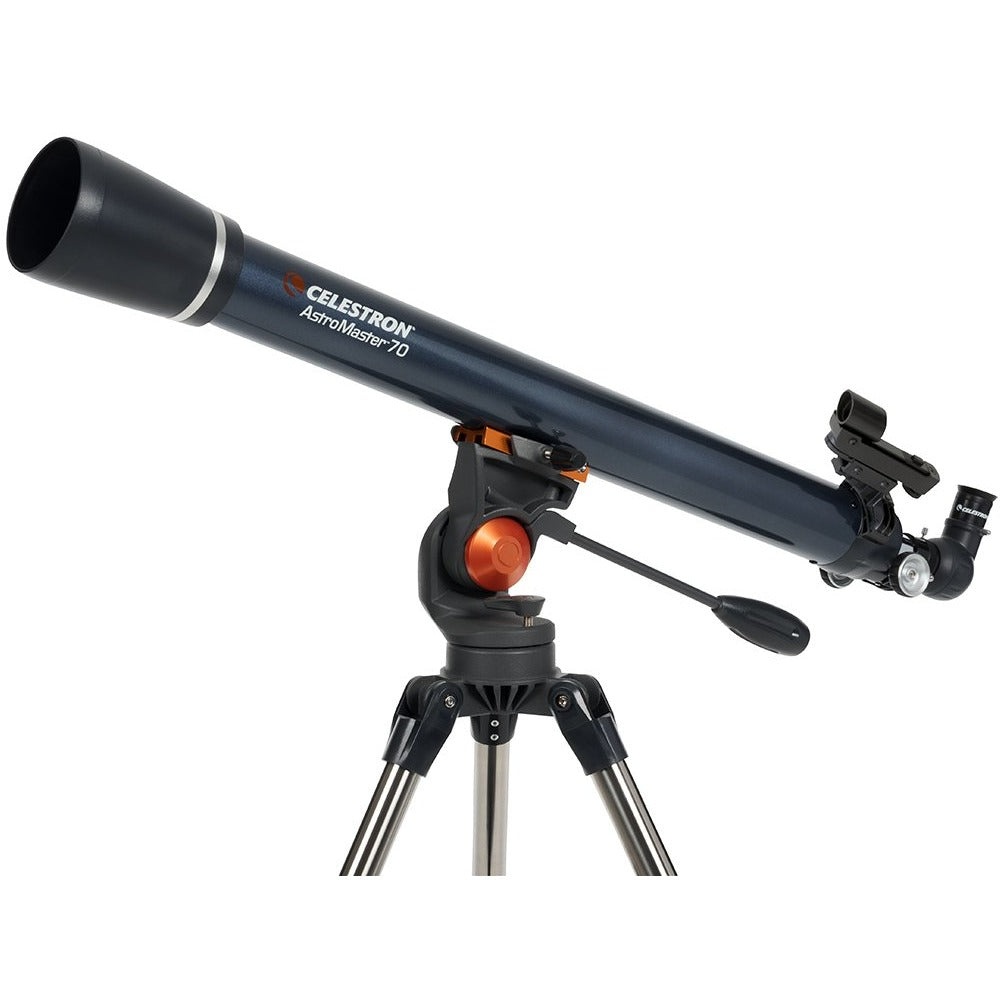
Quick pick: Celestron AstroMaster 70AZ. Best for first time stargazers who want an affordable, straightforward telescope for the Moon and a few planets. See it on Amazon (affiliate link)
What You're Getting: Key Specifications
The AstroMaster 70AZ is a 70mm refractor with a 900mm focal length, giving it an f/13 focal ratio. For context, that long focal length means the telescope has a narrow, magnified field of view, good for zeroing in on a single planet or a chunk of the Moon, less ideal for sweeping across wide star fields. The entire setup weighs 7.6 lbs (3.44 kg), which makes it light enough for one person to carry outside but sturdy enough not to wobble excessively in calm conditions.
The mount is a manual altazimuth design, meaning it moves left-right and up-down, like a camera tripod. There's no motorized tracking, so you'll need to nudge the telescope by hand to keep objects centered as Earth rotates. It's simple to understand and operate, but it does mean the observer stays engaged rather than stepping back while the scope tracks on its own.
Setup is no-tool, requiring no wrenches or specialized equipment, according to Recommended Optics. That's a real advantage if you're assembling it in a dark backyard with a child watching impatiently. Celestron's AstroMaster line is positioned as an entry-level series designed to lower the barrier to first-time stargazing.
What It Actually Shows: Moon, Planets, and Beyond
The AstroMaster 70AZ's optics are particularly suited to observing the Moon, bright planets, and other relatively bright targets. That's not a limitation; it's the telescope's intended strength. The long focal length and refractor design produce crisp, high-contrast views of objects that are already bright, which is exactly what you want when you're learning to point a telescope at the sky for the first time.
Here's what you can reasonably expect to see:
- The Moon: This is where the AstroMaster 70AZ genuinely shines. Craters, mountain ranges, and the shadowed edges of maria (the dark plains) become clearly visible, especially during partial phases when the terminator (the line dividing day and night on the lunar surface) cuts across interesting terrain.
- Jupiter: The planet appears as a small disc, and on good nights you may detect its four largest moons as tiny points of light flanking the planet. The cloud bands (equatorial belts) that experienced observers photograph require more aperture and steadier skies than this telescope provides.
- Saturn: You can identify Saturn as a non-circular object and, under favorable conditions, detect that the rings are present. Seeing the Cassini Division (the gap in the rings) would require more magnification and aperture than the 70mm objective can deliver.
- Bright star clusters: Open clusters like the Pleiades are visible and recognizable, though they won't fill the narrow field of view the way they would in a shorter focal-length scope.
What it won't show well: galaxies beyond Andromeda as anything more than faint smudges, most nebulae with any detail, or planetary surfaces at a level of detail that competes with a 6-inch or larger telescope. Telescope Advisor's 2026 review covers real-world Moon and planet views alongside honest pros and cons. The bottom line is that 70mm of aperture is enough to get started, enough to inspire curiosity, and not so much that you've overspent if the hobby doesn't stick.
Trade-offs Worth Knowing Up Front
Every telescope involves compromises, and the AstroMaster 70AZ has several that matter for first-time buyers.
The Altazimuth Mount Requires Patience
The manual altazimuth mount is simple, but it demands constant small adjustments. As Earth rotates, objects drift out of the field of view in 15 to 30 seconds depending on magnification. You re-center, observe for a bit, re-center again. For an adult this is manageable; for a child under eight or nine, it can become tedious quickly. There's no motorized tracking to handle this for you, and adding a tracking motor to an entry-level altazimuth mount isn't a practical upgrade path.
Chromatic Aberration Is Present
Refractor telescopes at this price point produce some color fringing (violet or green halos around bright objects) because the single-element lens doesn't focus all wavelengths of light at exactly the same point. On the Moon and bright planets, this is a mild nuisance rather than a deal-breaker. Telescope School's first-hand review identifies this as one of the scope's weaknesses and suggests affordable upgrades that can mitigate the effect. It's a normal trade-off for a sub-$200 refractor, not a defect.
The Eyepieces Are Functional, Not Exceptional
The included eyepieces will get you started, but they are the component most likely to benefit from an early upgrade. A 9mm eyepiece, for example, would increase planetary magnification and make Saturn's rings easier to resolve. This isn't a hidden cost so much as an expected one; most telescope buyers at this price level budget for one or two additional eyepieces within the first few months.
Deep-Sky Objects Are Limited by Aperture
A 70mm lens gathers roughly 100 times more light than the unaided human eye. That sounds like a lot, and for solar system targets it is. But for faint nebulae and galaxies, 70mm is the shallow end. If your primary interest is nebulae like Orion or galaxies beyond the Milky Way, you'll want more aperture (8 inches or more in a reflector), which means a larger, heavier telescope and a higher price. For a cost comparison: a 6-inch Dobsonian reflector gathers roughly five times more light than this 70mm refractor.
How It Compares: A Quick Decision Table
| Feature | Celestron AstroMaster 70AZ | Orion StarBlast 62mm (Tabletop) | Used 6-inch Dobsonian |
|---|---|---|---|
| Aperture | 70mm | 62mm | ~150mm |
| Focal length | 900mm (f/13) | 300mm (f/5) | ~1200mm (f/8) |
| Best for | Moon, bright planets | Wide-field, open clusters, portability | Everything including faint nebulae |
| Mount | Altazimuth tripod | Tabletop base (no tripod needed) | Manual Dobsonian rocker |
| Portability | Moderate (7.6 lbs + tripod) | High (tabletop, very light) | Low (heavy, bulky) |
| Setup complexity | No-tool, moderate | Minimal | Minimal once assembled |
| Price range | Budget entry | Similar or slightly less | Varies (often similar used) |
| Tracking | Manual only | Manual only | Manual only |
The StarBlast 62mm trades aperture for a wider field of view and extreme portability, ideal if you want a grab-and-go scope for camping trips or a tabletop option that doesn't need a tripod. The used Dobsonian offers dramatically more light-gathering at a similar or lower price point, but it's larger, heavier, and requires storage space. Each of these telescopes makes sense for a different kind of buyer.
Who This Telescope Fits Best
The AstroMaster 70AZ is a strong match if you recognize yourself in any of these situations:
- You're genuinely unsure whether astronomy will become a regular hobby. The financial commitment is modest, and the scope performs well enough to help you make an informed decision about whether to invest further.
- You're buying for a child or teenager and want something they can learn to operate independently. The no-tool setup and straightforward altazimuth mount mean a 10-year-old can be pointing at the Moon within 20 minutes of unboxing.
- Your primary targets are the Moon and bright planets. The long focal length and refractor optics are optimized for exactly these objects.
- Portability matters. At 7.6 lbs, it fits in a car trunk or a closet without rearranging your life around it.
If you already know you want to observe deep-sky objects, or if you want a scope that will remain satisfying for several years of growing skill, the AstroMaster 70AZ may leave you wanting more within a few months.
What to Verify Before You Buy
Before committing, walk through these practical checks:
- Where will you observe? You need a safe outdoor location with reasonable darkness. Suburban skies work fine for the Moon and planets; deep-sky targets benefit from darker locations. If you live in a heavily light-polluted city center, even a larger telescope won't help much.
- Where will you store it? Telescopes should live indoors; temperature swings, moisture, and dust in garages or sheds degrade optics over time. Confirm you have a closet or shelf that can accommodate a 7.6-lb telescope with its tripod.
- How much patience does the observer have? The manual mount means frequent re-centering. Younger children may lose interest; adults who prefer a hands-off experience may prefer a motorized (and pricier) alternative.
- What's included versus what you'll need? Verify the eyepieces and any accessories that come in the box. A star map app on a phone (with night-mode red lighting) is nearly essential for finding targets; plan to download one.
- Is this your primary interest, or a gift? If it's a gift for someone else, their level of enthusiasm matters more than the telescope's specifications. A scope that gets used is worth more than a scope that gathers dust in a garage.
Practical Accessories That Help
You don't need to buy anything extra on day one, but a few inexpensive additions improve the experience meaningfully:
- A star map app or planisphere: Finding objects is half the challenge for beginners. A red-light phone app preserves your night vision while helping you locate targets. Stellarium (free) is widely used.
- A better eyepiece (eventually): A 9mm or similar shorter-focal-length eyepiece increases magnification for planetary detail. Wait until you've used the included eyepieces a few times before deciding what focal length to add.
- A red flashlight: White light ruins night vision for 20 to 30 minutes. A cheap red-light flashlight lets you consult a map or adjust equipment without resetting your eyes.
- A dew shield: In humid climates, moisture condenses on the telescope's objective lens during long sessions. A simple dew shield (or even a cardboard tube extension) delays this.
Alternatives to Consider
If the AstroMaster 70AZ doesn't quite fit your situation, these alternatives address specific gaps:
- More portability: The Orion StarBlast 62mm tabletop reflector eliminates the tripod entirely and is compact enough for apartment balconies or camping trips.
- More aperture on a budget: A used 6-inch Dobsonian reflector offers substantially more light-gathering for a similar or lower price. The trade-off is size and weight; these are large telescopes that need a dedicated storage spot.
- Motorized tracking: Celestron's own AstroMaster line includes motorized variants at higher price points. If the constant manual re-centering is a concern, a motorized equatorial mount version solves that, though it adds cost and complexity.
- Photography interest: The AstroMaster 70AZ is not designed for astrophotography. If that's a goal, you'll need a different mount (equatorial, motorized) and a camera adapter, which effectively means shopping for a different telescope system.
The Bottom Line
The Celestron AstroMaster 70AZ does what it promises: it delivers clear views of the Moon and recognizable views of bright planets with a setup that a first-timer can manage on the first night. It's well-built for its price point, light enough to move easily, and forgiving enough that mistakes in setup don't ruin the experience.
Its limits are real but predictable. The 70mm aperture won't reveal faint galaxies. The manual mount requires patience. The included eyepieces are starting points, not endpoints. None of these are defects; they're the trade-offs of an entry-level refractor telescope.
If you want to find out whether you or your family enjoy stargazing without a major upfront investment, the AstroMaster 70AZ is a sensible starting point. If the hobby takes hold, you'll know exactly what you want in your next telescope, and you'll have learned the fundamentals on a scope that made those lessons accessible.
Sources
- Celestron AstroMaster 70AZ Review 2026: Telescope Advisor
- Celestron AstroMaster LT 70AZ Telescope Review: Telescope Guides
- Celestron AstroMaster 70 AZ Telescope Review: Telescope Guides
- Celestron AstroMaster 70AZ Review: Specs & Astronomy Use: Astronomy Trek
- Celestron 70AZ Astro Master Refractor Telescope Review: Telescopes for Beginners
- Celestron AstroMaster 70AZ Review: Telescope School
- Celestron AstroMaster LT 70AZ Refractor Telescope Review: Recommended Optics
ギフトをお探しですか?まずはこちら
- Best LEGO Botanicals Sets for Adult Builders and Gift-Givers (2026)
- LEGO Botanicals Bonsai Tree vs LEGO Botanicals Orchid: Which Is Better for Adult Builders and Gift Buyers?
- Holiday Gift Guide 2026: The Best Toys by Age and Budget, From Preschool to Grown-Ups
- Gifts for Grown-Ups Who Still Love Toys: LEGO, Board Games and Puzzles (2026)
How we research: This guide is based on manufacturer specifications, published independent reviews, and verified-buyer feedback, not hands-on testing.
Q4期間中は毎週金曜日にホリデーギフトガイドをお届け
週1回、最新レビューとコミュニティで実際に購入されているおもちゃをご紹介します。迷惑メールは送りません。いつでも配信停止できます。