Fisher-Price Baby's First Blocks: A Practical Buying Guide for Parents
A parent-focused guide to Fisher-Price Baby's First Blocks. Covers who it suits, what to check, version differences, and honest trade-offs before you buy.
Pubblicato il 9 ott 2026 · 8 min di lettura
Questa guida non è ancora stata tradotta, quindi stai leggendo la versione originale in inglese.
As an Amazon Associate, I earn from qualifying purchases. Your price stays the same.
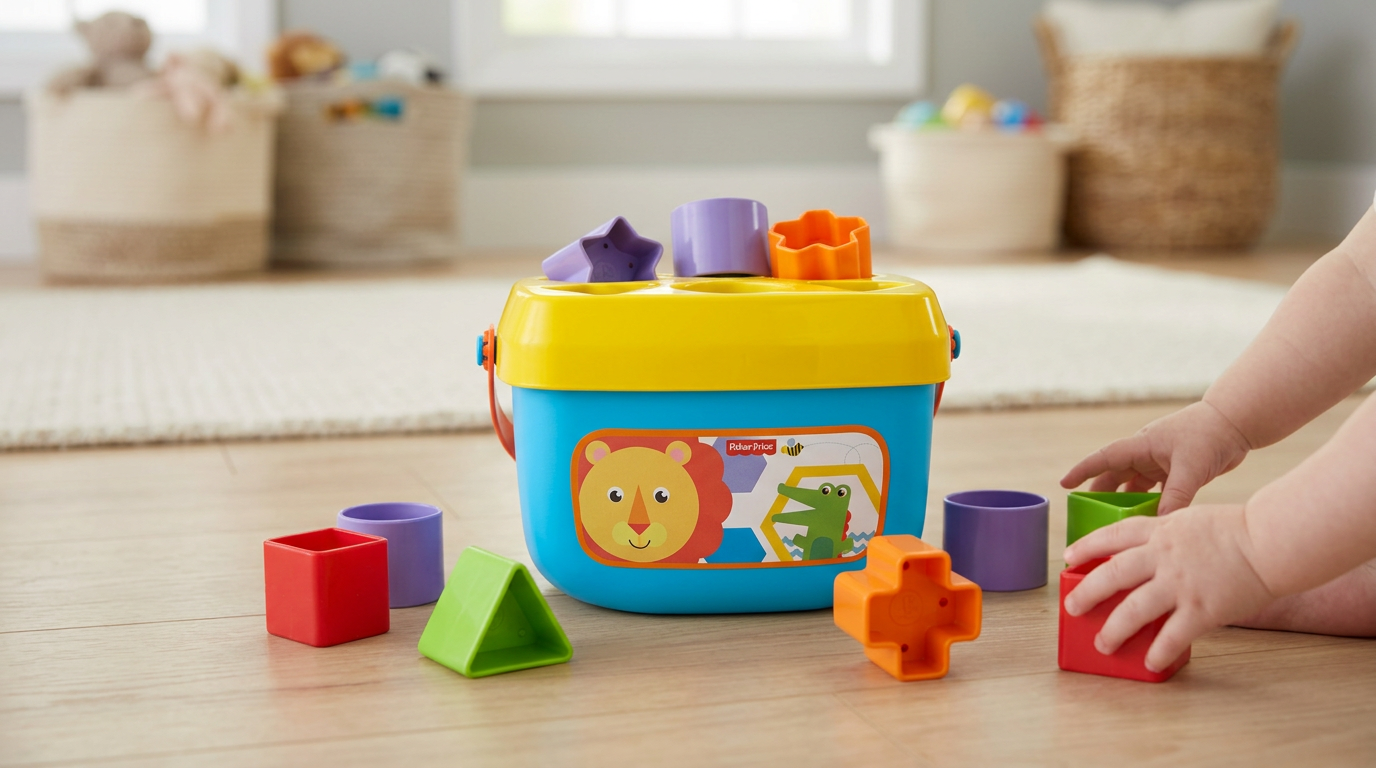
Fisher-Price Baby's First Blocks has been a staple in nurseries for years, and for good reason. The set pairs ten colorful blocks with a lidded storage bucket, aimed at babies from six months old. Through sorting, stacking, and dropping activities, it introduces shapes and colors while building early motor skills. If you are deciding whether this toy earns a spot in your home, this guide covers who it fits, what to check first, and how the available versions compare.
Quick pick: Fisher-Price Baby's First Blocks. Best for parents of 6- to 18-month-olds who want a simple, proven shape-sorter at a low cost. See it on Amazon (affiliate link).
Who Fisher-Price Baby's First Blocks Actually Serves
This toy targets a specific developmental window. The manufacturer recommends it for infants aged six months and older (Mattel), and that guidance aligns with when most babies begin grasping objects intentionally and responding to bold color patterns.
At six months, many babies are learning to transfer objects between hands. By nine to twelve months, shape-sorting play becomes a way to practice problem-solving: figuring out which block fits through which slot. Fisher-Price designed this set around that developmental arc (Amazon listing).
The toy works well for babies and toddlers in the roughly 6- to 24-month range, though every child is different. Some toddlers move on quickly once shape-matching becomes easy. Others return to it repeatedly for the satisfying act of dumping and refilling the bucket. Parents looking for a toy that holds interest for several months, rather than weeks, will find this set hits a practical sweet spot.
One thing worth noting: the ten shapes included in the set are the full extent of the challenge. There are no expansion packs or additional blocks. What you see in the box is what the child works with for the entire lifespan of the toy.
Who Should Look Elsewhere
If your child is already past 18 months and has solid shape-sorting skills, this set may feel too simple. Children who crave more complex construction or imaginative play scenarios are better served by open-ended building sets or figurines. The set also does not include sound or light features, so babies drawn primarily to cause-and-effect toys with auditory feedback may lose interest faster.
What Comes in the Set
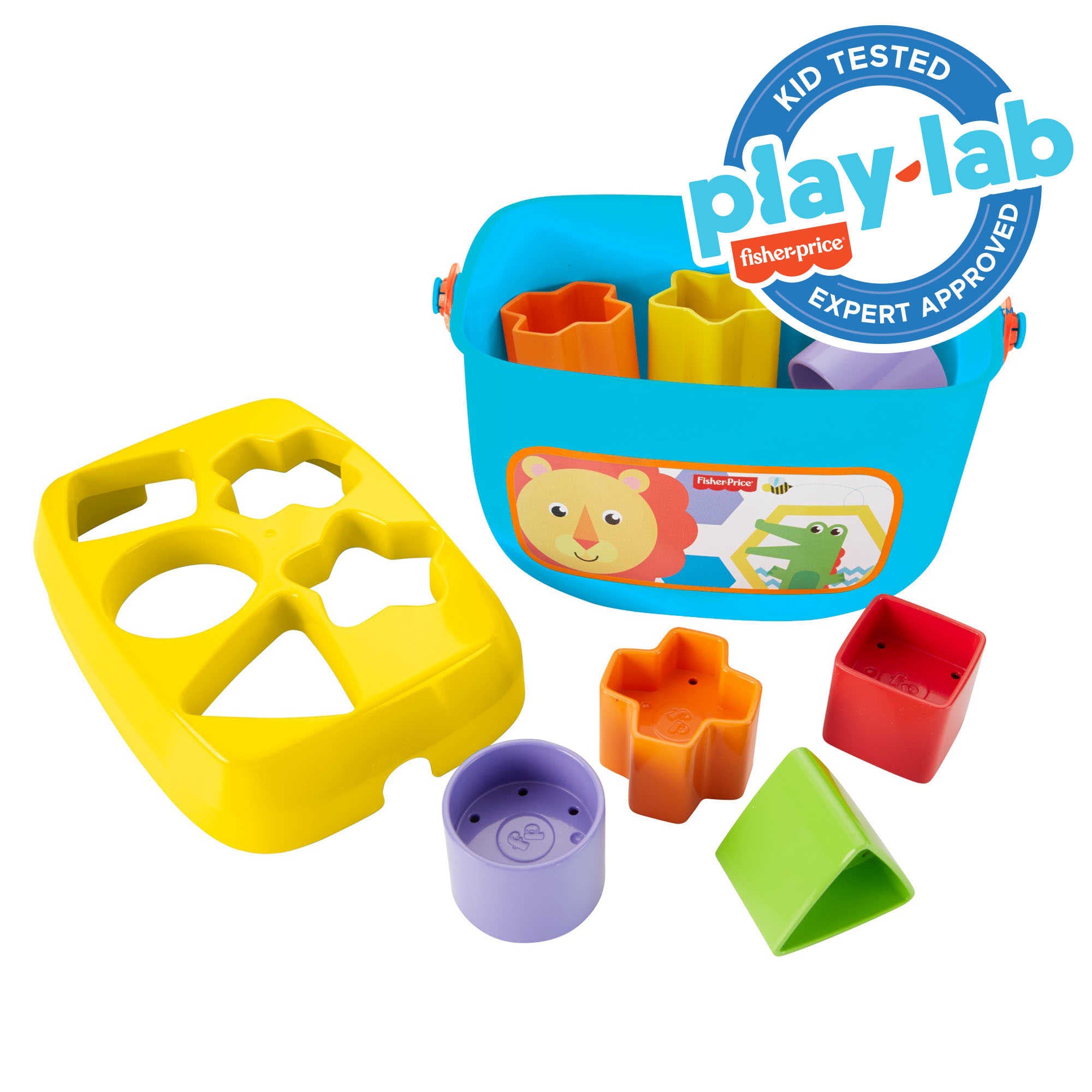
The standard Fisher-Price Baby's First Blocks includes (Kohl's):
- 10 chunky, colorful plastic blocks in various shapes
- A storage bucket with a shape-sorting lid
- An easy-carry handle on the bucket
The blocks are sized for small hands, with edges that are easy to grip. Each block fits through a corresponding slot on the bucket lid. When no slot matches, the child tries a different orientation or a different block. That process of trial and error is where most of the developmental value lives.
The entire set measures roughly 8.3 inches tall by 4.9 inches wide by 5.1 inches deep (Kohl's). That makes it compact enough to toss in a diaper bag for travel or tuck onto a shelf at home. The bucket doubles as storage, which parents appreciate when the play session ends.
What to Verify Before Buying
A few things are worth checking before you click "buy."
Safety Certifications
The product meets ASTM certification standards (Kohl's). ASTM (the American Society for Testing and Materials) publishes toy safety standards covering mechanical hazards, chemical content, and age-appropriate design. While the search results do not specify which particular ASTM standard this product was tested against, the manufacturer's claim of ASTM certification indicates it has gone through the relevant testing process.
Parents of children who still mouth toys should note that the blocks are plastic (Kohl's). The available product information does not confirm whether the set is BPA-free or phthalate-free. If those certifications matter to your family, consider contacting Mattel directly to confirm current material details before purchasing.
Age Fit for Your Specific Child
The six-month minimum is a starting point, not a guarantee of engagement. Some babies at six months will not yet have the coordination to fit blocks into slots. They may simply enjoy banging them together or mouthing them. That is developmentally normal, and the toy will grow with them over the following weeks and months.
If your child is closer to two years old, consider whether they already handle basic shape-sorting with ease. A child who finds this set too easy may benefit from a toy with more shapes or a more challenging sorting mechanism.
Cleanup and Maintenance
The blocks and bucket are plastic and can be wiped clean (Kohl's). The available information does not indicate they are dishwasher-safe, so plan on using a damp cloth for routine cleaning. For families dealing with frequent drool or food residue on toys, this is straightforward but worth knowing upfront.
Comparing the Available Versions
Fisher-Price sells at least two color variants of this toy, and the search results reveal some meaningful differences.
| Feature | Standard Version | Navy Fawn Version |
|---|---|---|
| Block count | 10 (Mattel) | 10 (Amazon) |
| Recommended age | 6+ months | 6+ months |
| Color scheme | Bright primary colors | Muted navy and fawn tones |
| Recycled content | Not specified | GRS certified, over 50% recycled content (Amazon) |
| Availability | Multiple retailers (Walmart, Target, Kohl's) | Amazon exclusive |
The decision comes down to two factors: color preference and environmental values. If a lower environmental footprint matters to you and you are comfortable buying through Amazon, the Navy Fawn version offers independently verified recycled content through the Global Recycled Standard (GRS). If you prefer shopping at a local retailer or want the classic bright color palette that many babies find visually engaging, the standard version is widely available.
Neither version differs in function, piece count, or developmental purpose. The blocks are the same shapes and sizes. The difference is cosmetic and material.
Trade-offs Worth Knowing
Every toy involves compromises. Here is what the facts support about this one.
What Works Well
Simplicity is the design intent. There are no batteries, no screens, no electronic sounds. For parents who want low-stimulation play that encourages focused attention, this is a feature, not a limitation. The toy asks the child to do one thing: figure out which shape fits where. In a market saturated with flashing, beeping toys, that restraint is worth acknowledging.
Storage is built in. The bucket with its lid and handle means the toy cleans up after itself, mostly (Kohl's). Parents who have stepped on scattered Duplo bricks at 2 a.m. will appreciate a toy that packs into its own container. The handle makes it portable for car trips, restaurant visits, and grandparent house stays.
The price point is low. While specific pricing was not available in the search results, Fisher-Price Baby's First Blocks is consistently positioned as a budget-friendly toy across the retailers listed (Walmart, Target, Kohl's, Staples). It is the kind of purchase that does not require much deliberation.
Proven developmental focus. The set is designed to develop hand-eye coordination and foundational early learning skills through sorting, stacking, and shape-matching play (Walmart). These are well-documented developmental milestones in the first two years of life.
Manufacturer track record. Fisher-Price, owned by Mattel, has produced infant toys for decades. This particular set has been a consistent seller across major retailers, which suggests sustained consumer confidence in the product.
Where It Falls Short
Limited longevity. Once a child masters the ten shapes, the toy has little left to offer in terms of challenge. Parents should expect a useful lifespan of roughly six to twelve months of active play, depending on the child's pace of development.
Single-purpose design. Unlike building blocks or art supplies, this set has one intended use. The blocks only go into the bucket one way. Children who prefer freeform creativity may outgrow it faster than children who enjoy repetitive, goal-oriented tasks.
Material transparency gaps. The product is plastic and meets ASTM standards, but the search results do not provide detailed information about specific chemical safety certifications beyond that. Parents who prioritize verified non-toxic, BPA-free claims may want to seek confirmation from the manufacturer directly.
Blocks scatter easily. Despite the storage bucket, ten small blocks spread across a room quickly. The lid helps, but babies are skilled at removing it. This is a minor nuisance rather than a dealbreaker, but it matters for parents who value tidy play spaces.
Practical Alternatives
The search results for this guide focused on Fisher-Price Baby's First Blocks and its variants. Without detailed spec sheets for competing products in the search data, a direct feature-by-feature comparison would risk presenting unverified claims. What follows is general guidance based on the toy's category.
Stacking cups or ring stacks. These cover similar developmental ground (grasping, sequencing, color recognition) at a comparable price point. They tend to be even simpler and take up less space, though they lack the shape-matching challenge that makes this set distinctive.
Soft fabric blocks. For younger babies still in the heavy mouthing phase, soft blocks eliminate the hard-plastic concern entirely. The trade-off is that they do not offer the same sorting and problem-solving play.
More complex shape sorters. Once your child outgrows the ten shapes in this set, shape sorters with more slots, multiple levels, or additional problem-solving elements can extend the learning curve. These typically cost more and occupy more space, but they serve the next developmental step.
The honest summary is that Fisher-Price Baby's First Blocks occupies a specific niche: an affordable, no-frills introduction to shape sorting for babies six months and older. It does not try to be more than that, and it handles its purpose well.
Should You Buy It?
If you are shopping for a baby between six and twelve months and want a straightforward, low-cost toy that introduces basic shapes and colors while building hand-eye coordination, Fisher-Price Baby's First Blocks is a practical choice. It is widely available, easy to clean, and comes from a manufacturer with decades of experience in infant toys.
If eco-friendly materials are a priority, the Navy Fawn version with its GRS-certified recycled content (Amazon) is worth a look, though it is only available through Amazon.
For older toddlers or children who need more challenge, plan to pair this with something more complex down the line. It is a starter toy, not a long-term one, and knowing that going in helps set the right expectations for both parent and child.
Sources
- Fisher-Price Baby's First Blocks on Amazon
- Fisher-Price Baby's First Blocks on Mattel Shop
- Fisher-Price Baby's First Blocks Navy Fawn on Amazon
- Fisher-Price Baby's First Blocks on Walmart
- Fisher-Price Baby's First Blocks on Target
- Fisher-Price Baby's First Blocks on Kohl's
- Fisher-Price Baby's First Blocks Shape-Sorting Toy on Walmart
- Fisher-Price Baby's First Blocks on Staples
Cerchi un regalo? Inizia da qui
- Best LEGO Botanicals Sets for Adult Builders and Gift-Givers (2026)
- LEGO Botanicals Bonsai Tree vs LEGO Botanicals Orchid: Which Is Better for Adult Builders and Gift Buyers?
- Holiday Gift Guide 2026: The Best Toys by Age and Budget, From Preschool to Grown-Ups
- Gifts for Grown-Ups Who Still Love Toys: LEGO, Board Games and Puzzles (2026)
How we research: This guide is based on manufacturer specifications, published independent reviews, and verified-buyer feedback, not hands-on testing.
La guida regali per le feste arriva ogni venerdì nel quarto trimestre
Un'email a settimana con la recensione più recente e i giocattoli che la nostra community sta davvero acquistando. Niente spam, puoi annullare l'iscrizione in qualsiasi momento.