STEM y ciencia · Edades: 6-14
Best Solar Robot Kits for Kids: 4 Sun-Powered Builds Compared (and the Catch No One Warns You About)
Four real solar robot kits compared on builds, age, and difficulty, plus the sunlight catch that turns half of them into desk ornaments indoors.
Publicado el 27 jun 2026 · 9 min de lectura
Esta guía aún no está traducida, por lo que estás leyendo la versión original en inglés.
As an Amazon Associate, I earn from qualifying purchases. Your price stays the same.

TL;DR
- Best overall (most builds, deepest lesson): OWI 14-in-1 Educational Solar Robot Kit (~$35–45). 14 robots, 190+ pieces, transparent gearbox. Ages 10+ with patience.
- Best value: Sillbird 12-in-1 Solar Robot Building Kit (~$25). 12 land-and-water builds, easier than OWI. Ages 8–13.
- Best for younger kids: Thames & Kosmos SolarBots 8-in-1 (~$27–30). 8 quick 15–20 min builds, 48-page color manual. Ages 6–9.
How we evaluated: This comparison draws on manufacturer specifications, Amazon product listings and verified-buyer feedback, published reviews (Popular Science, MomJunction, TechGearLab, FatBrainToys), and U.S. CPSC safety standards (16 CFR 1501), not hands-on testing of every kit.
The #1 thing parents get wrong: these robots are dead indoors
The box shows a robot scuttling across a kitchen table. Reality: under your kitchen lights, it won't move at all.
Every kit in this guide is solar-only, no battery compartment, no backup. The assembled robot moves only when sunlight hits its panel. This is the single most common complaint in owner reviews, mentioned in nearly every critical write-up: "works great on a beach trip; useless on a cloudy day."
The physics is simple. Toy-grade solar panels need bright, direct sun to generate enough voltage to spin the motor. Ordinary indoor LED or fluorescent light produces a fraction of that. Amazon Q&A threads and reviewers repeat the same fix: point a strong 50W+ halogen lamp or flashlight at the panel. It works, barely, and it's awkward. It is not the designed use.
So before you buy, answer one question: does your child have reliable access to direct sun? A sunny yard, a south-facing window, a balcony, 30+ minutes of bright daily light. If yes, these kits are a brilliant renewable-energy lesson. If your kid mostly plays indoors or you live somewhere grey, a solar-only kit will end up in a drawer, buy a battery-powered build kit instead.
Solar-only means sun-dependent. Confirm the sunshine before you confirm the order.
How to choose: sunlight, age, builds, and skill
Four levers decide which kit fits your kid.
Sunlight. Covered above, and non-negotiable. All four kits here are solar-only (manufacturer spec sheets and Amazon descriptions confirm no battery option). No sun, no movement.
Age. Manufacturer labels swing wildly, anywhere from 3+ to 10+, so cross-check against build complexity, not the box. MomJunction's educator roundup and the manufacturer labels point to a clear ladder: 6–8 for the simplest kits, 8–10 for mid-range, 10+ for the most involved.
Builds. More models means more engineering sessions per box. The OWI offers 14 builds, the Sillbird 12, the Thames & Kosmos 8, and the 4M kit just 1–2. A young first-timer is happy with fewer; an older tinkerer wants the replay value.
Skill level. Piece counts run from about 40 to 190+. High counts teach more mechanics but frustrate impatient kids, and reviewers are blunt that under-10s usually need adult help. Match the difficulty your child will actually finish.
Match the kit to the child, not to the most impressive number on the shelf.
OWI 14-in-1 Educational Solar Robot Kit: the most builds, the deepest lesson
The OWI 14-in-1 Educational Solar Robot Kit (~$35–45) is the most-recommended kit for an older, patient kid. OWI Robotics, a California maker established in 1980, packs 190+ snap-together pieces into one box that builds 14 different robots across two difficulty tiers: a beginner Level 1 and an advanced Level 2.
The models cover a wagging-tail dog, a running beetle, a walking crab, a zombie chaser, and a surf-bot, among others. A transparent gearbox housing leaves the mechanics visible, which reviewers single out as the real teaching strength: kids can see how the solar motor drives the gears. Builds run 30 minutes to 2 hours each depending on tier, and no tools are needed.
What's praised: the visible gearbox teaches mechanics, the solar-only design means no battery management, the robots genuinely move on sunny days, and the variety gives long replay value. The real downside is the workload: hundreds of plastic pieces, tedious punch-out prep, and instructions dense enough that kids under 10 struggle solo. Reviewers note a first build can swallow several hours from unboxing, and that movement collapses the moment the sun dips.
Who it's for: kids 10+ with persistence and fine-motor control, a sunny yard, and a parent who treats it as a building project rather than a finished toy.
Sillbird 12-in-1 Solar Robot Building Kit: the best value
The Sillbird 12-in-1 Solar Robot Building Kit (~$25) gives the most builds per dollar and is a Popular Science "Best Overall Pick" for 2026. (The 4M kit below is cheaper at ~$15–20, but it makes only one or two robots, Sillbird's 12 builds are the better value if you want play life, not just the lowest sticker price.) It uses 190 snap-together pieces to build 12 robots, including land and water variants like crab and turtle designs, with dual-motor capability on some builds.
Build time runs 20–45 minutes per model, quicker and more forgiving than the OWI. Owner sentiment is positive across 190+ verified Amazon reviews: affordable, plenty of builds for the price, solar panels that work well in bright sun, and a solid renewable-energy lesson. Reviewers at ClimateTechReview and roboTOPicks echo the value angle.
The real downside: it demands bright, direct sunlight even more than the others, and outdoor play is short without strong sun. The builds are simple forward-movers, no remote control, no interactivity, so novelty can fade. Pieces are small (the usual under-3 choking concern).
Who it's for: budget-conscious families and motivated kids 8+ who want maximum builds per dollar and a renewable-energy focus.
Thames & Kosmos SolarBots 8-in-1: the best for younger kids
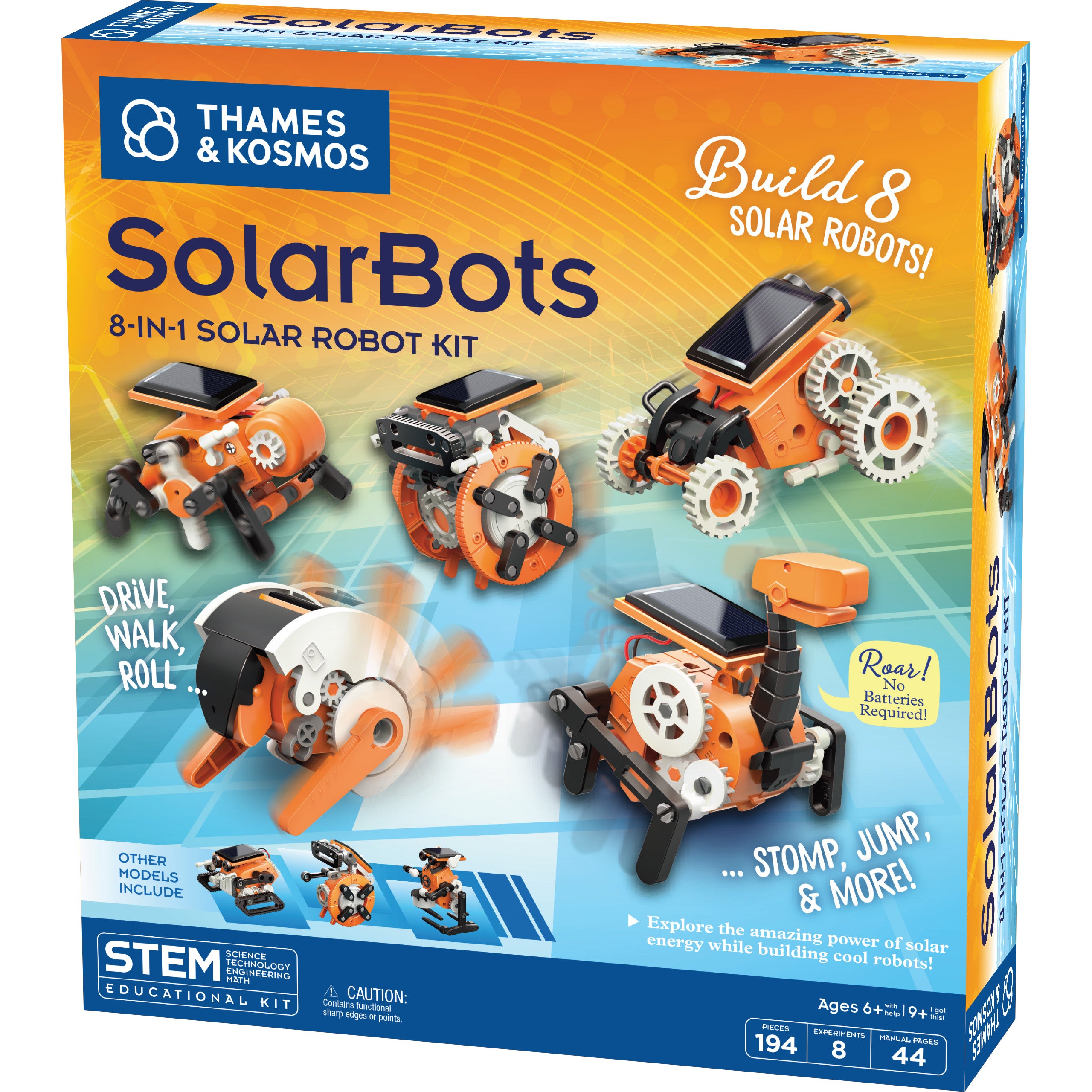
The Thames & Kosmos SolarBots 8-in-1 (~$27–30) is the pick for quick wins and younger builders. From Thames & Kosmos, a German-American maker established in 1992, it builds 8 solar robots: drummer, tank, racer, big-wheel, solar bug, armadillo, spinning, and dinosaur bots. It holds a 4.2-star rating on FatBrainToys.
The standout is speed: each build takes just 15–20 minutes, so kids finish in minutes rather than hours. A 48-page full-color manual with scientific-fact boxes makes it the strongest pick for a young child who needs visual guidance and fast gratification. The integrated solar panel means nothing extra to buy.
The catch is the single motorized gearbox, you must deconstruct one robot to build the next, which interrupts the play flow when a kid wants two robots out at once. Reviewers also flag cheap-feeling plastic, pieces that need wire cutters to free from their frames, and small parts that get lost easily.
Who it's for: ages 6–9 (younger with adult help), families who want quick builds and a parent-child activity, and outdoor STEM play.
4M Green Science Solar Robot Kit: the eco angle and the simplest build
The 4M Green Science Solar Robot Kit (~$15–20) is the cheapest and simplest, built around sustainability. From 4M's Kidzlabs brand, it makes 1–2 robot designs using recycled materials (a soda can, cardboard frame), with a transparent gearbox you can shape into a dinosaur or monster form. About 40 pieces; assembly runs 15–30 minutes.
What's praised: the eco-friendly philosophy, the low price, the single-build simplicity for young kids, and the visible gearbox. The real downside is the lack of replay: only 1–2 designs, a small robot with a short play life, and an underpowered panel in shade. Labels span 3+ to 8+, but the practical sweet spot is 5–7.
Who it's for: eco-minded families and younger kids (5–7) who want one easy build and a sustainability lesson rather than a multi-robot project.
Solar robot kits compared at a glance
| Feature | OWI 14-in-1 | Sillbird 12-in-1 | Thames & Kosmos SolarBots | 4M Green Science |
|---|---|---|---|---|
| ASIN (US Amazon) | B00CAWP9YI | B07T1NZD27 | B085P361MQ | B004NEWNB8 |
| Price (~$) | 35–45 | 25 | 27–30 | 15–20 |
| Age range | 8–14 | 8–13 | 6–9 | 3+/5+/8+ |
| Number of builds | 14 | 12 | 8 | 1–2 |
| Piece count | 190+ | 190 | ~80 | ~40 |
| Solar only | Yes | Yes | Yes | Yes |
| Build difficulty | Medium–hard | Easy–medium | Easy | Very easy |
| Build time / model | 30–120 min | 20–45 min | 15–20 min | 15–30 min |
| Verified rating | Mixed | ~4.5★ (PopSci pick) | 4.2★ (FatBrainToys) | Moderate |
| Best for | Persistent 10+ kids; replay | Budget; value | Quick wins; younger kids | Eco angle; simplicity |
Safety: small parts, choking hazard, and recall status
Solar robot kits are snap-together plastic, which means small parts everywhere.
Choking hazard. Every kit here contains snap-together pieces under 1.25 inches and carries the standard warning: "CHOKING HAZARD, Small parts. Not for children under 3 years." Under CPSC's small-parts ban, 16 CFR 1501, this label is required, and the risk is real: gearbox rivets, spacers, and motor connectors can come loose during assembly or disassembly. Supervise the build and the parts storage, especially with siblings under 3 in the home.
Compliance. All four kits are sold on Amazon US and carry ASTM F963-23 toy-safety attestation (manufacturer-declared; third-party testing not independently verified in this research).
Recall status. A CPSC recalls database check on 2026-06-27 found no active recalls for the OWI 14-in-1, Sillbird 12-in-1, or Thames & Kosmos SolarBots. Some early-2000s OWI batches had plastic-brittleness issues; current (2020+) versions report improved quality control. Buy from Amazon Prime or official retailers to reduce the chance of old or counterfeit stock from third-party sellers.
FAQ: what parents ask before buying
Q: Does a solar robot work indoors?
Technically yes, but poorly. These robots need direct sunlight to move reliably; ordinary indoor LED or fluorescent light produces too little voltage to drive the motor. Some owners point a bright 50W+ halogen lamp or flashlight at the panel, but that's awkward and not how they're meant to run. Plan on outdoor sunny-day play. If indoor play is the priority, a solar-only kit is the wrong buy.
Q: What age should I buy for?
Manufacturer labels range 3+ to 10+, so go by build complexity. Ages 4–7 suit the Thames & Kosmos SolarBots or the single-build 4M kit. Ages 8–10 fit the Sillbird 12-in-1. Ages 10+ suit the 190-piece OWI 14-in-1. Skip all of them for children under 3 due to the choking hazard.
Q: Do I need to buy batteries?
No. Every kit here is solar-only, no battery compartment, no backup. Built robots move only when sunlight hits the panel. That's deliberate (it teaches renewable energy) but it ties play to sunny weather.
Q: What's the difference between the OWI 14-in-1 and the Sillbird 12-in-1?
The OWI has 14 builds across two escalating difficulty tiers, tedious punch-out assembly, a deeper visible-gearbox lesson, and fits ages 10+ at ~$35–45. The Sillbird has 12 builds, easier pre-sorted assembly, a dual-motor option on some models, and fits ages 8+ at ~$25. OWI is for the kid who wants an engineering challenge; Sillbird is for quick wins and variety.
Q: Which kit teaches the most about solar energy?
The OWI 14-in-1 and Thames & Kosmos SolarBots lead. Both include manuals explaining solar-cell-to-motor energy conversion; OWI's transparent gearbox adds a mechanical-advantage lesson, and the Thames & Kosmos 48-page color manual has scientific-fact boxes throughout. The Sillbird and 4M manuals are lighter on theory.
The verdict: buy the OWI for a patient kid, the Sillbird for everyone else
Bottom line: For a patient kid aged 10+ with a sunny yard, buy the OWI 14-in-1 Educational Solar Robot Kit (~$35–45), 14 builds, a transparent gearbox that teaches real mechanics, and the longest replay value of the group.
If your child is younger or less patient, the Sillbird 12-in-1 ($25) is the smarter buy: a Popular Science pick, easier assembly, and the best builds-per-dollar at ages 8+. For a 6–8 year old who wants to finish a robot in 20 minutes, the Thames & Kosmos SolarBots 8-in-1 ($27–30) delivers quick wins and the best manual. The 4M Green Science kit (~$15–20) is the eco-angle entry for a single easy build. Whichever you pick, the rule that overrides everything: no direct sun, no working robot, so confirm the sunshine first.
A solar robot kit pairs well with the rest of a young scientist's shelf. If you're building one out, see our best STEM toys for 6 to 8 year-olds and our best microscopes for kids for two more curiosity-driven picks.
¿Buscas un regalo? Empieza aquí
- Best LEGO Botanicals Sets for Adult Builders and Gift-Givers (2026)
- LEGO Botanicals Bonsai Tree vs LEGO Botanicals Orchid: Which Is Better for Adult Builders and Gift Buyers?
- Holiday Gift Guide 2026: The Best Toys by Age and Budget, From Preschool to Grown-Ups
- Gifts for Grown-Ups Who Still Love Toys: LEGO, Board Games and Puzzles (2026)
How we research: This guide is based on manufacturer specifications, published independent reviews, and verified-buyer feedback, not hands-on testing.
La guía de regalos navideños llega cada viernes en el cuarto trimestre
Un correo a la semana con la reseña más reciente y los juguetes que nuestra comunidad está comprando. Sin spam, cancela la suscripción cuando quieras.