Rush Hour vs Gravity Maze vs Kanoodle for an 8-Year-Old
Rush Hour, Gravity Maze or Kanoodle? Compare price position, replay depth and learning style to pick the right logic puzzle for an 8-year-old.
نُشر بتاريخ 29/08/2026 · 5 دقائق قراءة
لم يُترجم هذا الدليل بعد، لذا فأنت تقرأ النسخة الإنجليزية الأصلية.
As an Amazon Associate, I earn from qualifying purchases. Your price stays the same.
As an Amazon Associate, I earn from qualifying purchases. The price you pay is the same. This guide is based on manufacturer specifications, published independent reviews, and verified-buyer feedback, not hands-on testing.
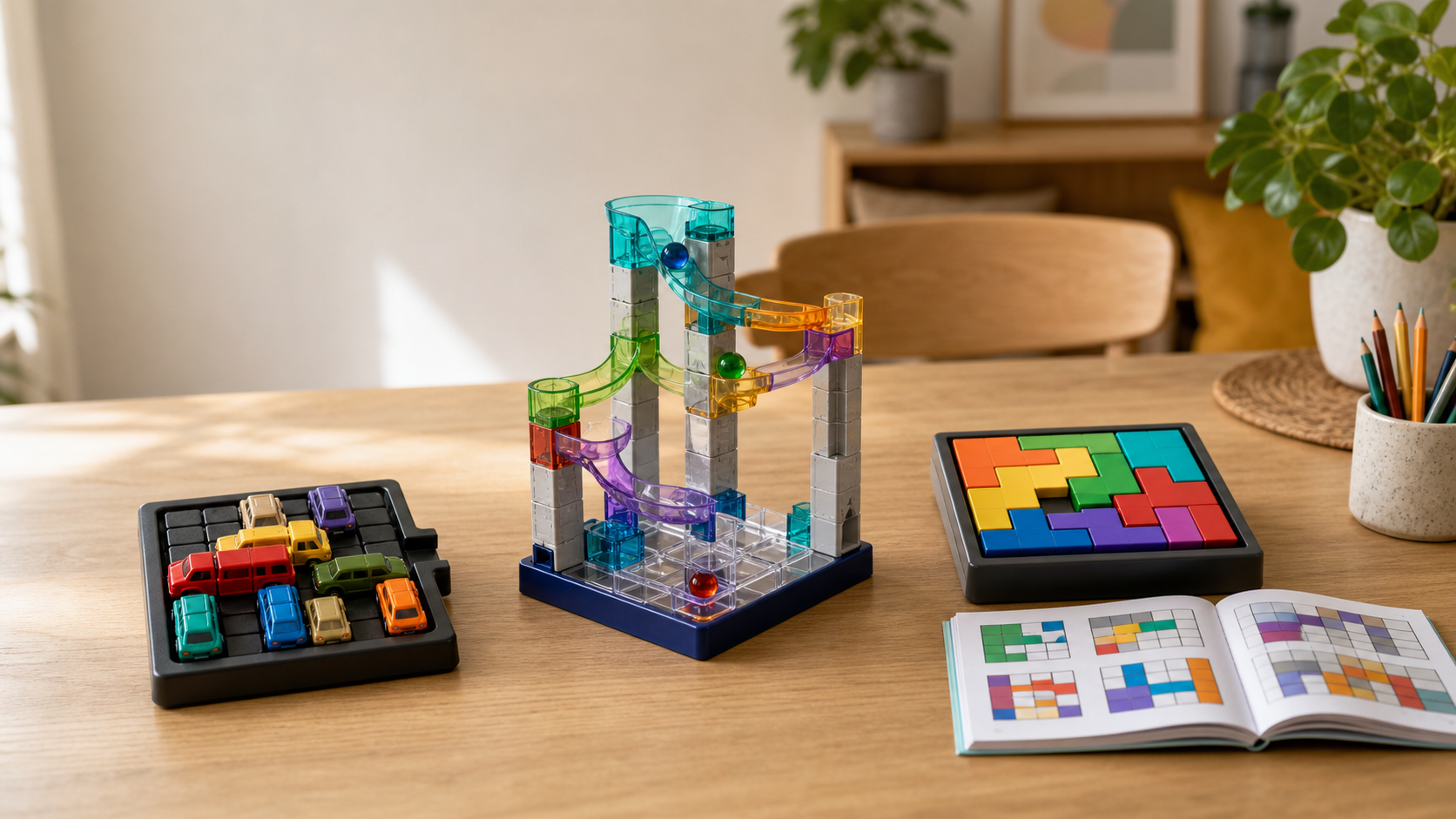
For most 8-year-olds, the right choice depends less on which puzzle has the strongest educational label and more on how the child likes to solve problems. Choose Rush Hour for methodical move-by-move planning, Gravity Maze for construction plus cause-and-effect reasoning, or Kanoodle for compact spatial puzzles. My general pick for a child who enjoys building is Gravity Maze, while the other two formats may suit children who prefer a more contained puzzle.
Check the current ThinkFun Gravity Maze listing to confirm the manufacturer age rating, included components, edition details, and current price before buying.
Quick decision: which puzzle fits which child?
- Choose Rush Hour for a child who likes rearranging pieces, planning several moves ahead, and working toward one clearly defined solution.
- Choose Gravity Maze for a child who enjoys building, testing a route, and figuring out how position and direction affect an outcome.
- Choose Kanoodle for a child drawn to compact pattern puzzles and fitting pieces into constrained spaces.
These are not interchangeable experiences. Rush Hour is centered on sequencing movement, Gravity Maze combines a logic challenge with a physical path, and Kanoodle emphasizes spatial arrangement. An 8-year-old may be capable of all three, but interest will determine whether the game becomes a repeat-use activity or sits on a shelf.
Price: compare the useful cost, not just the checkout total
Prices change too often for a fixed dollar comparison to stay helpful. Instead, I would check the current price of the exact edition and compare it with three practical factors: how many challenge configurations are included, whether replacement pieces appear easy to manage, and whether the format works for travel or mainly at a table.
Rush Hour and Kanoodle are usually considered as self-contained puzzle formats, while Gravity Maze has a larger construction element. That difference affects perceived value. A child who repeatedly rebuilds paths may get more use from Gravity Maze even if another option costs less on the day of purchase. Conversely, paying for a construction-focused puzzle makes little sense if the child dislikes setup and wants to begin solving immediately.
Also watch for editions with similar names. Packaging, challenge content, and included parts can vary. Compare the manufacturer’s current description rather than assuming that every version offers the same experience. For any of these games, a lower-priced listing is not a bargain if it is an incomplete edition or does not match the child’s preferred play style.
Replay depth: different kinds of repeat play
Rush Hour rewards finding a sequence
Rush Hour’s appeal comes from untangling a crowded arrangement through legal moves. The child must identify which piece is blocking progress, decide what must move first, and avoid creating a new obstruction. Replay depth therefore comes mainly from progressing through different starting layouts and improving planning discipline.
This format can be satisfying for a child who likes orderly rules and a clear endpoint. It may be less engaging for one who wants to invent structures or change the rules. Once a particular challenge and its solution become familiar, much of its uncertainty is gone, although a substantial challenge set can still support repeated sessions.
Gravity Maze adds a build-and-check loop
Gravity Maze asks the player to reason about a route and then represent that route with physical components. The useful learning moment is not simply reaching the end. It is comparing the expected path with what the constructed arrangement actually permits, then revising the setup.
That gives it a different kind of replay depth. Each new layout asks the child to interpret positions, connections, and direction together. The tactile construction stage can also hold the attention of children who lose interest when a logic game is entirely abstract. However, children who find setup tedious may prefer a puzzle with fewer components to arrange.
Kanoodle concentrates on spatial fitting
Kanoodle-style challenges focus attention on how individual pieces relate to the remaining open space. A placement that looks harmless early in the puzzle can make the final gap impossible to fill. Solving therefore requires the child to rotate possibilities mentally, notice shapes, and reconsider an apparently promising choice.
The compact format is a replay advantage for travel and short sessions, provided the child is comfortable managing small puzzle pieces. Its replay value depends heavily on whether spatial arrangement feels intriguing or frustrating. A child who enjoys tangrams, block patterns, or fitting puzzles is more likely to return to it than one who prefers movement and storytelling.
What does each game actually teach?
No tabletop puzzle teaches “logic” as one single transferable skill. Each one rehearses a narrower set of thinking habits, and those distinctions matter more than broad STEM claims.
- Rush Hour: sequencing, constraint awareness, planning ahead, and recognizing how one move changes later options.
- Gravity Maze: cause-and-effect reasoning, route planning, spatial orientation, prediction, and revision after an unsuccessful arrangement.
- Kanoodle: mental rotation, shape decomposition, spatial visualization, and eliminating placements that leave an unusable gap.
All three can also encourage persistence, but only when the difficulty is reasonably matched to the child. A puzzle that is too easy becomes a quick novelty; one that is too difficult can feel like arbitrary trial and error. Check the manufacturer’s age rating and challenge progression rather than buying solely because the box uses educational language.
Which is least likely to frustrate an 8-year-old?
There is no universal answer, because the source of frustration differs. Rush Hour may challenge children who act before planning. Gravity Maze may frustrate children who dislike assembling and correcting a physical layout. Kanoodle may be difficult for children who struggle to visualize rotated shapes.
Look at how the child already approaches ordinary play. A careful child who studies a board before moving may connect quickly with Rush Hour. A builder who experiments with tracks, blocks, or chain reactions is a stronger candidate for Gravity Maze. A child who enjoys pattern blocks and compact solo activities may prefer Kanoodle.
Adult help should preserve the reasoning rather than reveal the answer. Useful prompts include “What is blocking the next step?”, “Which part can you rule out?”, and “What changed after that move?” Those questions direct attention without turning the activity into an adult-solved demonstration.
Who should skip each option?
- Skip Rush Hour if the child mainly wants open-ended construction or becomes bored by tightly defined movement rules.
- Skip Gravity Maze if setup is likely to feel like a chore or if the child strongly prefers a compact puzzle with minimal assembly.
- Skip Kanoodle if small spatial pieces are easy to lose in the intended setting or if shape-fitting puzzles already cause disproportionate frustration.
For a typical 8-year-old who enjoys building and visible cause and effect, Gravity Maze is the most distinctive choice of the three. Rush Hour is the cleaner fit for deliberate sequence planning, while Kanoodle suits spatial thinkers and portable play. Before deciding, ask the child which sounds more appealing: moving through a traffic puzzle, building a route, or fitting shapes, then verify the current edition, age rating, and price on the product listing.
تبحث عن هدية؟ ابدأ من هنا
- Best LEGO Botanicals Sets for Adult Builders and Gift-Givers (2026)
- LEGO Botanicals Bonsai Tree vs LEGO Botanicals Orchid: Which Is Better for Adult Builders and Gift Buyers?
- Holiday Gift Guide 2026: The Best Toys by Age and Budget, From Preschool to Grown-Ups
- Gifts for Grown-Ups Who Still Love Toys: LEGO, Board Games and Puzzles (2026)
How we research: This guide is based on manufacturer specifications, published independent reviews, and verified-buyer feedback, not hands-on testing.
دليل هدايا الأعياد يصلك كل جمعة خلال الربع الرابع
رسالة واحدة أسبوعيًا تتضمن أحدث مراجعة والألعاب التي يشتريها مجتمعنا فعلًا. بلا رسائل مزعجة، ويمكنك إلغاء الاشتراك في أي وقت.